
Level:
Correct: 0
Incorrect: 0
Marks: 0/0
Exam Practice
Course:
Topics:
OCR GCSE Biology (Paper 2) Smart practice A mixed round aimed at your weak spots
Avg
score:
–
Topics
done:
0/28

Practical skills (biology PAGs B1-B8)

Practise 19 exam-style questions on Practical skills (biology PAGs B1-B8) for OCR GCSE Biology (Paper 2). Write your answer as you would in the exam and get it marked in seconds against the mark scheme, point by point, with the Study Helper on hand if you get stuck.

  • 19 questions
  • 1–6 marks each
  • Instant marking
  • No sign-up needed
19 questions, marked as you go

Sample questions with model answers

Here are 4 of the questions in this topic, each with a model answer, an explanation of why it earns the marks and the mark scheme an examiner would use.

Question 1

1 mark

A student measures the pH of the water in a pond with a pH probe. Before she starts, she puts the probe into a solution with a pH of exactly 7.0 and adjusts the probe until it reads 7.0.

Why does she do this?

Choose your answer.

  • A To clean the probe before it is used in the pond water.
  • B To make the readings more precise.
  • C To protect the probe from damage by acids.
  • D To set the probe so that its readings are accurate.

Model answer

D: to set the probe so that its readings are accurate.

Explanation

Adjusting an instrument against a standard of known value is called calibration. It removes a systematic error, such as a probe that always reads 0.2 pH units too high, so the readings become accurate (close to the actual value). Precision is different: it describes how close repeated readings are to each other.

Mark scheme
  1. 1 mark

    D / to set the probe so that its readings are accurate

    The only correct answer is D: this is calibration - checking the probe against a solution of known pH removes any error that would make every reading too high or too low, so the readings are close to the actual value. A is not correct because the solution is used to check the reading, not to clean the probe; B is not correct because precision is how close repeated readings are to each other, which calibration does not change; C is not correct because a solution of pH 7.0 does not protect the probe from acids. ALLOW the letter or the option. If more than one option is given, do not award the mark.
Question 2

2 marks

Mayfly nymphs are small animals that live in streams. They can only survive in water that contains a lot of dissolved oxygen.

A student will sample mayfly nymphs in a stream, above and below a pipe that releases treated sewage into the stream. The sewage contains dead organic matter, which is broken down by bacteria in the water.

Write a hypothesis for the investigation. Use scientific knowledge to give a reason for your hypothesis.

Model answer

Hypothesis: there will be fewer mayfly nymphs below the sewage pipe than above it.
Reason: bacteria break down the dead organic matter in the sewage, and they use oxygen for aerobic respiration as they do this, so the water below the pipe contains less dissolved oxygen.

Explanation

A hypothesis is a testable explanation based on scientific ideas, not just a question. Here the idea is that decomposers respire aerobically, using up dissolved oxygen as they break down the sewage, so animals that need a lot of oxygen, such as mayfly nymphs, become rarer below the pipe.

Mark scheme
  1. 1 mark

    (hypothesis) there will be fewer mayfly nymphs below / downstream of the pipe than above it

    1 mark for each of points 1 and 2. ALLOW ORA (allow the reverse argument): more mayfly nymphs above the pipe. ALLOW the sewage will reduce the number of mayfly nymphs. DO NOT ALLOW a question or an aim instead of a hypothesis (for example 'Does sewage affect mayflies?').

  2. 1 mark

    (reason) the bacteria use (dissolved) oxygen as they break down the sewage / for (aerobic) respiration, so there is less oxygen in the water below the pipe

    ALLOW decomposers / microorganisms for bacteria. The reason must link the bacteria (or decomposition) to the use of oxygen. IGNORE 'sewage is polluted / poisonous' on its own.

Question 3

2 marks

Since 2017, volunteers in the UK Pollinator Monitoring Scheme have done Flower-Insect Timed Counts (FIT Counts). Each volunteer watches a 50 cm × 50 cm patch of flowers for 10 minutes and counts the insects that visit the flowers, in broad groups such as bumblebees and hoverflies.

Scientists use the results to monitor pollinating insects.

Suggest one advantage and one disadvantage of using results collected by many volunteers.

Model answer

Advantage: thousands of counts can be made in places all over the UK, far more than scientists could do alone, so the results are more representative.
Disadvantage: some volunteers may put insects in the wrong group or miss some, so the results may be less accurate.

Explanation

Large numbers of volunteers give a large sample spread over many places, which makes the results more representative. The cost is that the people taking measurements are less consistent and less expert, so there may be more errors; clear instructions and simple broad groups of insects help to reduce this.

Mark scheme
  1. 1 mark

    (advantage) many more places / much more data can be sampled than scientists could manage alone, so the results are more representative (of the whole country)

    1 mark for any one of points 1 to 3, max 1 (the advantage). 1 mark for any one of points 4 to 6, max 1 (the disadvantage). For each part, if more than one answer is given, a wrong one cancels a right one. ALLOW a large sample size from all over the UK.

  2. 1 mark

    (advantage) it costs less, because the volunteers are not paid

    ALLOW it is cheaper.

  3. 1 mark

    (advantage) it gets the public interested in / learning about insects and pollinators

    ALLOW it raises awareness of the decline of pollinators.

  4. 1 mark

    (disadvantage) volunteers may identify insects wrongly / count in different ways (miss insects or count them twice), so the results are less accurate / less consistent

    ALLOW volunteers may not have been trained / may not follow the method exactly. IGNORE 'human error' on its own.

  5. 1 mark

    (disadvantage) counts are made in different conditions (weather / time of day / type of flower), so they are hard to compare

    ALLOW counts are made on different days or at different times of year.

  6. 1 mark

    (disadvantage) volunteers choose where to count, for example patches with lots of flowers, so the places sampled may not be typical (biased)

    ALLOW the patches are not chosen at random.

Question 4

4 marks

Fresh kiwi fruit contains a protease enzyme that breaks down the protein in jelly.

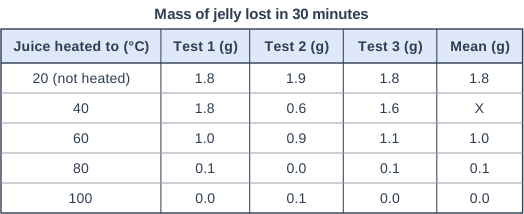
A student heated samples of fresh kiwi fruit juice to different temperatures for 5 minutes, then cooled them all to room temperature. She put a 5.0 g cube of jelly into each sample, and after 30 minutes she found the mass of jelly that had been lost. She did each test three times.

The table shows her results. One result at 40 °C is anomalous.

Identify the anomalous result and calculate the mean mass lost at 40 °C without it.

Explain why the student cooled all the samples to room temperature before adding the jelly.

Suggest how the student could find more precisely the lowest temperature that stops the enzyme working.

Mass of jelly lost in 30 minutes. Table with columns "Juice heated to (°C)", "Test 1 (g)", "Test 2 (g)", "Test 3 (g)", "Mean (g)". Juice heated to (°C): 20 (not heated); Test 1 (g): 1.8; Test 2 (g): 1.9; Test 3 (g): 1.8; Mean (g): 1.8 | Juice heated to (°C): 40; Test 1 (g): 1.8; Test 2 (g): 0.6; Test 3 (g): 1.6; Mean (g): X | Juice heated to (°C): 60; Test 1 (g): 1.0; Test 2 (g): 0.9; Test 3 (g): 1.1; Mean (g): 1.0 | Juice heated to (°C): 80; Test 1 (g): 0.1; Test 2 (g): 0.0; Test 3 (g): 0.1; Mean (g): 0.1 | Juice heated to (°C): 100; Test 1 (g): 0.0; Test 2 (g): 0.1; Test 3 (g): 0.0; Mean (g): 0.0.

Model answer

The anomalous result is 0.6 g (test 2 at 40 °C).
Mean at 40 °C = (1.8 + 1.6) ÷ 2 = 1.7 g
Cooling every sample to room temperature means the jelly was digested at the same temperature each time, so any difference in the mass lost was caused only by how hot the juice had been heated. Warm juice would also melt some of the jelly.
To find the temperature more precisely, she should test temperatures between 60 °C and 80 °C, for example 65 °C, 70 °C and 75 °C.

Explanation

An anomalous result does not fit the pattern of the other repeats, so it is left out when the mean is calculated. The investigation tests the effect of heating the juice, so the temperature while the enzyme acts on the jelly must be kept the same. The results show that heating to 80 °C or more denatures the enzyme, and that this happens somewhere between 60 °C and 80 °C, so testing at smaller intervals in that range narrows it down.

Mark scheme
  1. 1 mark

    anomalous result = 0.6 (g, test 2 at 40 °C) / (1.8 + 1.6) ÷ 2; or a correct final answer of 1.7 g with no working

    An answer of 1.7 g with no working scores marking points 1 and 2 only. An answer of 1.3 g (the anomalous result included: 4.0 ÷ 3 = 1.33) scores 0. 1 mark for any one of points 3 and 4, max 1. For the reason for cooling, if more than one answer is given, a wrong one cancels a right one.

  2. 1 mark

    1.7 (g)

    ALLOW 1.70 (g). IGNORE units.

  3. 1 mark

    (cooling) so the jelly was digested at the same temperature in every sample (temperature was a control variable), so differences in mass lost were caused only by the earlier heating of the juice

    ALLOW so it is a fair test, if linked to the temperature while the jelly is in the juice being the same. ALLOW because the enzyme works at different rates at different temperatures. IGNORE 'to make it a fair test' on its own.

  4. 1 mark

    (cooling) warm juice would melt / dissolve the jelly, so mass would be lost even without the enzyme

    ALLOW so that the mass lost is caused only by the enzyme. IGNORE 'so the jelly is not damaged' on its own.

  5. 1 mark

    test more temperatures between 60 °C and 80 °C / use smaller intervals between 60 °C and 80 °C (for example every 5 °C)

    ALLOW test temperatures such as 65 °C, 70 °C and 75 °C. ALLOW smaller intervals over a range that includes 60 °C to 80 °C (for example every 5 °C from 60 °C to 100 °C). The idea of smaller temperature intervals between 60 °C and 80 °C is needed. IGNORE 'repeat the investigation' or 'do more repeats' on its own (this does not narrow the temperature down).

Ready to try the rest? Every answer you write is marked against the mark scheme, so you can see exactly where the marks are.

Study Helper Hints first, answers after you try

Stuck on this one? Ask for a hint and I’ll point you in the right direction, without giving the answer away. Once you’ve checked your answer, I’ll show you how the marks are awarded.