
Level:
Correct: 0
Incorrect: 0
Marks: 0/0
Exam Practice
Course:
Topics:
OCR GCSE Biology (Paper 2) Smart practice A mixed round aimed at your weak spots
Avg
score:
–
Topics
done:
0/28

Defence against disease and the immune system

Practise 18 exam-style questions on Defence against disease and the immune system for OCR GCSE Biology (Paper 2). Write your answer as you would in the exam and get it marked in seconds against the mark scheme, point by point, with the Study Helper on hand if you get stuck.

  • 18 questions
  • 1–6 marks each
  • Instant marking
  • No sign-up needed
18 questions, marked as you go

Sample questions with model answers

Here are 4 of the questions in this topic, each with a model answer, an explanation of why it earns the marks and the mark scheme an examiner would use.

Question 1

1 mark

Some bacteria release poisons called toxins. Some of the antibodies made by white blood cells stick to toxins and stop them damaging the body's cells.

What name is given to these antibodies?

Model answer

Antitoxins.

Explanation

Antitoxins are made by white blood cells (lymphocytes). They bind to a particular toxin and neutralise it, so it cannot damage cells. Do not confuse them with antibiotics, which are medicines that kill bacteria.

Mark scheme
  1. 1 mark

    antitoxins

    ALLOW antitoxin. DO NOT ALLOW antibiotics / antigens / antitoxics. IGNORE antibodies on its own (given in the question).
Question 2

2 marks

Platelets are small fragments of cells. They have no nucleus. A platelet stays in the blood for only about 7 to 10 days.

The bone marrow makes new platelets all the time.

Explain why the bone marrow needs to keep making new platelets.

Model answer

Platelets have no nucleus, so they cannot divide to make more platelets, and each one lasts only about 7 to 10 days. Without new platelets from the bone marrow, the number in the blood would fall, the blood would not clot at a cut, and pathogens could get in through the wound.

Explanation

Platelets are pieces of larger cells in the bone marrow, so they have no nucleus and cannot divide. Because they are short-lived and are used up in clots, the bone marrow has to keep replacing them. Enough platelets are needed so that a clot can quickly seal any cut, stopping bleeding and keeping pathogens out.

Mark scheme
  1. 1 mark

    platelets have no nucleus, so they cannot divide to make more platelets

    1 mark for each of points 1 to 3, max 2. ALLOW platelets cannot reproduce / copy themselves.

  2. 1 mark

    old platelets are lost after about 7 to 10 days (and some are used up in clots), so without new ones the number of platelets would fall

    ALLOW platelets do not last long / are used up when the blood clots.

  3. 1 mark

    then the blood would not clot at cuts, so bleeding would not stop and pathogens could get into the body

    ALLOW so there would not be enough platelets to seal wounds. IGNORE 'so the body stays healthy' on its own.

Question 3

2 marks

The body has non-specific defences, such as the skin and stomach acid, and an immune system, which makes antibodies against pathogens.

A student says: 'The immune system can destroy any pathogen, so the non-specific defences are not really needed.'

Explain why the non-specific defences are important.

Model answer

Non-specific defences, such as the skin and stomach acid, keep out or kill most pathogens straight away, whatever type they are. The immune system is slow the first time it meets a pathogen: it takes several days to make enough of the right antibodies, and in that time the pathogen can multiply and make the person ill. So keeping pathogens out in the first place is very important.

Explanation

The two kinds of defence work together. Non-specific defences act at once against all pathogens, so most never get in. The immune system is specific and, against a pathogen it has not met before, it needs time to respond, which is why people often become ill the first time they are infected.

Mark scheme
  1. 1 mark

    non-specific defences stop most pathogens getting into the body (or kill them) straight away, and they work against all types of pathogen

    ALLOW they are the first line of defence / they keep most pathogens out. ALLOW they do not depend on having met the pathogen before.

  2. 1 mark

    the first time a pathogen gets in, the immune system takes several days to make enough antibodies, and in that time the pathogen can multiply and cause disease

    ALLOW the immune system is slow against a new pathogen. ALLOW without non-specific defences, so many pathogens would get in that the immune system could not destroy them all.

Question 4

3 marks

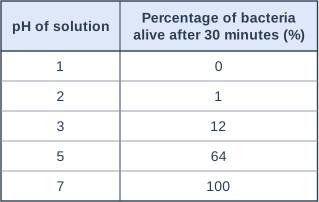
A scientist tested how well a type of food-poisoning bacterium survives in acid. She put the same number of bacteria into solutions of different pH for 30 minutes, then counted how many were still alive. The table shows her results.

The contents of the human stomach usually have a pH of about 2, but for a short time after a meal the pH can rise to about 5.

A student says: 'Stomach acid kills all the bacteria in our food, so bacteria in food can never make us ill.'

Use the data to evaluate the student's statement.

Table with columns "pH of solution", "Percentage of bacteria alive after 30 minutes (%)". pH of solution: 1; Percentage of bacteria alive after 30 minutes (%): 0 | pH of solution: 2; Percentage of bacteria alive after 30 minutes (%): 1 | pH of solution: 3; Percentage of bacteria alive after 30 minutes (%): 12 | pH of solution: 5; Percentage of bacteria alive after 30 minutes (%): 64 | pH of solution: 7; Percentage of bacteria alive after 30 minutes (%): 100.

Model answer

The data partly support the student: at pH 2 only 1 % of the bacteria survive, so stomach acid kills 99 % of them. But it does not kill all of them. If food contains 100 000 bacteria, 1 % is still 1000 bacteria that could reach the intestines. Just after a meal the pH may rise to about 5, when 64 % of the bacteria survive. So bacteria in food can still make us ill, and the student's statement is wrong.

Explanation

An evaluation looks at evidence on both sides before reaching a conclusion. Stomach acid is a non-specific defence that kills most pathogens in food, but the data show that some survive, especially when the pH is higher after a meal. So it reduces the risk of food poisoning rather than removing it.

Mark scheme
  1. 1 mark

    (supports) at pH 2 only 1 % of the bacteria survive / 99 % are killed, so stomach acid kills most bacteria in food

    Max 2 if no data from the table are used. 1 mark for each of points 1 to 4, max 3.

  2. 1 mark

    (against) not all are killed: 1 % survive at pH 2, so if the food contains many bacteria, large numbers can still reach the intestines

    ALLOW a worked example, for example 1 % of 100 000 bacteria is 1000 bacteria.

  3. 1 mark

    (against) just after a meal the pH may be about 5, when 64 % of the bacteria survive

    ALLOW at a higher pH many more bacteria survive, with a value from the table.

  4. 1 mark

    (conclusion) so bacteria in food can still cause food poisoning, and the student's statement is wrong

    This mark needs a reason from point 2 or point 3. IGNORE the student is wrong with no reason.

Ready to try the rest? Every answer you write is marked against the mark scheme, so you can see exactly where the marks are.

Study Helper Hints first, answers after you try

Stuck on this one? Ask for a hint and I’ll point you in the right direction, without giving the answer away. Once you’ve checked your answer, I’ll show you how the marks are awarded.