
Level:
Correct: 0
Incorrect: 0
Marks: 0/0
Exam Practice
Course:
Topics:
Avg
score:
–
Topics
done:
0/28

Series and parallel circuits and circuit symbols

Practise 14 exam-style questions on Series and parallel circuits and circuit symbols for OCR GCSE Combined Science (Physics Paper 11). Write your answer as you would in the exam and get it marked in seconds against the mark scheme, point by point, with the Study Helper on hand if you get stuck.

  • 14 questions
  • 1–6 marks each
  • Instant marking
  • No sign-up needed
14 questions, marked as you go

Sample questions with model answers

Here are 4 of the questions in this topic, each with a model answer, an explanation of why it earns the marks and the mark scheme an examiner would use.

Question 1

1 mark

A battery is connected in series with two lamps.

Which statement describes the energy transferred by the charge in this circuit?

Choose your answer.

  • A The energy transferred by each coulomb of charge is shared between the two lamps.
  • B Each coulomb of charge transfers all of its energy to the first lamp.
  • C Each coulomb of charge gains energy as it passes through each lamp.
  • D The lamps transfer more energy than the battery supplies to the charge.

Model answer

A

Explanation

Potential difference is the energy transferred per coulomb. In a series circuit every coulomb passes through each component in turn, so the energy from the battery is shared between them and the potential differences add up to the supply's. The charge itself is not used up: it carries energy from the battery to the lamps.

Mark scheme
  1. 1 mark

    A / The energy transferred by each coulomb of charge is shared between the two lamps.

    The only correct answer is A: in series, each coulomb passes through both lamps, so the energy it gains in the battery is shared, which is why the potential differences across the lamps add up to the battery's potential difference. B is not correct because each coulomb also transfers energy in the second lamp (both lamps light); C is not correct because charge gains energy in the battery and transfers it in the lamps; D is not correct because energy is conserved: the lamps cannot transfer more energy than the battery supplies. ALLOW the letter or the option. If more than one option is given, do not award the mark.
Question 2

2 marks

A student wants to measure the current in a lamp. By mistake, she connects the ammeter in parallel with the lamp instead of in series.

Explain what happens to the lamp and to the reading on the ammeter.

Model answer

An ammeter has a very low resistance. Connected in parallel with the lamp, it gives the current an easy path around the lamp, so almost all the current goes through the ammeter and the lamp goes out. The current through the ammeter is very large, much larger than the lamp's normal current, so the reading is not the lamp's current and the ammeter could be damaged.

Explanation

Ammeters are designed with a very low resistance so that they can be put in series without changing the current. In parallel, that low resistance acts almost like a wire across the lamp. Voltmeters are the opposite: they have a very high resistance, so they are connected in parallel.

Mark scheme
  1. 1 mark

    the ammeter has a very low resistance, so (almost) all the current passes through the ammeter instead of the lamp, and the lamp goes out / is very dim

    ALLOW the ammeter short-circuits the lamp. ALLOW (almost) no current in the lamp. IGNORE the lamp is brighter.

  2. 1 mark

    the ammeter reading is very large / much larger than the normal current in the lamp, so it does not measure the lamp's current (and the ammeter could be damaged)

    ALLOW the ammeter's fuse may blow / the battery could overheat. DO NOT ALLOW the ammeter reads zero.

Question 3

3 marks

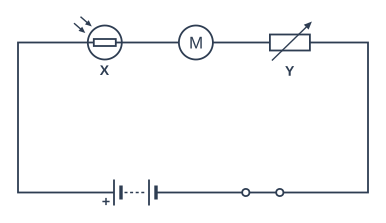
The diagram shows a circuit that a student builds for a model fairground ride.

Name component X and component Y.

Explain why component Y is connected in series with the motor.

Circuit diagram. All the components are connected in series in a single loop. Going round the loop from the + terminal of the battery: component X (drawn as a small rectangle inside a circle, with two arrows pointing in towards the circle); then a motor; then component Y (drawn as a rectangle with a diagonal arrow drawn through it); then a closed switch; and back to the − terminal of the battery.

Model answer

X is a light-dependent resistor (LDR). Y is a variable resistor.
In series there is only one path, so the same current passes through Y and the motor. Changing the resistance of Y changes the current in the motor, so Y controls the speed of the motor.

Explanation

A variable resistor is a resistor symbol with an arrow drawn diagonally through it; an LDR has two arrows pointing in towards it. A component that controls another must be in series with it, so that the same current passes through both. In parallel, Y would have its own branch and would not change the motor's current.

Mark scheme
  1. 1 mark

    (X is a) light-dependent resistor / LDR

    ALLOW light dependent resistor. DO NOT ALLOW light-emitting diode / LED / photodiode.

  2. 1 mark

    (Y is a) variable resistor

    ALLOW rheostat. DO NOT ALLOW thermistor / potentiometer / resistor on its own.

  3. 1 mark

    in series, all the current in the motor also passes through Y / Y and the motor have the same current, so changing the resistance of Y changes the current in the motor (and so its speed)

    ALLOW so that Y can control the current in the motor. ALLOW to control the speed of the motor, if linked to the current. IGNORE to protect the motor on its own.

Question 4

4 marks

In a series circuit, the potential differences across the components add up to the potential difference across the supply.

In a parallel circuit, each branch has the same potential difference as the supply.

Use ideas about energy and charge to explain these two rules.

Model answer

Potential difference is the energy transferred per coulomb of charge: a 6 V supply gives 6 J to each coulomb.
In a series circuit each coulomb passes through every component in turn, so the energy it gained from the supply is shared between the components. Energy is conserved, so the energy transferred per coulomb in all the components adds up to the energy per coulomb given by the supply: the potential differences add up to the supply's.
In a parallel circuit each coulomb goes through only one branch. It transfers all of the energy it gained from the supply in that branch, so the potential difference across each branch equals the supply's.

Explanation

Link potential difference to energy per coulomb, then follow one coulomb round each circuit. In series it visits every component, so its energy is shared; in parallel it visits only one branch, so it gives up all its energy there. Answers that talk about current being shared confuse current with potential difference.

Mark scheme
  1. 1 mark

    potential difference is the energy transferred per unit charge / per coulomb (1 V = 1 J/C)

    ALLOW the supply gives energy to each coulomb of charge, and the components transfer energy from it. IGNORE voltage is the push on its own.

  2. 1 mark

    in series, each coulomb passes through every component in turn, so the energy it gains from the supply is shared between / transferred in parts to the components

    ALLOW each charge goes through all the components.

  3. 1 mark

    energy is conserved: the total energy transferred per coulomb in the components equals the energy given per coulomb by the supply, so the potential differences add up to the supply's

    ALLOW the charge loses all the energy it gained before it returns to the supply.

  4. 1 mark

    in parallel, each coulomb passes through only one branch, so it transfers all the energy it gained from the supply in that branch, so each branch has the same potential difference as the supply

    ALLOW the charge splits at the junction and each part goes through one branch only, transferring all its energy there.

Ready to try the rest? Every answer you write is marked against the mark scheme, so you can see exactly where the marks are.

Study Helper Hints first, answers after you try

Stuck on this one? Ask for a hint and I’ll point you in the right direction, without giving the answer away. Once you’ve checked your answer, I’ll show you how the marks are awarded.