
Level:
Correct: 0
Incorrect: 0
Marks: 0/0
Exam Practice
Course:
Topics:
Avg
score:
–
Topics
done:
0/28

Practical skills (physics PAGs P1-P6)

Practise 15 exam-style questions on Practical skills (physics PAGs P1-P6) for OCR GCSE Combined Science (Physics Paper 11). Write your answer as you would in the exam and get it marked in seconds against the mark scheme, point by point, with the Study Helper on hand if you get stuck.

  • 15 questions
  • 1–6 marks each
  • Instant marking
  • No sign-up needed
15 questions, marked as you go

Sample questions with model answers

Here are 4 of the questions in this topic, each with a model answer, an explanation of why it earns the marks and the mark scheme an examiner would use.

Question 1

1 mark

A student drops a tennis ball from a balcony and uses a stopwatch to time its fall to the ground. She repeats the measurement five times.

Time (s):   1.04   0.98   1.06   1.30   1.00

She decides that 1.30 s is anomalous and leaves it out.

The uncertainty in her mean time can be estimated as half of the range of her results.

What is the uncertainty?

Choose your answer.

  • A ±0.04 s
  • B ±0.08 s
  • C ±0.16 s
  • D ±0.32 s

Model answer

A

range = 1.06 − 0.98 = 0.08 s, so uncertainty = 0.08 ÷ 2 = ±0.04 s

Explanation

Leave out the anomalous result first, then find the range of the remaining results (largest minus smallest) and halve it. Including an anomalous result makes the uncertainty look much bigger than it really is. The mean time is 1.02 s, so the student could write her result as 1.02 ± 0.04 s.

Mark scheme
  1. 1 mark

    A / ±0.04 s

    The only correct answer is A: without the anomalous result, the range is 1.06 − 0.98 = 0.08 s, and half of the range is 0.04 s. B is not correct because it is the whole range, not half of it; C is not correct because it includes the anomalous 1.30 s (half of 1.30 − 0.98); D is not correct because it is the whole range including the anomalous result. ALLOW the letter or the option. If more than one option is given, do not award the mark.
Question 2

2 marks

A student hangs a load from a spring and measures the extension of the spring.

She then hangs the same load from two springs, each identical to the first. The springs hang side by side, and the load hangs from a light bar fixed to the bottom of both springs, so that both springs stretch by the same amount.

The springs obey Hooke's law.

Write a hypothesis for the extension of the two springs compared with the extension of one spring. Use Hooke's law to explain your hypothesis.

Model answer

Hypothesis: the extension with two springs side by side will be half the extension with one spring.
The load is shared equally, so each spring is pulled with half the force. By Hooke's law, force = spring constant × extension, so the extension is directly proportional to the force: half the force gives half the extension.

Explanation

A hypothesis is a testable prediction based on a scientific idea, here Hooke's law. The student could test it by measuring the extension in both arrangements for several loads. A common error is to predict that two springs stretch twice as far, which is true for springs joined end to end, not side by side.

Mark scheme
  1. 1 mark

    (hypothesis) the extension of the two springs will be half the extension of one spring

    ALLOW the two springs will stretch half as much. DO NOT ALLOW 'the extension will be smaller' without 'half'.

  2. 1 mark

    each spring supports half of the load / the force on each spring is halved, and extension is (directly) proportional to force (force = spring constant × extension), so each spring stretches half as much

    Both ideas (half the force on each spring and extension proportional to force) are needed. ALLOW the two springs together behave like one spring with twice the spring constant.

Question 3

3 marks

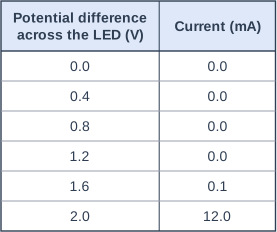
A student investigates how the current in an LED depends on the potential difference across it. She connects the LED in series with a resistor, an ammeter and a variable power supply, with a voltmeter across the LED. She changes the potential difference across the LED in steps of 0.4 V.

The table shows her results.

Suggest an improvement to the values of potential difference she uses, and explain why. Explain why the resistor is connected in series with the LED.

Table with columns "Potential difference across the LED (V)", "Current (mA)". Potential difference across the LED (V): 0.0; Current (mA): 0.0 | Potential difference across the LED (V): 0.4; Current (mA): 0.0 | Potential difference across the LED (V): 0.8; Current (mA): 0.0 | Potential difference across the LED (V): 1.2; Current (mA): 0.0 | Potential difference across the LED (V): 1.6; Current (mA): 0.1 | Potential difference across the LED (V): 2.0; Current (mA): 12.0.

Model answer

She should take readings at smaller steps, for example every 0.1 V, between 1.6 V and 2.0 V. The current is zero up to about 1.6 V and then rises very steeply, from 0.1 mA to 12.0 mA, so readings every 0.4 V miss the shape of the graph and the potential difference at which the LED starts to conduct.
The resistor limits the current. Once the LED conducts, its resistance becomes very small, so without the resistor the current could become large enough to overheat and damage the LED.

Explanation

Readings should be closer together where a quantity changes quickly, so that the shape of the graph can be drawn accurately. An LED, like other diodes, only lets a significant current pass above a certain potential difference, after which the current rises steeply; a series resistor keeps that current safe.

Mark scheme
  1. 1 mark

    take readings at smaller steps of potential difference (for example every 0.1 V) between 1.6 V and 2.0 V

    ALLOW take more readings above 1.6 V / in the range where the current starts to flow. DO NOT ALLOW 'take more readings' without saying where or with smaller steps. IGNORE repeat readings.

  2. 1 mark

    because the current changes rapidly in this range (from 0.1 mA to 12.0 mA), so more readings are needed to show the shape of the graph / to find the potential difference at which the LED starts to conduct

    ALLOW the current stays zero below 1.6 V, so readings there add little information.

  3. 1 mark

    the resistor limits the current (once the LED conducts its resistance becomes very small), so the current cannot become large enough to damage (overheat) the LED

    ALLOW to protect the LED (or the ammeter) from too large a current. DO NOT ALLOW 'to control the potential difference' on its own.

Question 4

4 marks

A manufacturer says that its 100 Ω resistors have a tolerance of ±5%. This means that the resistance of each resistor is within 5% of 100 Ω.

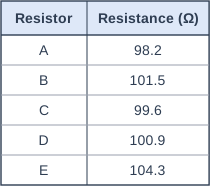
A student uses a multimeter to measure the resistance of five of these resistors. The table shows her results.

Evaluate whether her results support the manufacturer's claim. Use calculations in your answer.

Table with columns "Resistor", "Resistance (Ω)". Resistor: A; Resistance (Ω): 98.2 | Resistor: B; Resistance (Ω): 101.5 | Resistor: C; Resistance (Ω): 99.6 | Resistor: D; Resistance (Ω): 100.9 | Resistor: E; Resistance (Ω): 104.3.

Model answer

5% of 100 Ω = 5 Ω, so each resistor should have a resistance from 95 Ω to 105 Ω.
The student's results go from 98.2 Ω (resistor A) to 104.3 Ω (resistor E), so all five are within this range, and the results support the claim.
The mean is (98.2 + 101.5 + 99.6 + 100.9 + 104.3) ÷ 5 = 100.9 Ω, within 1% of 100 Ω.
However, she tested only five resistors, and resistor E is only 0.7 Ω from the upper limit. A small sample cannot show that every resistor made is within ±5%, so she should test a larger random sample before concluding that the claim is fully supported.

Explanation

A tolerance gives the range within which every value should lie, so first convert the percentage into a range of resistances, then compare each result (especially the largest and smallest) with it. A good evaluation also considers how far the evidence can be trusted: here the sample is small and one value is close to the limit.

Mark scheme
  1. 1 mark

    5% of 100 Ω is 5 Ω, so the resistance should be from 95 Ω to 105 Ω

    Max 2 if no calculation is given. ALLOW the percentage difference from 100 Ω calculated for each resistor (for example E: 4.3%).

  2. 1 mark

    all five results (from 98.2 Ω to 104.3 Ω) are within this range, so the results support the claim

    ALLOW the largest difference from 100 Ω is 4.3 Ω (4.3%), which is less than 5 Ω (5%). DO NOT ALLOW 'the results support the claim' with no comparison.

  3. 1 mark

    the mean resistance is 100.9 Ω, which is close to 100 Ω (within 1%) / a different valid evaluation point from the one credited in marking point 4, for example resistor E (104.3 Ω) is only 0.7 Ω below the upper limit

    ALLOW 100.9 or 101 Ω for the mean. ALLOW the results are spread on both sides of 100 Ω (two below and three above). ALLOW, for this mark, resistor E (104.3 Ω) is close to the upper limit, or the accuracy (or resolution) of the multimeter is not known, if a different point is credited in marking point 4. DO NOT ALLOW the range (6.1 Ω) or the half-range (about 3.1 Ω) compared with 10 Ω or 5 Ω on its own, because this does not show where the values lie.

  4. 1 mark

    but only five resistors were tested, so the results cannot show that every resistor in the batch is within 5% / a larger random sample should be tested

    ALLOW resistor E (104.3 Ω) is close to the limit, so other resistors may be outside it. ALLOW the accuracy (or resolution) of the multimeter is not known.

Ready to try the rest? Every answer you write is marked against the mark scheme, so you can see exactly where the marks are.

Study Helper Hints first, answers after you try

Stuck on this one? Ask for a hint and I’ll point you in the right direction, without giving the answer away. Once you’ve checked your answer, I’ll show you how the marks are awarded.