
Level:
Correct: 0
Incorrect: 0
Marks: 0/0
Exam Practice
Course:
Topics:
Avg
score:
–
Topics
done:
0/28

Interactions between objects and forces as vectors

Practise 14 exam-style questions on Interactions between objects and forces as vectors for OCR GCSE Combined Science (Physics Paper 11). Write your answer as you would in the exam and get it marked in seconds against the mark scheme, point by point, with the Study Helper on hand if you get stuck.

  • 14 questions
  • 1–4 marks each
  • Instant marking
  • No sign-up needed
14 questions, marked as you go

Sample questions with model answers

Here are 4 of the questions in this topic, each with a model answer, an explanation of why it earns the marks and the mark scheme an examiner would use.

Question 1

1 mark

A person leans with her back against a vertical wall.

In which direction does the normal contact force of the wall on the person act?

Choose your answer.

  • A horizontally, away from the wall
  • B horizontally, towards the wall
  • C vertically downwards
  • D vertically upwards, along the wall

Model answer

A
The normal contact force acts at right angles to the surface of the wall, away from the wall.

Explanation

A normal contact force always acts at right angles (normal) to the surface that exerts it, pushing away from that surface. On a floor that is upwards, but on a vertical wall it is horizontal. Friction is the contact force that acts along a surface.

Mark scheme
  1. 1 mark

    A / horizontally, away from the wall

    The only correct answer is A: a normal contact force acts at right angles to the surface and pushes away from it, so the wall pushes the person horizontally away from the wall. B is not correct because horizontally towards the wall is the direction of the person's push on the wall, which is a force on the wall, not on the person; C is not correct because vertically downwards is the direction of her weight; D is not correct because a vertical force from the wall would act along its surface (as friction does), not at right angles to it. ALLOW the letter or the option. If more than one option is given, do not award the mark.
Question 2

2 marks

Gravitational forces and electrostatic forces are two ways in which objects interact.

Give one similarity and one difference between gravitational forces and electrostatic forces.

Model answer

Similarity: both are non-contact forces, so they act between objects that are not touching.
Difference: gravitational forces always attract, but electrostatic forces can attract or repel.

Explanation

Gravity, electrostatics and magnetism are all non-contact interactions. Gravity acts between any two objects with mass and is always attractive; electrostatic forces act only between charged objects, attracting unlike charges and repelling like charges. A difference must say what is true of each force.

Mark scheme
  1. 1 mark

    similarity: both are non-contact forces / both act between objects that are not touching / both act on each of the two objects in the interaction / both get weaker as the objects get further apart

    ALLOW both are vector quantities / both have a size and a direction. DO NOT ALLOW 'both are forces' or 'both always attract'. When a candidate gives contradictory responses, no mark should be awarded, even if one of the answers is correct.

  2. 1 mark

    difference: gravitational forces only attract, but electrostatic forces can attract or repel / gravitational forces act between all objects that have mass, but electrostatic forces act only between charged objects

    ORA (allow the reverse argument). Both sides of the comparison are needed: DO NOT ALLOW 'electrostatic forces can repel' on its own. IGNORE comments about which force is stronger.

Question 3

2 marks

A pile of books rests on a wooden shelf. A student says:

'The shelf cannot push upwards on the books. It is not moving, and nothing is making it push.'

Explain how the shelf exerts an upward force on the books.

Model answer

The weight of the books pushes down on the shelf and squashes and bends it very slightly, pushing its particles closer together. Like a compressed spring, the deformed shelf pushes back up on the books. This upward push is the normal contact force: the heavier the books, the more the shelf deforms and the bigger the upward force.

Explanation

A normal contact force comes from a tiny deformation of the surface; it does not need the surface to be moving or powered. The surface deforms until it pushes back hard enough. Saying only that 'the shelf has a reaction force' does not explain how the force arises.

Mark scheme
  1. 1 mark

    the books (their weight) squash / bend / deform the shelf (slightly) / push the particles of the shelf (slightly) closer together

    ALLOW the shelf bends a little under the books.

  2. 1 mark

    the deformed shelf pushes back / exerts an upward (normal contact) force on the books / tries to return to its original shape (like a compressed spring)

    ALLOW the more the shelf is deformed, the bigger the upward force. DO NOT ALLOW 'the shelf has a force in it' / 'gravity pushes the shelf up'.

Question 4

4 marks

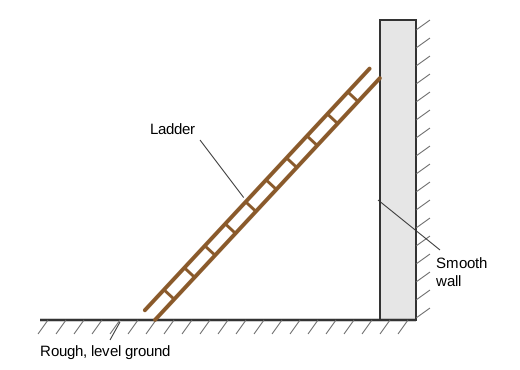
The diagram shows a ladder leaning against a smooth vertical wall. The foot of the ladder rests on rough, level ground. The ladder is at rest.

The wall is smooth, so there is no friction between the wall and the ladder.

Describe the free-body force diagram for the ladder. Name the four forces acting on the ladder and give the direction of each one. Explain the direction of the friction force.

A straight ladder leans with its top against a vertical wall labelled 'Smooth wall'. Its foot rests on horizontal ground labelled 'Rough, level ground', some distance from the bottom of the wall. No forces are drawn.

Model answer

Four forces act on the ladder:
- its weight (the pull of the Earth), acting vertically downwards;
- the normal contact force of the wall on the top of the ladder, acting horizontally, at right angles to the wall and away from it;
- the normal contact force of the ground on the foot of the ladder, acting vertically upwards;
- friction from the ground on the foot of the ladder, acting horizontally towards the wall.
The wall pushes the ladder horizontally away from the wall. The ladder is at rest, so another horizontal force must balance this push. The only one is friction at the foot, so friction must act towards the wall; without it, the foot would slide away from the wall.

Explanation

Contact forces from a surface act at right angles to it (normal contact forces) and along it (friction). A smooth wall gives no friction, so it only pushes at right angles to itself. The direction of the friction at the foot follows from the horizontal forces on a ladder at rest having to balance.

Mark scheme
  1. 1 mark

    weight / gravitational force of the Earth (on the ladder), acting vertically downwards

    Max 3 if a friction force from the wall is included. Each of marking points 1, 2 and 3 needs the force (or the object that exerts it) and its direction. IGNORE where the arrows start.

  2. 1 mark

    normal contact force of the wall (on the top of the ladder), acting horizontally, away from the wall / at right angles to the wall

    DO NOT ALLOW a force from the wall acting vertically / along the wall.

  3. 1 mark

    normal contact force of the ground (on the foot of the ladder), acting vertically upwards

    ALLOW reaction / contact force of the ground, upwards.

  4. 1 mark

    friction from the ground (on the foot of the ladder), acting horizontally towards the wall, because it must balance the horizontal push of the wall / it stops the foot sliding away from the wall

    The direction and a reason are both needed for this mark. ALLOW the foot of the ladder would slip outwards, away from the wall, so friction acts towards the wall. DO NOT ALLOW friction acting away from the wall, upwards or downwards.

Ready to try the rest? Every answer you write is marked against the mark scheme, so you can see exactly where the marks are.

Study Helper Hints first, answers after you try

Stuck on this one? Ask for a hint and I’ll point you in the right direction, without giving the answer away. Once you’ve checked your answer, I’ll show you how the marks are awarded.