
Level:
Correct: 0
Incorrect: 0
Marks: 0/0
Exam Practice
Course:
Topics:
Avg
score:
–
Topics
done:
0/28

Gas pressure and temperature

Practise 13 exam-style questions on Gas pressure and temperature for OCR GCSE Combined Science (Physics Paper 11). Write your answer as you would in the exam and get it marked in seconds against the mark scheme, point by point, with the Study Helper on hand if you get stuck.

  • 13 questions
  • 1–4 marks each
  • Instant marking
  • No sign-up needed
13 questions, marked as you go

Sample questions with model answers

Here are 4 of the questions in this topic, each with a model answer, an explanation of why it earns the marks and the mark scheme an examiner would use.

Question 1

1 mark

A sealed steel cylinder of helium, used for filling party balloons, is moved from a cold storeroom at 5 °C into a warm shop at 25 °C. The helium warms up to 25 °C.

Which quantity stays the same?

Choose your answer.

  • A the average kinetic energy of the helium atoms
  • B the average speed of the helium atoms
  • C the mass of helium in the cylinder
  • D the pressure of the helium

Model answer

C. The cylinder is sealed, so the mass of helium inside cannot change.

Explanation

In a closed system the mass of gas, and so the number of particles, is fixed, and a rigid steel cylinder keeps the volume fixed too. Warming the helium increases the average kinetic energy and speed of its atoms, so they hit the walls more often and harder, and the pressure rises. Only the mass (and the number of atoms and the volume) stays the same.

Mark scheme
  1. 1 mark

    C / the mass of helium in the cylinder

    The only correct answer is C: the cylinder is sealed (a closed system), so no helium can get in or out and its mass stays the same. A and B are not correct because the average kinetic energy and the average speed of the atoms increase as the temperature rises. D is not correct because the pressure of a fixed mass of gas at constant volume increases when its temperature rises. ALLOW the letter or the option. If more than one option is given, do not award the mark.
Question 2

1 mark

On a summer afternoon, the air inside a parked car is at 50 °C. Late at night, the air in the car is at 10 °C.

State how the motion of the air molecules at 50 °C is different from their motion at 10 °C.

Model answer

At 50 °C the air molecules move faster on average: they have a greater average kinetic energy than at 10 °C.

Explanation

The temperature of a gas is linked to the average kinetic energy of its molecules: the higher the temperature, the faster they move on average. Answers that say only that the molecules 'move more' are too vague, and gas molecules do not vibrate about fixed positions.

Mark scheme
  1. 1 mark

    at 50 °C the molecules move faster on average / have a greater average kinetic energy

    ORA (allow the reverse argument): at 10 °C the molecules move more slowly. ALLOW the molecules move faster. IGNORE they move more / have more energy without reference to speed or kinetic energy. DO NOT ALLOW the molecules vibrate faster or the molecules are bigger.

Question 3

2 marks

The molecules of a gas in a sealed container hit the walls at random times and in random places. A pressure sensor on one wall gives a steady reading while the temperature of the gas stays constant.

Explain why the reading is steady, even though the collisions happen at random.

Model answer

There are so many molecules that an enormous number of them hit the wall every second, so the random variations average out. At a constant temperature the average speed of the molecules does not change, so on average the same number of molecules hit the wall each second with the same force. The total force on the wall, and so the pressure, stays steady.

Explanation

Pressure is the result of a huge number of tiny impacts. Individual collisions are random, but with so many of them the average force on a wall is constant, as long as the average speed of the molecules (set by the temperature) does not change. A common error is to say that every molecule moves at the same constant speed.

Mark scheme
  1. 1 mark

    there is an extremely large number of molecules / collisions with the wall every second

    ALLOW millions of collisions every second. ALLOW the random collisions average out.

  2. 1 mark

    at a constant temperature the average speed of the molecules stays the same, so on average the number of collisions each second and the force of each collision stay the same (so the total force on the wall, and the pressure, are steady)

    ALLOW the average kinetic energy of the molecules is constant, so the average force on the wall is constant. IGNORE the molecules move at a constant speed (individual speeds change in collisions).

Question 4

4 marks

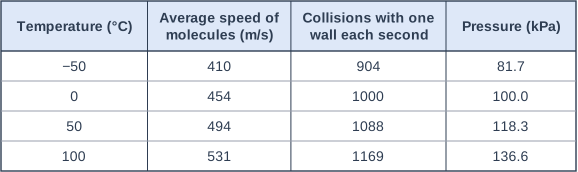
A computer model shows the motion of nitrogen molecules in a sealed box of fixed volume. For four temperatures, the model gives the average speed of the molecules, the number of collisions with one wall each second and the pressure of the gas.

The table shows the results.

Use the data to show that the pressure increases by a greater percentage than the number of collisions each second. Explain why, using ideas about the molecules.

Table with columns "Temperature (°C)", "Average speed of molecules (m/s)", "Collisions with one wall each second", "Pressure (kPa)". Temperature (°C): −50; Average speed of molecules (m/s): 410; Collisions with one wall each second: 904; Pressure (kPa): 81.7 | Temperature (°C): 0; Average speed of molecules (m/s): 454; Collisions with one wall each second: 1000; Pressure (kPa): 100.0 | Temperature (°C): 50; Average speed of molecules (m/s): 494; Collisions with one wall each second: 1088; Pressure (kPa): 118.3 | Temperature (°C): 100; Average speed of molecules (m/s): 531; Collisions with one wall each second: 1169; Pressure (kPa): 136.6.

Model answer

Between −50 °C and 100 °C the number of collisions each second rises from 904 to 1169, an increase of (1169 − 904) ÷ 904 × 100 = 29%. Over the same range the pressure rises from 81.7 kPa to 136.6 kPa, an increase of (136.6 − 81.7) ÷ 81.7 × 100 = 67%. So the pressure increases by a much greater percentage.
This is because the average speed of the molecules increases (from 410 m/s to 531 m/s) as the temperature rises. Faster molecules hit the wall more often, but each collision also exerts a greater force on the wall. The pressure depends on both the number of collisions each second and the force of each one, so it increases by more than the number of collisions alone.

Explanation

Percentage increase = increase ÷ starting value × 100; the same pair of temperatures must be used for both quantities. The difference between the two percentages shows that something besides the number of collisions affects the pressure: faster molecules also hit the wall harder. Explaining a rise in pressure only by 'more collisions' misses half of the idea.

Mark scheme
  1. 1 mark

    the number of collisions each second increases by about 29% (from 904 to 1169) between −50 °C and 100 °C

    ALLOW a correct percentage or ratio for any pair of temperatures, eg 17% from 0 °C to 100 °C (1000 to 1169), or a ratio of 1.29. ALLOW 29.3%.

  2. 1 mark

    the pressure increases by about 67% (from 81.7 kPa to 136.6 kPa) over the same range, so the pressure increases by a greater percentage

    The same pair of temperatures must be used as in marking point 1, eg 37% from 0 °C to 100 °C (100.0 to 136.6 kPa). ALLOW a ratio of 1.67. ALLOW 67.2%.

  3. 1 mark

    at a higher temperature the molecules move faster (the average speed increases), so each collision with the wall exerts a greater force

    ALLOW the molecules hit the wall harder. ALLOW use of the data, eg the average speed rises from 410 m/s to 531 m/s.

  4. 1 mark

    the pressure depends on both the number of collisions each second and the force of each collision, and both increase, so the pressure increases by more than the number of collisions

    ALLOW the extra force from each collision adds to the effect of the extra collisions.

Ready to try the rest? Every answer you write is marked against the mark scheme, so you can see exactly where the marks are.

Study Helper Hints first, answers after you try

Stuck on this one? Ask for a hint and I’ll point you in the right direction, without giving the answer away. Once you’ve checked your answer, I’ll show you how the marks are awarded.