
Level:
Correct: 0
Incorrect: 0
Marks: 0/0
Exam Practice
Course:
Topics:
Avg
score:
–
Topics
done:
0/28

Electromagnetism and solenoids

Practise 14 exam-style questions on Electromagnetism and solenoids for OCR GCSE Combined Science (Physics Paper 11). Write your answer as you would in the exam and get it marked in seconds against the mark scheme, point by point, with the Study Helper on hand if you get stuck.

  • 14 questions
  • 1–6 marks each
  • Instant marking
  • No sign-up needed
14 questions, marked as you go

Sample questions with model answers

Here are 4 of the questions in this topic, each with a model answer, an explanation of why it earns the marks and the mark scheme an examiner would use.

Question 1

1 mark

A vertical copper rod passes through a hole in a horizontal wooden board. The rod carries a current downwards.

A plotting compass stands on the board, 2 cm to the north of the rod. The current is large, so the effect of the Earth's magnetic field can be ignored.

In which direction does the north end of the compass needle point?

Choose your answer.

  • A East
  • B North
  • C South
  • D West

Model answer

A (seen from above the field goes clockwise round the rod, which is towards the east on its north side)

Explanation

Use the right-hand grip rule: point the thumb of the right hand in the direction of the current (down) and the fingers curl in the direction of the field, which is clockwise when seen from above. Picture a map seen from above: on the north side of the rod, a clockwise circle is moving towards the east. A common error is to think that the needle points towards or away from the wire.

Mark scheme
  1. 1 mark

    A / east

    The only correct answer is A: seen from above, a downward current is flowing away from the viewer, so the field lines are clockwise circles around the rod (right-hand grip rule: thumb along the current, fingers curl in the direction of the field); on the north side of the rod a clockwise circle is heading east. B is not correct because the field is not along the line from the rod to the compass: it goes round the rod, at right angles to that line; C is not correct for the same reason; D is not correct because west is the direction of an anticlockwise field, which an upward current would produce. ALLOW the letter or the option. If more than one option is given, do not award the mark.
Question 2

2 marks

A student lays a long straight wire across the top of a plotting compass. She connects the wire to a cell and a switch. Before she closes the switch, the needle points north.

When she closes the switch, the compass needle does not move.

Suggest two reasons why the needle does not move.

Model answer

1. There may be no current in the wire, for example because of a loose connection or a flat cell.
2. The current may be too small, so the magnetic field around the wire is too weak to turn the needle against the Earth's field.

Explanation

A current produces a magnetic field around a wire, but the effect is only seen if the current is large enough and the compass is close enough, because the field gets weaker with distance and depends on the current. The direction of the wire also matters: the field above or below a wire is at right angles to the wire, so a wire laid along the needle (north-south) gives the biggest effect.

Mark scheme
  1. 1 mark

    there is no current (in the wire) / the circuit is not complete

    1 mark for each different reason, max 2. ALLOW a loose connection / a flat cell / a broken wire / a faulty switch. Max 1 if more than two reasons are given and one of them is wrong.

  2. 1 mark

    the current is too small, so the magnetic field of the wire is too weak (to turn the needle)

    ALLOW the cell gives too small a current. ALLOW the field of the wire is too weak compared with the Earth's field.

  3. 1 mark

    the wire is too far from the compass needle (so its field at the needle is too weak)

    ALLOW the compass is not close enough to the wire.

  4. 1 mark

    the wire runs east-west / at right angles to the needle, so its field at the compass is along the needle (north-south) and does not turn it

    ALLOW the wire is not lined up with the needle / is not along the north-south direction.

Question 3

2 marks

Two identical solenoids, P and Q, lie end to end on the same axis, with a small gap between them. They are connected in series to a cell, so they carry the same current. Seen from the left-hand end, the current flows clockwise round both solenoids.

Deduce whether the solenoids attract or repel each other. Explain your answer.

Model answer

The current flows the same way round both solenoids, so their magnetic fields point in the same direction along the axis: each solenoid is like a bar magnet, and both point the same way. Using the right-hand grip rule, with the fingers curling clockwise as seen from the left, the thumb points to the right, so the field inside each solenoid points to the right. Each solenoid has a south pole at its left-hand end and a north pole at its right-hand end. So the north pole at the right-hand end of P faces the south pole at the left-hand end of Q across the gap. Unlike poles attract, so the solenoids attract each other.

Explanation

A solenoid carrying a current has a field like that of a bar magnet, with poles that depend on the direction of the current. When the current flows the same way round two solenoids on the same axis, their fields line up, so the ends that face each other are unlike poles and the solenoids attract; the field lines run straight across the gap from one into the other. A common error is to assume that two identical solenoids must have like poles facing each other.

Mark scheme
  1. 1 mark

    the current flows round both solenoids in the same direction, so their magnetic fields point the same way along the axis / their poles are the same way round (each has a south pole at its left-hand end and a north pole at its right-hand end)

    Attract with no reason scores 0. ALLOW each solenoid is like a bar magnet pointing the same way. ALLOW a correct use of the right-hand grip rule (or another correct rule) showing that the right-hand end of each solenoid is a north pole. If the poles are named they must be correct.

  2. 1 mark

    so the ends that face each other across the gap (the right-hand end of P and the left-hand end of Q) are unlike poles / a north pole faces a south pole, so the solenoids attract

    ALLOW the field lines run straight across the gap from one solenoid into the other, so they attract. DO NOT ALLOW repel.

Question 4

4 marks

A student uses a magnetic field sensor to investigate the magnetic field of a long straight wire carrying a current of 10 A. She moves the sensor along a straight line directly away from the wire, keeping it pointing in the same direction. She does NOT set the sensor to zero before she starts.

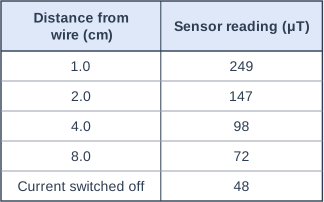
The table shows her results. The last row shows the reading with the current switched off.

Predict the sensor reading when the sensor is 16.0 cm from the wire. Use the results to explain your prediction.

Table with columns "Distance from wire (cm)", "Sensor reading (μT)". Distance from wire (cm): 1.0; Sensor reading (μT): 249 | Distance from wire (cm): 2.0; Sensor reading (μT): 147 | Distance from wire (cm): 4.0; Sensor reading (μT): 98 | Distance from wire (cm): 8.0; Sensor reading (μT): 72 | Distance from wire (cm): Current switched off; Sensor reading (μT): 48.

Model answer

With the current off the sensor reads 48 μT. This is the Earth's field, and it is included in every reading, so I subtract it to find the field of the wire alone:
1.0 cm: 249 − 48 = 201 μT
2.0 cm: 147 − 48 = 99 μT
4.0 cm: 98 − 48 = 50 μT
8.0 cm: 72 − 48 = 24 μT
Each time the distance doubles, the field of the wire halves (201, 99, 50, 24 μT). So at 16.0 cm the field of the wire is about 24 ÷ 2 = 12 μT.
The Earth's field is the same at every position, so the sensor will read about 12 + 48 = 60 μT.

Explanation

The sensor was not set to zero, so every reading includes the same background field of 48 μT. Only after subtracting it does the pattern appear: the field of the wire halves when the distance doubles. The prediction is then the field of the wire at 16.0 cm plus the background. Common errors are to halve the raw reading at 8.0 cm (36 μT) or to forget to add the background back (12 μT).

Mark scheme
  1. 1 mark

    the reading with the current off (48 μT) is the background / Earth's field, which is included in every reading: subtracting it gives the field of the wire as 201, 99, 50 and 24 μT at 1.0, 2.0, 4.0 and 8.0 cm; or a correct final answer from 59 to 61 μT with no working

    An answer from 59 to 61 μT with no working scores marking points 1, 2 and 3. ALLOW 2 marks (marking points 1 and 2) for a final answer of 12 μT (or 12 to 13 μT): the field of the wire with the background not added back. A prediction made from the raw readings (for example 36 μT, half of 72 μT) scores 0 for marking points 1 to 3. For this mark at least three correct values are needed, or 48 μT subtracted in the working.

  2. 1 mark

    the field of the wire halves each time the distance doubles (201, 99, 50, 24 μT), so at 16.0 cm it is about 12 μT; or a correct final answer from 59 to 61 μT with no working

    ALLOW 12 to 13 μT (for example 201 ÷ 16 = 12.6 μT, using field × distance = constant). ALLOW ECF from a wrong background value used consistently.

  3. 1 mark

    evaluation: predicted reading = 12 + 48 = 60 μT

    ALLOW 59 to 61 μT. ALLOW ECF for adding 48 μT to a wrongly predicted field of the wire.

  4. 1 mark

    explanation: the sensor measures the total field, and the Earth's (background) field is the same at every distance, so it is removed before finding the pattern and added back for the predicted reading

    ALLOW the raw readings do not halve because each includes the same 48 μT background. IGNORE the readings are not accurate.

Ready to try the rest? Every answer you write is marked against the mark scheme, so you can see exactly where the marks are.

Study Helper Hints first, answers after you try

Stuck on this one? Ask for a hint and I’ll point you in the right direction, without giving the answer away. Once you’ve checked your answer, I’ll show you how the marks are awarded.