
Level:
Correct: 0
Incorrect: 0
Marks: 0/0
Exam Practice
Course:
Topics:
Avg
score:
–
Topics
done:
0/28

Internal energy and specific heat capacity

Practise 17 exam-style questions on Internal energy and specific heat capacity for OCR GCSE Combined Science (Physics Paper 11). Write your answer as you would in the exam and get it marked in seconds against the mark scheme, point by point, with the Study Helper on hand if you get stuck.

  • 17 questions
  • 1–6 marks each
  • Instant marking
  • No sign-up needed
17 questions, marked as you go

Sample questions with model answers

Here are 4 of the questions in this topic, each with a model answer, an explanation of why it earns the marks and the mark scheme an examiner would use.

Question 1

1 mark

In a foundry, 3.0 kg of molten aluminium at its melting point is poured into a mould. The aluminium solidifies. Its temperature stays at its melting point while it solidifies.

Which quantity is needed to calculate the energy transferred from the aluminium as it solidifies?

Choose your answer.

  • A density of aluminium
  • B specific heat capacity of aluminium
  • C specific latent heat of fusion of aluminium
  • D specific latent heat of vaporisation of aluminium

Model answer

C. The aluminium changes from liquid to solid at a constant temperature, so the specific latent heat of fusion is needed.

Explanation

Specific heat capacity is used when the temperature of a material changes without a change of state. Specific latent heat is used for a change of state at constant temperature: fusion for melting or solidifying, vaporisation for boiling, evaporating or condensing. The same specific latent heat of fusion applies to melting and to solidifying: energy is supplied when a solid melts and released when the liquid solidifies.

Mark scheme
  1. 1 mark

    C / specific latent heat of fusion of aluminium

    The only correct answer is C: solidifying (freezing) is the reverse of melting, and the energy transferred is mass × specific latent heat of fusion. A is not correct because density links mass and volume, not energy. B is not correct because specific heat capacity is used when the temperature changes, and here the temperature stays the same. D is not correct because vaporisation is the change of state between liquid and gas. ALLOW the letter or the option. If more than one option is given, do not award the mark.
Question 2

2 marks

A heater warms the air in a classroom from 14 °C to 20 °C.

The mass of the air in the classroom is about 200 kg. The specific heat capacity of air is about 1000 J/kg °C.

Estimate the energy needed to warm the air.

Use the equation: change in thermal energy = mass × specific heat capacity × change in temperature

Model answer

change in temperature = 20 − 14 = 6 °C
change in thermal energy = 200 × 1000 × 6 = 1 200 000 J (about 1.2 MJ)

Explanation

Find the change in temperature first, then substitute into change in thermal energy = mass × specific heat capacity × change in temperature. The answer is an estimate because the mass and the specific heat capacity are approximate values. The heater must really supply more energy than this, because the walls and furniture are warmed too. A common error is to use 20 °C instead of the 6 °C change.

Mark scheme
  1. 1 mark

    substitution: 200 × 1000 × (20 − 14) / 200 × 1000 × 6; or a correct final answer of 1 200 000 J with no working

    An answer of 1 200 000 J with no working scores 2 marks. ALLOW 1.2 × 10⁶ J, 1.2 MJ or 1200 kJ. A calculation that uses 20 °C or 14 °C instead of the change in temperature (4 000 000 J or 2 800 000 J) scores 0.

  2. 1 mark

    evaluation: 1 200 000 (J)

    ALLOW 1.2 × 10⁶ J, 1.2 MJ or 1200 kJ. IGNORE units unless the question asks for them.

Question 3

3 marks

The cooling system of a car engine contains 6.5 kg of coolant. On a cold morning, the engine warms the coolant from 8 °C to 90 °C.

The specific heat capacity of the coolant is 3500 J/kg °C.

Calculate the energy transferred to the coolant.

Use the equation: change in thermal energy = mass × specific heat capacity × change in temperature

Give your answer in MJ to 2 significant figures.

Model answer

change in temperature = 90 − 8 = 82 °C
change in thermal energy = 6.5 × 3500 × 82 = 1 865 500 J
= 1.8655 MJ = 1.9 MJ (to 2 significant figures)

Explanation

Find the change in temperature (82 °C, not 90 °C), substitute, then convert J to MJ by dividing by 1 000 000. Round only at the end: 1.8655 MJ becomes 1.9 MJ to 2 significant figures. Students often lose the last mark by leaving the answer in J or by not rounding.

Mark scheme
  1. 1 mark

    substitution: 6.5 × 3500 × (90 − 8) / 6.5 × 3500 × 82; or a correct final answer of 1.9 MJ with no working

    An answer of 1.9 MJ with no working scores 3 marks. ALLOW 2 marks for 1 865 500 J, 1.9 × 10⁶ J, 1.8655 MJ or 1.87 MJ (not given in MJ to 2 significant figures). A calculation that uses 90 °C as the change in temperature (2 047 500 J) scores only the final mark by ECF if it is correctly given as 2.0 MJ.

  2. 1 mark

    1 865 500 (J) / 1.8655 (MJ); or a correct final answer of 1.9 MJ with no working

    ALLOW 1.87 MJ or 1.866 MJ.

  3. 1 mark

    1.9 (MJ)

    This mark is for the answer in MJ to 2 significant figures: 1.9 × 10⁶ J (not in MJ) does not score this mark. ALLOW ECF for a correct conversion to MJ to 2 significant figures of a wrongly calculated value, eg 2 047 500 J to 2.0 MJ.

Question 4

4 marks

A student heats different masses of water in a polystyrene cup. Each time, she uses an electric heater and a joulemeter to transfer 12 600 J of energy to the water, and she measures the temperature rise.

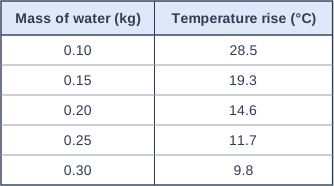
The table shows her results.

The student says: 'The temperature rise is inversely proportional to the mass of water.'

Use the result for 0.20 kg of water to calculate a value for the specific heat capacity of water. Then use the data to evaluate the student's statement.

Use the equation: change in thermal energy = mass × specific heat capacity × change in temperature

Table with columns "Mass of water (kg)", "Temperature rise (°C)". Mass of water (kg): 0.10; Temperature rise (°C): 28.5 | Mass of water (kg): 0.15; Temperature rise (°C): 19.3 | Mass of water (kg): 0.20; Temperature rise (°C): 14.6 | Mass of water (kg): 0.25; Temperature rise (°C): 11.7 | Mass of water (kg): 0.30; Temperature rise (°C): 9.8.

Model answer

specific heat capacity = 12 600 ÷ (0.20 × 14.6) = 12 600 ÷ 2.92 = 4315 J/kg °C (about 4300 J/kg °C)

If the rise is inversely proportional to the mass, mass × temperature rise should be constant. 0.10 × 28.5 = 2.85, 0.20 × 14.6 = 2.92 and 0.30 × 9.8 = 2.94. Doubling the mass from 0.10 kg to 0.20 kg roughly halves the rise. So the data support the statement approximately, but not exactly: the product is a little smaller for the smallest masses, probably because the water got hotter and more energy was transferred to the surroundings.

Explanation

For a fixed energy, change in temperature = energy ÷ (mass × specific heat capacity), so the rise should be inversely proportional to the mass. To test inverse proportion, show that mass × rise stays about constant, or that doubling the mass halves the rise; saying only that the rise falls as the mass increases is not enough. The calculated value is above 4200 J/kg °C because some energy is not transferred to the water.

Mark scheme
  1. 1 mark

    specific heat capacity = 12 600 ÷ (0.20 × 14.6); or a correct final answer of 4315 J/kg °C with no working

    An answer of 4315 J/kg °C (ALLOW 4300 or 4320 J/kg °C) with no working scores marking points 1 and 2. ALLOW 12 600 = 0.20 × c × 14.6. A value calculated from a different row of the table scores marking point 1 only.

  2. 1 mark

    4315 (J/kg °C)

    ALLOW 4300 or 4320 J/kg °C.

  3. 1 mark

    correct use of the data to show that mass × temperature rise is about the same for every result / that doubling the mass about halves the temperature rise

    At least two results must be compared, eg 0.10 × 28.5 = 2.85 and 0.30 × 9.8 = 2.94; or from 0.10 kg to 0.20 kg the rise falls from 28.5 °C to 14.6 °C (about half); or three times the mass (0.30 kg) gives 9.8 °C (about a third of 28.5 °C). ALLOW c calculated for two or more rows and shown to be about the same. IGNORE 'as the mass increases the temperature rise decreases' on its own (this does not show inverse proportion).

  4. 1 mark

    judgement: the statement is (approximately) supported, but mass × temperature rise is not exactly constant / the smallest masses have a smaller temperature rise than inverse proportion predicts (because more energy is transferred to the surroundings when the water gets hotter)

    This mark depends on marking point 3. ALLOW the results support the statement within experimental error. ALLOW the small differences are caused by energy transferred to the cup or the surroundings.

Ready to try the rest? Every answer you write is marked against the mark scheme, so you can see exactly where the marks are.

Study Helper Hints first, answers after you try

Stuck on this one? Ask for a hint and I’ll point you in the right direction, without giving the answer away. Once you’ve checked your answer, I’ll show you how the marks are awarded.