
Level:
Correct: 0
Incorrect: 0
Marks: 0/0
Exam Practice
Course:
Topics:
Avg
score:
–
Topics
done:
0/28

Conservation of mass and physical changes

Practise 12 exam-style questions on Conservation of mass and physical changes for OCR GCSE Combined Science (Physics Paper 11). Write your answer as you would in the exam and get it marked in seconds against the mark scheme, point by point, with the Study Helper on hand if you get stuck.

  • 12 questions
  • 1–6 marks each
  • Instant marking
  • No sign-up needed
12 questions, marked as you go

Sample questions with model answers

Here are 4 of the questions in this topic, each with a model answer, an explanation of why it earns the marks and the mark scheme an examiner would use.

Question 1

1 mark

A blacksmith heats an iron bar until it glows red, hammers it into a new shape and leaves it to cool. While the iron is hot, a thin black layer of iron oxide forms on its surface.

Which statement describes these changes?

Choose your answer.

  • A Changing the shape and forming the black layer are both chemical changes.
  • B Changing the shape is a physical change, and forming the black layer is a chemical change.
  • C Changing the shape is a chemical change, and forming the black layer is a physical change.
  • D Changing the shape and forming the black layer are both physical changes.

Model answer

B

Explanation

Ask whether a new substance has formed. Hammering only changes the shape of the iron, so it is still iron and the change is physical, but iron oxide is a different substance from iron, so its formation is a chemical change. One process can involve both kinds of change.

Mark scheme
  1. 1 mark

    B / changing the shape is a physical change, and forming the black layer is a chemical change

    The only correct answer is B: after hammering, the bar is still iron with the properties of iron, so changing its shape is a physical change; the black iron oxide is a new substance with different properties from iron, so forming it is a chemical change. A is not correct because hammering forms no new substance; C is not correct because it reverses the two changes; D is not correct because the black layer is a new substance, and cooling or reshaping does not turn it back into iron. ALLOW the letter or the statement. If more than one option is given, do not award the mark.
Question 2

2 marks

A bottle garden is a large glass bottle containing soil and small plants. The bottle is sealed with a stopper.

Every day, water evaporates from the soil and the leaves and then condenses on the inside of the glass. The mass of the sealed bottle garden stays the same for many years.

Explain why the mass stays the same even though water keeps evaporating and condensing.

Model answer

The bottle is sealed, so no particles can get in or out. When water evaporates and condenses, the water molecules only change between the liquid and the gas; none are created or destroyed. So the total mass of water in the bottle, and the mass of the bottle garden, stays the same.

Explanation

Two ideas are needed: a closed system, and changes of state that do not create or destroy particles. The water simply cycles between liquid and vapour inside the bottle. A common error is to think that water vapour weighs nothing, so the mass would fall when water evaporates.

Mark scheme
  1. 1 mark

    the bottle is sealed, so no particles / water / matter can enter or leave

    ALLOW it is a closed system. IGNORE references to photosynthesis or respiration.

  2. 1 mark

    evaporating and condensing are changes of state: the water molecules are not created or destroyed, they only change between liquid and gas (so the total mass of water stays the same)

    ALLOW the water vapour stays inside the bottle and turns back into liquid water. ALLOW the number of water molecules stays the same. DO NOT ALLOW the water vapour has no mass.

Question 3

3 marks

Instant coffee can be made by freeze-drying. A tray of frozen coffee is put in a chamber, and the air is pumped out. The ice in the frozen coffee sublimes: it changes straight into water vapour. The water vapour then freezes onto a very cold metal coil in the chamber.

The mass of the tray of coffee is 3.20 kg at the start and 1.12 kg at the end. Assume that all of the water vapour freezes onto the coil.

Predict the mass of ice that forms on the coil. Explain your prediction.

Model answer

Mass of ice on the coil = 3.20 − 1.12 = 2.08 kg.
When the ice sublimes, the water molecules change from a solid into a gas but none are created or destroyed, so the mass of water is conserved. All the water vapour freezes onto the coil, so the coil gains exactly the mass that the coffee lost.

Explanation

The coffee loses mass only because water molecules leave it as vapour. Because changes of state conserve mass and all of the vapour is collected, the mass of ice on the coil equals the mass lost by the tray. A common error is to give the mass of the dried coffee instead of the mass of water removed.

Mark scheme
  1. 1 mark

    2.08 (kg)

    An answer of 2.08 kg with no working scores marking point 1 only. ALLOW 2.1 kg / 2080 g. DO NOT ALLOW 4.32 kg (masses added) or 1.12 kg (the mass of the dried coffee).

  2. 1 mark

    subliming is a change of state, so the water molecules that leave the coffee are not created or destroyed / the mass of water is conserved

    ALLOW the ice changes into water vapour but its particles (and their mass) are unchanged. ALLOW sublimation is a physical change, so no mass is lost.

  3. 1 mark

    all of the water vapour ends up as ice on the coil, so the mass gained by the coil equals the mass lost by the coffee (3.20 − 1.12)

    ALLOW the water that leaves the coffee all collects on the coil. ALLOW the mass lost by the tray is the mass of water that sublimed.

Question 4

4 marks

A teacher wants to show that mass is conserved when water evaporates and condenses. She heats salt water in a flask. The steam passes through a condenser, and the liquid water drips into a beaker.

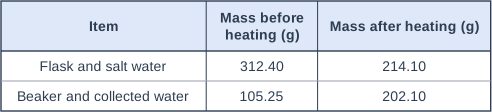
The table shows her results.

Use the results to evaluate her claim that the experiment shows mass is conserved.

Table with columns "Item", "Mass before heating (g)", "Mass after heating (g)". Item: Flask and salt water; Mass before heating (g): 312.40; Mass after heating (g): 214.10 | Item: Beaker and collected water; Mass before heating (g): 105.25; Mass after heating (g): 202.10.

Model answer

Mass of water lost from the flask = 312.40 − 214.10 = 98.30 g
Mass of water collected = 202.10 − 105.25 = 96.85 g
The two masses differ by only 1.45 g, about 1.5 % of the water that evaporated, so the results support the claim that mass is conserved. The small difference is probably because some water vapour escaped from the end of the condenser, or some water stayed on the inside of the condenser, so not all of it reached the beaker. No water was destroyed.

Explanation

Compare the mass that left the flask with the mass that arrived in the beaker. They are close but not identical, so a good evaluation explains the gap with a sensible source of loss rather than concluding that mass was destroyed. The salt stays in the flask, so the mass lost from the flask is only water.

Mark scheme
  1. 1 mark

    mass of water lost from the flask = 312.40 − 214.10 = 98.30 (g)

    Max 3 if there is no judgement about the claim. ALLOW 98.3 g.

  2. 1 mark

    mass of water collected in the beaker = 202.10 − 105.25 = 96.85 (g)

    ALLOW 96.9 g.

  3. 1 mark

    the two masses are almost the same / differ by only 1.45 g (about 1.5 % of the water evaporated), so the results support the claim

    ALLOW ECF from wrong subtractions. ALLOW the total mass before (417.65 g) and after (416.20 g) compared, differing by 1.45 g. The judgement must be based on the data.

  4. 1 mark

    the small difference is because some water vapour escaped (for example from the end of the condenser) / some water was left inside the condenser, so not all of the water was collected (no mass was destroyed)

    ALLOW some steam did not condense / water evaporated from the beaker. IGNORE human error / the balance was wrong (on their own). DO NOT ALLOW some of the water was destroyed / mass was lost when it changed state.

Ready to try the rest? Every answer you write is marked against the mark scheme, so you can see exactly where the marks are.

Study Helper Hints first, answers after you try

Stuck on this one? Ask for a hint and I’ll point you in the right direction, without giving the answer away. Once you’ve checked your answer, I’ll show you how the marks are awarded.