
Level:
Correct: 0
Incorrect: 0
Marks: 0/0
Exam Practice
Course:
Topics:
Avg
score:
–
Topics
done:
0/28

Newton's third law and circular motion

Practise 13 exam-style questions on Newton's third law and circular motion for OCR GCSE Combined Science (Physics Paper 11). Write your answer as you would in the exam and get it marked in seconds against the mark scheme, point by point, with the Study Helper on hand if you get stuck.

  • 13 questions
  • 1–6 marks each
  • Instant marking
  • No sign-up needed
13 questions, marked as you go

Sample questions with model answers

Here are 4 of the questions in this topic, each with a model answer, an explanation of why it earns the marks and the mark scheme an examiner would use.

Question 1

1 mark

A car pulls a caravan along a level road using a tow bar. At first the car and caravan speed up. Later they move at a constant speed.

How does the size of the force of the car on the caravan compare with the size of the force of the caravan on the car?

Choose your answer.

  • A always equal
  • B bigger at all times
  • C bigger only while speeding up
  • D smaller only while speeding up

Model answer

A (always equal)

Explanation

Newton's third law applies in non-equilibrium situations as well as equilibrium ones. While the caravan speeds up, the forward pull of the car on the caravan is bigger than the resistive forces on the caravan, but it is still exactly equal to the backward pull of the caravan on the car. A common misconception is that the object 'winning' or causing the motion exerts the bigger force.

Mark scheme
  1. 1 mark

    A / always equal

    The only correct answer is A: the two forces are a Newton's third law pair, so they are always equal in size and opposite in direction, whether or not the vehicles are accelerating. B is not correct because the car cannot pull the caravan without the caravan exerting an equal force back on the car; C is not correct because third law forces are equal even while the caravan speeds up (it speeds up because the force on it is bigger than the resistive forces on it); D is not correct because the force of the caravan on the car is never bigger than the force of the car on the caravan. ALLOW the letter or the option. If more than one option is given, do not award the mark.
Question 2

1 mark

An apple hangs on a tree. The Earth pulls the apple downwards with a gravitational force of 1.5 N.

Give the size and direction of the force that the apple exerts on the Earth.

Model answer

1.5 N, upwards (towards the apple)

Explanation

The Earth and the apple attract each other by gravity, so by Newton's third law the apple pulls the Earth with a gravitational force equal in size (1.5 N) and opposite in direction (upwards, towards the apple). Many students think that only the Earth pulls; in fact every gravitational interaction produces a force on each object.

Mark scheme
  1. 1 mark

    1.5 N upwards / 1.5 N towards the apple

    Both the size and the direction are needed for the mark. ALLOW 'a gravitational pull of 1.5 N on the Earth towards the apple'. DO NOT ALLOW 0 N, 'the apple does not pull the Earth', or 1.5 N downwards. IGNORE the force of the stalk on the apple.

Question 3

3 marks

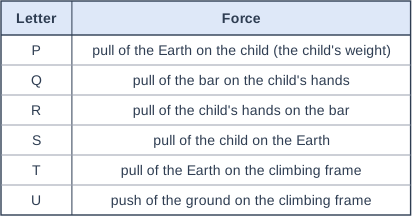
A child hangs at rest from a horizontal bar on a climbing frame. The table lists six forces, P to U.

Give the letters of the two Newton's third law pairs in the table.

Then give the letters of the two forces that are balanced because the child is at rest.

Table with columns "Letter", "Force". Letter: P; Force: pull of the Earth on the child (the child's weight) | Letter: Q; Force: pull of the bar on the child's hands | Letter: R; Force: pull of the child's hands on the bar | Letter: S; Force: pull of the child on the Earth | Letter: T; Force: pull of the Earth on the climbing frame | Letter: U; Force: push of the ground on the climbing frame.

Model answer

Newton's third law pairs: P and S (the gravitational interaction between the child and the Earth); Q and R (the contact interaction between the bar and the child's hands).
Balanced forces on the child: P and Q.

Explanation

A third law pair is two forces from the same interaction, acting on different objects: the Earth pulls the child and the child pulls the Earth; the bar pulls the child and the child pulls the bar. Balanced forces act on the same object: the child is at rest, so the upward pull of the bar on the child equals the child's weight. T and U both act on the climbing frame, so they cannot be a third law pair.

Mark scheme
  1. 1 mark

    P and S

    Max 2 if a third pair (for example T and U, or P and Q) is also given as a Newton's third law pair. ALLOW the two pairs in either order.

  2. 1 mark

    Q and R

    Both letters are needed.

  3. 1 mark

    P and Q (are the balanced forces)

    Both letters are needed. DO NOT ALLOW Q and R or P and S (these act on different objects, so they cannot balance each other).

Question 4

4 marks

A student of mass 55 kg stands on a set of bathroom scales in a lift. The scales show the force that the student exerts on them, in newtons.

The lift starts to move upwards with an acceleration of 1.2 m/s².

Gravitational field strength = 10 N/kg

Calculate the reading on the scales while the lift is accelerating. Explain how Newton's third law is used to find the reading.

Model answer

Weight of the student = 55 kg × 10 N/kg = 550 N
Resultant force needed = mass × acceleration = 55 × 1.2 = 66 N (upwards)
Upward force of the scales on the student = 550 + 66 = 616 N
By Newton's third law, the student pushes down on the scales with a force equal in size to the force of the scales on the student, so the reading on the scales is 616 N.

Explanation

Two forces act on the student: the weight (down) and the push of the scales (up). To accelerate upwards, the push of the scales must be bigger than the weight by mass × acceleration. The scales measure the force on them, which is the other force in the third law pair, so the reading is 616 N. A common error is to subtract the resultant force, which gives the reading for a lift accelerating downwards.

Mark scheme
  1. 1 mark

    weight of the student = 55 × 10 = 550 (N); or a correct final answer of 616 N with no working

    An answer of 616 N with no working scores marking points 1, 2 and 3. ALLOW use of 9.8 N/kg: 539 N and a final answer of 605 N. ALLOW 2 marks for 484 N (resultant force subtracted from the weight). ALLOW 1 mark for 66 N (resultant force only).

  2. 1 mark

    resultant (upward) force on the student = mass × acceleration = 55 × 1.2 = 66 (N); or a correct final answer of 616 N with no working

    ALLOW 66 N seen anywhere in the working.

  3. 1 mark

    upward force of the scales on the student = 550 + 66 = 616 (N)

    ALLOW 620 N. ALLOW ECF from an incorrect weight or resultant force.

  4. 1 mark

    (by Newton's third law) the force of the student on the scales is equal in size (and opposite in direction) to the force of the scales on the student, so the scales read the same value

    ALLOW the student pushes down on the scales with the same force as the scales push up on the student. The idea of the two forces acting on different objects (the student and the scales) is needed. DO NOT ALLOW 'the reading equals the weight'.

Ready to try the rest? Every answer you write is marked against the mark scheme, so you can see exactly where the marks are.

Study Helper Hints first, answers after you try

Stuck on this one? Ask for a hint and I’ll point you in the right direction, without giving the answer away. Once you’ve checked your answer, I’ll show you how the marks are awarded.