
Level:
Correct: 0
Incorrect: 0
Marks: 0/0
Exam Practice
Course:
Topics:
Avg
score:
–
Topics
done:
0/28

Force and extension

Practise 17 exam-style questions on Force and extension for OCR GCSE Combined Science (Physics Paper 11). Write your answer as you would in the exam and get it marked in seconds against the mark scheme, point by point, with the Study Helper on hand if you get stuck.

  • 17 questions
  • 1–6 marks each
  • Instant marking
  • No sign-up needed
17 questions, marked as you go

Sample questions with model answers

Here are 4 of the questions in this topic, each with a model answer, an explanation of why it earns the marks and the mark scheme an examiner would use.

Question 1

1 mark

A spring in a gym machine stretches by 4.5 cm when a force of 36 N acts on it. The spring does not go past its limit of proportionality.

Which value is the spring constant?

Choose your answer.

  • A 1.6 N/m
  • B 8.0 N/m
  • C 800 N/m
  • D 8000 N/m

Model answer

C: k = F ÷ x = 36 ÷ 0.045 = 800 N/m

Explanation

Rearrange force = spring constant × extension to give spring constant = force ÷ extension, and convert the extension to metres first (4.5 cm = 0.045 m) so that the answer is in N/m. Dividing by 4.5 gives the spring constant in N/cm, which is 100 times smaller than the value in N/m.

Mark scheme
  1. 1 mark

    C / 800 N/m

    The only correct answer is C: spring constant = force ÷ extension = 36 ÷ 0.045 = 800 N/m (4.5 cm = 0.045 m). A is not correct because 1.6 comes from multiplying the force by the extension (36 × 0.045); B is not correct because 8.0 comes from dividing by the extension in cm (36 ÷ 4.5), which gives N/cm, not N/m; D is not correct because 8000 comes from converting 4.5 cm wrongly to 0.0045 m. ALLOW the letter or the value. If more than one option is given, do not award the mark.
Question 2

2 marks

A spring in a children's ride-on toy has a spring constant of 360 N/m. When a child sits on the toy, the spring is stretched by 7.2 cm.

Show that the energy transferred in stretching the spring is about 0.9 J.

Use the equation: energy transferred in stretching = ½ × spring constant × (extension)²

Model answer

energy = ½ × 360 × 0.072²
= 180 × 0.005184
= 0.933 J, which is about 0.9 J

Explanation

Convert 7.2 cm to 0.072 m, square it, then multiply by ½ and the spring constant. In a 'show that' question, write the substitution and give the answer to more significant figures than the value in the question (0.93 J, not just 0.9 J). Using 7.2 instead of 0.072 gives an answer 10 000 times too big.

Mark scheme
  1. 1 mark

    substitution: ½ × 360 × 0.072²

    This is a 'show that' question: the marks are for the working, and the given value on its own scores 0. ALLOW 0.5 × 360 × 0.005184 / 180 × 0.072². DO NOT ALLOW 7.2 used in place of 0.072 for this mark.

  2. 1 mark

    evaluation: 0.93 (J) / 0.933 (J)

    The answer must be given to at least 2 significant figures (0.93), so that it is more precise than the 'about 0.9 J' in the question. ALLOW 0.9331 / 0.93312. A final answer of 0.9 J on its own does not score this mark.

Question 3

3 marks

A company makes trampolines. Each spring around the edge of a trampoline must store 12 J of energy when it is stretched by 0.15 m.

Calculate the spring constant needed.

Use the equation: energy transferred in stretching = ½ × spring constant × (extension)²

Give your answer to 2 significant figures.

Model answer

energy = ½ × spring constant × (extension)²
12 = ½ × k × 0.15²
k = 2 × 12 ÷ 0.0225
k = 1066.7 N/m
k = 1100 N/m (to 2 significant figures)

Explanation

Rearrange the equation before substituting: k = 2E ÷ x². Square the extension (0.15² = 0.0225) and remember the factor of 2 that comes from the ½. Then round to 2 significant figures as the question asks: 1066.7 becomes 1100, not 1000 or 1070.

Mark scheme
  1. 1 mark

    rearrangement: spring constant = 2 × energy ÷ (extension)² / 2 × 12 ÷ 0.15²; or a correct final answer of 1100 N/m (or 1066.7 / 1067 / 1070 N/m) with no working

    An answer of 1100 N/m with no working scores 3 marks. ALLOW 12 = ½ × k × 0.15² as the first step. ALLOW 2 marks for 1066.7 or 1067 N/m (not rounded to 2 significant figures). ALLOW 1 mark for 530 N/m (the ½ not used: 12 ÷ 0.15² = 533), given to 2 significant figures.

  2. 1 mark

    evaluation: 1066.7 / 1067 / 1070 (N/m); or a correct final answer of 1100 N/m with no working

    ALLOW 1066 or 1066.67.

  3. 1 mark

    1100 (N/m) to 2 significant figures

    ALLOW 1.1 × 10³ (N/m), including typed forms such as 1.1E3 or 1.1 times 10 to the power 3. ALLOW ECF for the significant-figure mark from a valid calculation.

Question 4

4 marks

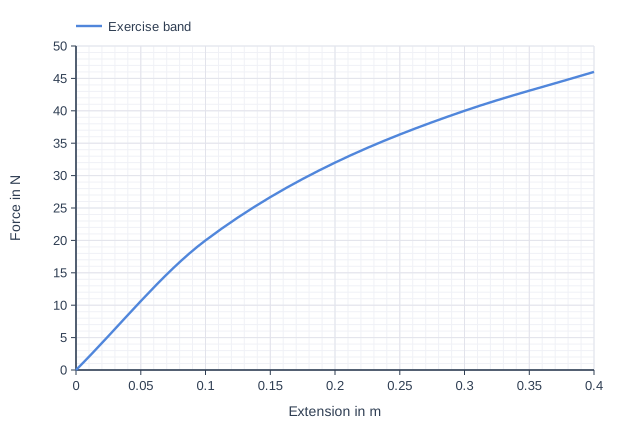
A fitness coach tests an elastic exercise band. The graph shows how the force needed to stretch the band changes with its extension.

Estimate the work done in stretching the band to an extension of 0.40 m.

A student says the work done can be found with the equation: energy transferred in stretching = ½ × spring constant × (extension)², using a spring constant of 46 N ÷ 0.40 m. Explain why this method gives a value that is too small.

Line graph of Force in N (y-axis, 0 to 50) against extension in m (x-axis, 0 to 0.4). "Exercise band" is a smooth curve through (0, 0), (0.1, 20), (0.2, 32), (0.3, 40), (0.4, 46).

Model answer

Work done = area under the force–extension graph. Splitting it into strips 0.10 m wide:
0.10 × (0 + 20) ÷ 2 = 1.0 J
0.10 × (20 + 32) ÷ 2 = 2.6 J
0.10 × (32 + 40) ÷ 2 = 3.6 J
0.10 × (40 + 46) ÷ 2 = 4.3 J
Total ≈ 11.5 J (about 12 J).

The student's method uses one spring constant (115 N/m), which treats the graph as a straight line from the origin to 46 N at 0.40 m and gives ½ × 115 × 0.40² = 9.2 J. But the band's relationship is non-linear: the curve lies above that straight line, so the real area under the graph, and the real work done, is larger.

Explanation

The work done in stretching is always the area under the force–extension graph. The equation energy = ½ × k × x² is only the area of a triangle, so it works only when force is proportional to extension. For a curved graph, estimate the area by counting squares or adding trapeziums; the answer is an estimate, so a range of values is accepted.

Mark scheme
  1. 1 mark

    method: area under the graph found by counting squares or by splitting it into shapes (for example strips 0.10 m wide); or a correct final answer of any value from 10.5 to 12.5 J with no working

    An answer from 10.5 to 12.5 J with no working scores marking points 1 and 2. For reference: four trapeziums 0.10 m wide give 1.0 + 2.6 + 3.6 + 4.3 = 11.5 J, and the area under the smooth curve is about 11.7 J; the graph has large squares (0.05 m × 5 N = 0.25 J, so the area is about 46 to 47 large squares) divided into small squares (0.01 m × 1 N = 0.01 J, so about 1150 to 1200 small squares): ALLOW either, as long as the value of the square counted is used correctly. DO NOT ALLOW 18.4 J (46 × 0.40, the area of a rectangle).

  2. 1 mark

    evaluation: any value from 10.5 to 12.5 (J)

    IGNORE units unless the question asks for them.

  3. 1 mark

    the band's force–extension relationship is non-linear / the graph is not a straight line, so the band does not have one constant spring constant

    ALLOW 'the force is not proportional to the extension' / 'the equation only applies when force is proportional to extension'.

  4. 1 mark

    the curve lies above the straight line from the origin to the final point, so the area under the curve is greater than the triangle that the equation gives

    ALLOW the equation gives ½ × 115 × 0.40² = 9.2 J, which is less than the area under the curve. ALLOW 'at smaller extensions the force is larger than the straight-line (constant spring constant) model predicts'.

Ready to try the rest? Every answer you write is marked against the mark scheme, so you can see exactly where the marks are.

Study Helper Hints first, answers after you try

Stuck on this one? Ask for a hint and I’ll point you in the right direction, without giving the answer away. Once you’ve checked your answer, I’ll show you how the marks are awarded.