
Level:
Correct: 0
Incorrect: 0
Marks: 0/0
Exam Practice
Course:
Topics:
Avg
score:
–
Topics
done:
0/28

Series and parallel circuit calculations

Practise 17 exam-style questions on Series and parallel circuit calculations for OCR GCSE Combined Science (Physics Paper 11). Write your answer as you would in the exam and get it marked in seconds against the mark scheme, point by point, with the Study Helper on hand if you get stuck.

  • 17 questions
  • 1–6 marks each
  • Instant marking
  • No sign-up needed
17 questions, marked as you go

Sample questions with model answers

Here are 4 of the questions in this topic, each with a model answer, an explanation of why it earns the marks and the mark scheme an examiner would use.

Question 1

1 mark

A 2.0 m length of nichrome wire has a resistance of 6.0 Ω. The resistance of the wire is proportional to its length.

A student connects 0.50 m of this wire in series with a 3.0 Ω resistor and a 4.5 V battery.

What is the current in the circuit?

Choose your answer.

  • A 0.50 A
  • B 1.0 A
  • C 1.5 A
  • D 3.0 A

Model answer

B

Explanation

First find the resistance of the length of wire used: 0.50 m is a quarter of 2.0 m, so it has a quarter of the resistance, 1.5 Ω. Resistances in series add, so the total is 4.5 Ω and the current is 4.5 V ÷ 4.5 Ω = 1.0 A. Using the whole wire or only one of the two resistances gives the wrong options.

Mark scheme
  1. 1 mark

    B / 1.0 A

    The only correct answer is B: 0.50 m is a quarter of 2.0 m, so its resistance is 6.0 ÷ 4 = 1.5 Ω; the total resistance in series is 1.5 + 3.0 = 4.5 Ω, so the current = 4.5 ÷ 4.5 = 1.0 A. A is not correct because it uses the resistance of the whole 2.0 m of wire (4.5 ÷ 9.0); C is not correct because it uses only the 3.0 Ω resistor (4.5 ÷ 3.0); D is not correct because it uses only the 1.5 Ω of wire (4.5 ÷ 1.5). ALLOW the letter or the option. If more than one option is given, do not award the mark.
Question 2

2 marks

The handset that controls a model boat contains a 2.7 kΩ resistor and a 3.3 kΩ resistor connected in series.

The current in the resistors is 0.85 mA.

Calculate the potential difference across the two resistors together.

Model answer

Total resistance = 2.7 kΩ + 3.3 kΩ = 6.0 kΩ = 6000 Ω
Current = 0.85 mA = 0.00085 A
V = I × R = 0.00085 × 6000 = 5.1 V

Explanation

Resistances in series add, so the pair has a resistance of 6.0 kΩ. Then use potential difference = current × resistance, converting mA to A and kΩ to Ω first (or multiplying mA by kΩ, which gives volts directly). Forgetting one of the conversions gives an answer 1000 times too big or too small.

Mark scheme
  1. 1 mark

    total resistance = 2.7 + 3.3 = 6.0 kΩ and (V = I × R =) 0.00085 × 6000; or a correct final answer of 5.1 V with no working

    An answer of 5.1 V with no working scores 2 marks. ALLOW 8.5 × 10⁻⁴ × 6.0 × 10³ or 0.85 × 6.0 (milliamps × kilohms gives volts). ALLOW 1 mark for 5100 or 0.0051 (a power of ten error when converting mA or kΩ). ALLOW 1 mark for 2.3 V or 2.8 V (the p.d. across one resistor only).

  2. 1 mark

    evaluation: 5.1 (V)

    IGNORE units unless the question asks for them. ALLOW 2.295 + 2.805 = 5.1 V.

Question 3

3 marks

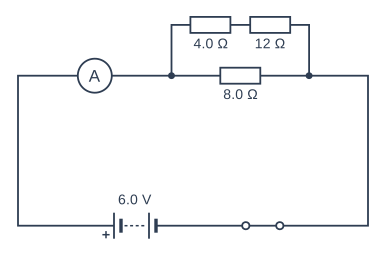
In the circuit in the diagram, a 6.0 V battery is connected to two branches in parallel. One branch has two resistors in series.

Calculate the reading on the ammeter.

Use the equation: potential difference = current × resistance

Circuit diagram. Going round the loop from the + terminal of the battery (labelled 6.0 V): an ammeter; then two branches in parallel (one branch has a resistor labelled 8.0 Ω; the other branch has a resistor labelled 4.0 Ω then a resistor labelled 12 Ω); then a closed switch; and back to the − terminal of the battery.

Model answer

Each branch has the battery p.d. of 6.0 V across it.
Branch with the 8.0 Ω resistor: I = V ÷ R = 6.0 ÷ 8.0 = 0.75 A
Other branch: resistance = 4.0 + 12 = 16 Ω, so I = 6.0 ÷ 16 = 0.375 A
Ammeter reading = 0.75 + 0.375 = 1.125 A (about 1.1 A)

Explanation

Treat each branch separately: both branches have the full 6.0 V across them. In the lower branch the two resistors are in series, so add their resistances before working out the current. The ammeter is in the main wire, so it reads the sum of the branch currents.

Mark scheme
  1. 1 mark

    current in the 8.0 Ω branch = 6.0 ÷ 8.0 = 0.75 A; or a correct final answer of 1.125 A / 1.1 A with no working

    An answer of 1.125 A (ALLOW 1.1 A or 1.13 A) with no working scores 3 marks. ALLOW 1 mark (this marking point) for 2.75 A (each resistor treated as a separate parallel branch). 0.25 A (all three resistors treated as being in series) scores 0.

  2. 1 mark

    current in the other branch = 6.0 ÷ (4.0 + 12) = 6.0 ÷ 16 = 0.375 A; or a correct final answer of 1.125 A / 1.1 A with no working

    ALLOW 0.38 A or 0.37 A. The 4.0 Ω and 12 Ω resistors are in series, so their resistances add.

  3. 1 mark

    evaluation: 0.75 + 0.375 = 1.125 (A) / 1.13 (A) / 1.1 (A)

    ALLOW ECF for the sum of two wrongly calculated branch currents. IGNORE units unless the question asks for them.

Question 4

4 marks

A gardener uses a frost alarm in a greenhouse. A thermistor is connected in series with a 2.2 kΩ resistor and a 6.0 V battery. As the temperature falls, the resistance of the thermistor increases.

The alarm sounds when the potential difference across the thermistor reaches 4.5 V.

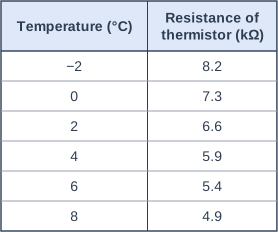
The table shows how the resistance of the thermistor changes with temperature.

Determine the temperature at which the alarm sounds.

Table with columns "Temperature (°C)", "Resistance of thermistor (kΩ)". Temperature (°C): −2; Resistance of thermistor (kΩ): 8.2 | Temperature (°C): 0; Resistance of thermistor (kΩ): 7.3 | Temperature (°C): 2; Resistance of thermistor (kΩ): 6.6 | Temperature (°C): 4; Resistance of thermistor (kΩ): 5.9 | Temperature (°C): 6; Resistance of thermistor (kΩ): 5.4 | Temperature (°C): 8; Resistance of thermistor (kΩ): 4.9.

Model answer

p.d. across the fixed resistor = 6.0 − 4.5 = 1.5 V
Current in the circuit: I = V ÷ R = 1.5 ÷ 2200 = 6.8 × 10⁻⁴ A
Resistance of the thermistor = V ÷ I = 4.5 ÷ 6.82 × 10⁻⁴ = 6600 Ω = 6.6 kΩ
From the table, a resistance of 6.6 kΩ is at 2 °C, so the alarm sounds when the temperature falls to 2 °C.

Explanation

The thermistor and the fixed resistor share the 6.0 V, and the same current passes through both. Find the current from the fixed resistor, then the thermistor's resistance, and read the temperature from the table. A quicker route is to use the ratio of the p.d.s: the thermistor has three times the p.d., so it has three times the resistance (6.6 kΩ).

Mark scheme
  1. 1 mark

    p.d. across the 2.2 kΩ resistor = 6.0 − 4.5 = 1.5 V; or a correct final answer of 2 °C with no working

    An answer of 2 °C with no working scores 4 marks. ALLOW the ratio method: resistance of thermistor ÷ 2.2 kΩ = 4.5 ÷ 1.5 = 3, so the thermistor's resistance is 3 × 2.2 = 6.6 kΩ (the first three marking points).

  2. 1 mark

    current = 1.5 ÷ 2200 = 6.8 × 10⁻⁴ A / 0.68 mA; or a correct final answer of 2 °C with no working

    ALLOW 0.00068 A or 0.682 mA. ALLOW ECF from a wrong p.d. across the resistor.

  3. 1 mark

    resistance of the thermistor = 4.5 ÷ 6.8 × 10⁻⁴ = 6600 Ω / 6.6 kΩ; or a correct final answer of 2 °C with no working

    ALLOW 6.6 kΩ to 6.7 kΩ (from a rounded current). ALLOW ECF from a wrong current.

  4. 1 mark

    (temperature =) 2 (°C)

    ALLOW ECF: the temperature read from the table for a wrongly calculated resistance that matches a value in the table.

Ready to try the rest? Every answer you write is marked against the mark scheme, so you can see exactly where the marks are.

Study Helper Hints first, answers after you try

Stuck on this one? Ask for a hint and I’ll point you in the right direction, without giving the answer away. Once you’ve checked your answer, I’ll show you how the marks are awarded.