
Level:
Correct: 0
Incorrect: 0
Marks: 0/0
Exam Practice
Course:
Topics:
Avg
score:
–
Topics
done:
0/28

Newton's second law, inertia and momentum

Practise 17 exam-style questions on Newton's second law, inertia and momentum for OCR GCSE Combined Science (Physics Paper 11). Write your answer as you would in the exam and get it marked in seconds against the mark scheme, point by point, with the Study Helper on hand if you get stuck.

  • 17 questions
  • 1–6 marks each
  • Instant marking
  • No sign-up needed
17 questions, marked as you go

Sample questions with model answers

Here are 4 of the questions in this topic, each with a model answer, an explanation of why it earns the marks and the mark scheme an examiner would use.

Question 1

1 mark

A rescue helicopter uses a winch and cable to lift a rescuer of mass 75 kg upwards. The tension in the cable is 870 N.

Gravitational field strength = 10 N/kg

What is the acceleration of the rescuer?

Choose your answer.

  • A 1.6 m/s² upwards
  • B 10 m/s² upwards
  • C 11.6 m/s² upwards
  • D 21.6 m/s² upwards

Model answer

A

Explanation

Newton's second law uses the RESULTANT force. Find the weight (W = m × g = 750 N), subtract it from the upward tension to get 120 N, then divide by the mass. The commonest error is to divide the tension by the mass and forget the weight.

Mark scheme
  1. 1 mark

    A / 1.6 m/s² upwards

    The only correct answer is A: weight = 75 × 10 = 750 N, so the resultant force = 870 − 750 = 120 N upwards, and acceleration = 120 ÷ 75 = 1.6 m/s² upwards. B is not correct because 750 ÷ 75 = 10 m/s² uses the weight instead of the resultant force; C is not correct because 870 ÷ 75 = 11.6 m/s² uses the tension and ignores the weight; D is not correct because (870 + 750) ÷ 75 = 21.6 m/s² adds the weight instead of subtracting it. ALLOW the letter or the option. If more than one option is given, do not award the mark. (Using 9.8 N/kg gives 1.8 m/s², which is not an option; ALLOW A.)
Question 2

2 marks

In a well-known trick, a performer pulls a smooth tablecloth very quickly from under a set of plates and glasses. The plates and glasses stay almost exactly where they were.

Use the idea of inertia to explain why.

Model answer

The plates and glasses have inertia: they are at rest, and their velocity is difficult to change. The smooth cloth exerts only a small friction force on them, and because it is pulled away very quickly, this force acts for only a very short time. So the plates and glasses get only a tiny acceleration for a tiny time, their velocity hardly changes, and they stay almost where they were.

Explanation

Inertia means an object tends to keep its velocity, here zero. A small force acting for a very short time changes the velocity of the plates by only a tiny amount, so they barely move. If the cloth were pulled slowly, the same friction force would act for longer and drag the plates with it.

Mark scheme
  1. 1 mark

    the plates and glasses have inertia: their velocity (zero) is difficult to change / they tend to stay at rest

    ALLOW 'they resist a change in their motion'. ALLOW 'a heavier plate has more inertia, so is harder to move'.

  2. 1 mark

    the (friction) force from the cloth on them is small and acts for only a very short time, so their velocity changes only a tiny amount / they hardly accelerate / hardly move

    Both the small force and the short time are needed for this mark. ALLOW 'the cloth is smooth so the friction is small, and it is pulled away so fast that they have no time to speed up'. DO NOT ALLOW 'there is no force on the plates'.

Question 3

3 marks

A student investigates collisions between two trolleys on a level runway. Friction can be ignored.

Trolley A has a mass of 0.50 kg. It moves at 0.84 m/s towards trolley B, which is at rest. The trolleys stick together and move off at 0.35 m/s.

Calculate the mass of trolley B.

Use the equation: momentum = mass × velocity

Model answer

momentum before = 0.50 × 0.84 = 0.42 kg m/s
Momentum is conserved, so momentum after = 0.42 kg m/s
0.42 = (0.50 + mass of B) × 0.35
0.50 + mass of B = 0.42 ÷ 0.35 = 1.2 kg
mass of B = 1.2 − 0.50 = 0.70 kg

Explanation

After the trolleys stick together, they move as one object whose mass is the sum of the two masses. Conservation of momentum gives the total mass (momentum ÷ velocity); trolley B's mass is what is left after taking away trolley A's 0.50 kg. The common slip is to stop at 1.2 kg.

Mark scheme
  1. 1 mark

    momentum before = 0.50 × 0.84 = 0.42 (kg m/s); or a correct final answer of 0.70 kg with no working

    An answer of 0.70 kg with no working scores 3 marks. ALLOW 2 marks for 1.2 kg (the total mass, not reduced by the mass of trolley A).

  2. 1 mark

    momentum is conserved, so total mass after = 0.42 ÷ 0.35 = 1.2 (kg); or a correct final answer of 0.70 kg with no working

    ALLOW 0.42 = (0.50 + mass of B) × 0.35. ALLOW ECF from a wrong momentum.

  3. 1 mark

    evaluation: mass of trolley B = 1.2 − 0.50 = 0.70 (kg)

    ALLOW 0.7 kg. ALLOW ECF from a wrong total mass.

Question 4

4 marks

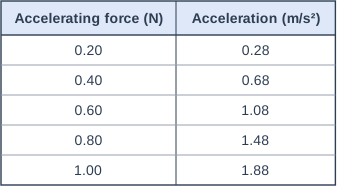
A student measures the acceleration of a trolley on a level bench for five different accelerating forces. The bench is not tilted, so friction acts on the trolley. The total mass being accelerated is the same in every run, and the friction force is the same in every run.

The table shows the student's results.

The inertial mass of an object is defined as the ratio of resultant force to acceleration.

Use the results to determine:
• the total mass being accelerated
• the friction force on the trolley.

Table with columns "Accelerating force (N)", "Acceleration (m/s²)". Accelerating force (N): 0.20; Acceleration (m/s²): 0.28 | Accelerating force (N): 0.40; Acceleration (m/s²): 0.68 | Accelerating force (N): 0.60; Acceleration (m/s²): 1.08 | Accelerating force (N): 0.80; Acceleration (m/s²): 1.48 | Accelerating force (N): 1.00; Acceleration (m/s²): 1.88.

Model answer

Each extra 0.20 N of accelerating force gives an extra 0.40 m/s² of acceleration, so the friction does not affect the change.
mass = change in force ÷ change in acceleration = (1.00 − 0.20) ÷ (1.88 − 0.28) = 0.80 ÷ 1.60 = 0.50 kg
In the first run: resultant force = mass × acceleration = 0.50 × 0.28 = 0.14 N
The accelerating force is 0.20 N, so friction = 0.20 − 0.14 = 0.06 N.

Explanation

With friction, the resultant force is the accelerating force minus the friction, so dividing one accelerating force by its acceleration gives the wrong mass. Using the CHANGE in force and the change in acceleration cancels the constant friction and gives the inertial mass (the gradient of a force-acceleration graph). The friction is then the part of the accelerating force that produces no acceleration.

Mark scheme
  1. 1 mark

    uses a change in force ÷ the change in acceleration, for example (1.00 − 0.20) ÷ (1.88 − 0.28); or a correct final answer of 0.50 kg (mass) and 0.06 N (friction) with no working

    An answer of 0.50 kg and 0.06 N with no working scores 4 marks. ALLOW the gradient of a graph of accelerating force against acceleration. DO NOT ALLOW a single force divided by its acceleration, for example 0.20 ÷ 0.28 = 0.71 kg or 1.00 ÷ 1.88 = 0.53 kg: this ignores the friction.

  2. 1 mark

    total mass = 0.50 (kg); or a correct final answer of 0.50 kg (mass) and 0.06 N (friction) with no working

    ALLOW 0.5 kg.

  3. 1 mark

    resultant force in one run = mass × acceleration, for example 0.50 × 0.28 = 0.14 (N); or a correct final answer of 0.50 kg (mass) and 0.06 N (friction) with no working

    ALLOW ECF from a wrong mass. ALLOW the idea that the accelerating force when the acceleration is zero (the intercept on the force axis, found by extending the pattern) is the friction force.

  4. 1 mark

    evaluation: friction = 0.20 − 0.14 = 0.06 (N)

    ALLOW ECF from a wrong mass, for example 0.53 kg gives 0.20 − 0.15 = 0.05 N. ALLOW 0.060 N.

Ready to try the rest? Every answer you write is marked against the mark scheme, so you can see exactly where the marks are.

Study Helper Hints first, answers after you try

Stuck on this one? Ask for a hint and I’ll point you in the right direction, without giving the answer away. Once you’ve checked your answer, I’ll show you how the marks are awarded.