
Level:
Correct: 0
Incorrect: 0
Marks: 0/0
Exam Practice
Course:
Topics:
Avg
score:
–
Topics
done:
0/28

Magnets and magnetic fields

Practise 15 exam-style questions on Magnets and magnetic fields for OCR GCSE Combined Science (Physics Paper 11). Write your answer as you would in the exam and get it marked in seconds against the mark scheme, point by point, with the Study Helper on hand if you get stuck.

  • 15 questions
  • 1–6 marks each
  • Instant marking
  • No sign-up needed
15 questions, marked as you go

Sample questions with model answers

Here are 4 of the questions in this topic, each with a model answer, an explanation of why it earns the marks and the mark scheme an examiner would use.

Question 1

1 mark

A student draws one curved field line around a bar magnet. Point P is on the line, close to the north pole of the magnet. Point Q is on the same line, level with the middle of the magnet, where the line is furthest from the magnet.

Which statement compares the magnetic field at P with the magnetic field at Q?

Choose your answer.

  • A Stronger at P, and in a different direction
  • B Stronger at P, and in the same direction
  • C Stronger at Q, and in a different direction
  • D The same at P and Q, as they are on the same line

Model answer

A (the field is stronger near the pole, and its direction changes along the curved line)

Explanation

A field-line diagram shows two things: the direction of the field at a point is along the line through that point (with its arrow), and the strength of the field is shown by how close together neighbouring lines are. Around a bar magnet both change from point to point. A common error is to think that all the points on one field line have the same field.

Mark scheme
  1. 1 mark

    A / stronger at P, and in a different direction

    The only correct answer is A: the field lines are closest together near the poles, so the field is stronger at P than at Q; the direction of the field at a point is along the field line at that point, and the line curves, so the direction at P (leaving the pole) is different from the direction at Q (parallel to the magnet). B is not correct because the line is curved, so its direction changes between P and Q; C is not correct because the field is weaker further from the poles, where the lines are further apart; D is not correct because the strength is shown by how close neighbouring lines are, not by which line a point is on. ALLOW the letter or the option. If more than one option is given, do not award the mark.
Question 2

2 marks

A magnetic building toy has plastic rods with a small permanent magnet in each end, and some steel balls. Models are made by fixing the ends of the rods to the balls.

When a child pushes the ends of two rods together, the ends sometimes push each other apart. The end of a rod always sticks to a steel ball, whichever end of the rod is used.

Explain these observations.

Model answer

Two rod ends push apart when like poles face each other (two north poles or two south poles), because like poles repel. The steel ball is not a magnet, but it becomes an induced magnet when a rod's magnet is near it, with the unlike pole next to the rod, so it is attracted to either end of a rod.

Explanation

Repulsion happens only between two magnets with like poles facing. A magnetic material such as steel is magnetised by any magnet placed near it, always with the opposite pole facing the magnet, so it is attracted whichever pole is used. A common error is to explain the attraction in terms of positive and negative charges.

Mark scheme
  1. 1 mark

    the ends push apart when like poles (two north poles or two south poles) face each other, because like poles repel

    ALLOW same poles repel. The idea of like / same poles is needed: DO NOT ALLOW 'the magnets repel' on its own.

  2. 1 mark

    the steel ball becomes an induced magnet / is magnetised by the rod's magnet (with an unlike pole next to the rod), so it is attracted to either pole

    ALLOW steel is a magnetic material, so it is attracted to both / either pole(s) of a magnet. DO NOT ALLOW the steel ball is a permanent magnet. DO NOT ALLOW answers in terms of charge.

Question 3

3 marks

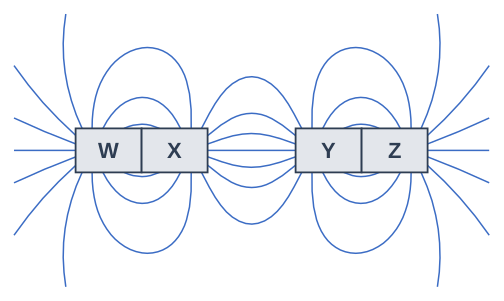
The diagram shows the magnetic field pattern around two bar magnets placed in a line. The ends of the magnets are labelled W, X, Y and Z. The arrows on the field lines are not shown, and the poles are not named.

Deduce whether the two magnets attract or repel each other.

The right-hand magnet is then turned round, so that end Z faces end X across the gap.

Describe how the field pattern in the gap changes. Explain your answer.

Two bar magnets lie in a line with a gap between them. Both magnets are the same grey colour. The left magnet's ends are labelled W (left) and X (right); the right magnet's ends are labelled Y (left) and Z (right), so X and Y face each other across the gap. Field lines go straight across the gap from one magnet to the other, close together and nearly parallel, and other field lines curve around the outside of the magnets. The field lines have no arrows.

Model answer

The magnets attract. The field lines go straight across the gap from X to Y, joining the two magnets, which happens only when unlike poles face each other.

Y is unlike X, and Z is the opposite end of the same magnet as Y, so Z is the same type of pole as X. When the magnet is turned round, like poles face each other across the gap and the magnets repel. The field lines from X and from Z now curve away from each other and do not cross the gap, leaving a point in the middle of the gap where there is no field (a neutral point).

Explanation

When unlike poles face each other, field lines run straight across the gap from one magnet to the other; when like poles face each other, the lines turn away from each other and leave a neutral point between them. Each magnet has a north pole at one end and a south pole at the other, so turning the right-hand magnet round changes which pole faces X. Students who do not use the field lines as evidence for attraction lose the first mark.

Mark scheme
  1. 1 mark

    (the magnets) attract, because the field lines go straight across the gap from one magnet to the other / join X to Y, so X and Y are unlike poles

    The reason is needed for this mark. DO NOT ALLOW repel.

  2. 1 mark

    Z is the same type of pole as X (because Y and Z are opposite ends of one magnet and Y is unlike X), so like poles now face each other (and the magnets repel)

    ALLOW X and Z are both north poles or both south poles. ALLOW like poles now face each other on its own.

  3. 1 mark

    the field lines from X and Z curve away from each other and do not cross the gap / there is a point in the middle of the gap with no field (a neutral point)

    ALLOW the lines from the two facing ends push away from each other and leave the gap upwards and downwards. ALLOW ECF from 'repel' in marking point 1 for a correct description of the pattern for unlike poles.

Question 4

4 marks

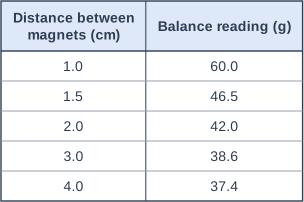
A student investigates the force between two magnets. She places a ring magnet on a top-pan balance. She holds a second ring magnet directly above it, with like poles facing, and records the balance reading for different distances between the magnets.

With the top magnet removed, the balance reading is 36.0 g.

The table shows her results.

Gravitational field strength = 10 N/kg

Calculate the magnetic force on the bottom magnet when the magnets are 1.0 cm apart and when they are 2.0 cm apart.

Use your answers to describe how the strength of the magnetic field of the top magnet changes with distance.

Table with columns "Distance between magnets (cm)", "Balance reading (g)". Distance between magnets (cm): 1.0; Balance reading (g): 60.0 | Distance between magnets (cm): 1.5; Balance reading (g): 46.5 | Distance between magnets (cm): 2.0; Balance reading (g): 42.0 | Distance between magnets (cm): 3.0; Balance reading (g): 38.6 | Distance between magnets (cm): 4.0; Balance reading (g): 37.4.

Model answer

The top magnet repels the bottom magnet, pushing it down, so the extra balance reading is caused by the magnetic force.
At 1.0 cm: increase in reading = 60.0 − 36.0 = 24.0 g = 0.024 kg
Force = m × g = 0.024 × 10 = 0.24 N
At 2.0 cm: increase in reading = 42.0 − 36.0 = 6.0 g = 0.0060 kg
Force = 0.0060 × 10 = 0.060 N
When the distance doubles from 1.0 cm to 2.0 cm, the force falls to a quarter (0.24 ÷ 0.060 = 4). So the magnetic field of the top magnet gets weaker further from the magnet, and it falls quickly with distance.

Explanation

The like poles repel, so the top magnet pushes the bottom magnet down onto the balance; the increase in the reading above 36.0 g is the magnetic force expressed as a mass. Convert the increase to kilograms and multiply by g to find the force in newtons. Common errors are using the whole balance reading instead of the increase, and forgetting to convert grams to kilograms.

Mark scheme
  1. 1 mark

    increase in reading: 60.0 − 36.0 = 24.0 g = 0.024 kg (at 1.0 cm) and 42.0 − 36.0 = 6.0 g = 0.0060 kg (at 2.0 cm); or a correct final answer of 0.24 N and 0.060 N with no working

    An answer of 0.24 N and 0.060 N with no working scores marking points 1, 2 and 3. ALLOW 1 mark (marking point 2) for 0.60 N and 0.42 N (balance readings used without subtracting 36.0 g). ALLOW 2 marks for 240 N and 60 N (masses not converted to kg). ALLOW use of 9.8 N/kg: 0.235 N / 0.24 N and 0.059 N.

  2. 1 mark

    force = mass × gravitational field strength: 0.024 × 10 and 0.0060 × 10; or a correct final answer of 0.24 N and 0.060 N with no working

    ALLOW (W =) m × g used with either mass.

  3. 1 mark

    evaluation: 0.24 (N) at 1.0 cm and 0.060 (N) at 2.0 cm

    Both values are needed. ALLOW 0.06 N. ALLOW 240 mN and 60 mN.

  4. 1 mark

    when the distance doubles the force falls to a quarter / the force decreases (quickly) as the distance increases, so the field (of the top magnet) is weaker further from the magnet

    ALLOW ECF from wrongly calculated forces if the trend described matches them. ALLOW the field strength decreases with distance. ORA (allow the reverse argument). The link to the field becoming weaker is needed.

Ready to try the rest? Every answer you write is marked against the mark scheme, so you can see exactly where the marks are.

Study Helper Hints first, answers after you try

Stuck on this one? Ask for a hint and I’ll point you in the right direction, without giving the answer away. Once you’ve checked your answer, I’ll show you how the marks are awarded.