
Level:
Correct: 0
Incorrect: 0
Marks: 0/0
Exam Practice
Course:
Topics:
OCR GCSE Physics (Paper 3) Smart practice A mixed round aimed at your weak spots
Unit 1
Matter
Unit 2
Forces
Unit 3
Electricity
Unit 4
Magnetism and magnetic fields
Unit 9
Practical skills
Avg
score:
–
Topics
done:
0/36

Newton's first law and resultant forces

Practise 18 exam-style questions on Newton's first law and resultant forces for OCR GCSE Physics (Paper 3). Write your answer as you would in the exam and get it marked in seconds against the mark scheme, point by point, with the Study Helper on hand if you get stuck.

  • 18 questions
  • 1–6 marks each
  • Instant marking
  • No sign-up needed
18 questions, marked as you go

Sample questions with model answers

Here are 4 of the questions in this topic, each with a model answer, an explanation of why it earns the marks and the mark scheme an examiner would use.

Question 1

1 mark

A mountain rescue team lowers a stretcher down a vertical cliff on a rope. The weight of the stretcher and the injured walker on it is 950 N. The team lowers the stretcher at a constant velocity. Ignore air resistance.

Which statement about the tension in the rope as the stretcher moves down is correct?

Choose your answer.

  • A It is equal to 950 N, because the resultant force on the stretcher is zero.
  • B It is greater than 950 N, because the rope must stop the stretcher from falling.
  • C It is less than 950 N, because the stretcher is moving downwards.
  • D It is zero, because the stretcher's inertia keeps it moving downwards.

Model answer

A

Explanation

Constant velocity means zero resultant force (Newton's first law), so the forces on the stretcher are balanced: tension upwards = weight downwards = 950 N, the same as when it hangs at rest. The direction of motion does not matter. Many students think that an object moving downwards must have a downward resultant force; that is needed only while it is speeding up.

Mark scheme
  1. 1 mark

    A / It is equal to 950 N, because the resultant force on the stretcher is zero.

    The only correct answer is A: the stretcher moves at a constant velocity, so by Newton's first law the resultant force on it is zero, and the upward tension must balance the 950 N weight. B is not correct because a tension greater than the weight would give an upward resultant force, and the stretcher would slow down; C is not correct because a downward resultant force is needed only to speed the stretcher up, not to keep it moving downwards at a constant velocity (a common misconception); D is not correct because with no tension the resultant force would be the weight, and the stretcher would speed up as it fell. ALLOW the letter or the option. If more than one option is given, do not award the mark.
Question 2

2 marks

During a curling match, a player lets go of a stone on a level sheet of ice. Nothing pushes the stone forwards after it is released, but it glides about 30 m in a straight line, slowing down very gradually, before it stops.

A spectator says: 'The stone stops because the push from the player runs out.'

Use Newton's first law to explain why the spectator is wrong, and describe how the stone would move if there were no friction and no air resistance.

Model answer

The spectator is wrong: no force is needed to keep the stone moving. After it is released, friction from the ice and air resistance act backwards on the stone, so there is a small resultant force opposite to its motion. This resultant force makes its velocity decrease gradually until it stops.
If there were no friction and no air resistance, the resultant force on the stone would be zero. By Newton's first law it would then keep moving in a straight line at a constant speed and would never stop.

Explanation

Newton's first law says that an object keeps the same velocity unless a resultant force acts on it, so a moving object does not need a forward force to keep going. The stone slows down because of a backward resultant force (friction and air resistance), not because a 'push' runs out. This idea that motion needs a force is one of the commonest misconceptions in forces.

Mark scheme
  1. 1 mark

    the stone slows down because friction from the ice (and air resistance) act backwards on it: there is a (small) resultant force opposite to its motion, which decreases its velocity

    The idea of a backward resultant force (friction) causing the slowing is needed: 'no forward force is needed to keep it moving' on its own does not score this mark. DO NOT ALLOW 'the force of the push gets used up' or 'it runs out of force'.

  2. 1 mark

    with no friction and no air resistance, the resultant force would be zero, so (by Newton's first law) the stone would keep moving in a straight line at a constant speed / constant velocity (it would not stop)

    ALLOW 'it would carry on at the same velocity for ever'. DO NOT ALLOW 'it would go faster' or 'it would slow down more slowly'.

Question 3

3 marks

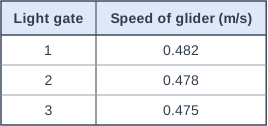
A student gives a glider a short push along a level linear air track and then lets go. Air blown out of tiny holes in the track lifts the glider, so that it floats just above the track. Three light gates measure the speed of the glider as it travels along the track.

The table shows the student's results.

The student says:

'The speed of the glider stays the same, so there are no forces acting on the glider.'

Evaluate the student's statement. Use the results in your answer.

Table with columns "Light gate", "Speed of glider (m/s)". Light gate: 1; Speed of glider (m/s): 0.482 | Light gate: 2; Speed of glider (m/s): 0.478 | Light gate: 3; Speed of glider (m/s): 0.475.

Model answer

The student is wrong. Forces do act on the glider: its weight acts downwards and the air from the track pushes it upwards, and these vertical forces are balanced. The results also show that the speed is not exactly constant: it falls from 0.482 m/s at light gate 1 to 0.475 m/s at light gate 3. So there must be a small resultant force backwards on the glider, from air resistance. Even if the speed were exactly constant, this would only show that the resultant force is zero (Newton's first law), not that there are no forces.

Explanation

Newton's first law links a constant velocity to a zero RESULTANT force, not to an absence of forces. Here the speed drops a little, so a small resultant force (air resistance) acts against the motion. A common mistake is to agree that an object moving steadily has no forces acting on it.

Mark scheme
  1. 1 mark

    forces do act on the glider: its weight (downwards) and the upward force of the air (from the track) / these vertical forces are balanced

    Max 3 from the four marking points. Max 2 if no data from the table are used. ALLOW 'the air pushes the glider up' / normal contact force / lift for the upward force. ALLOW there is no resultant vertical force because the weight is balanced by the push of the air.

  2. 1 mark

    the speed does not stay exactly the same: it decreases slightly, from 0.482 m/s to 0.475 m/s

    Data must be quoted for this mark: ALLOW any two speeds from the table quoted to show a decrease, or a decrease of 0.007 m/s (or 0.004 m/s and 0.003 m/s). ALLOW the speed is almost constant (with data).

  3. 1 mark

    so there is a small resultant force backwards / opposite to the motion (air resistance / drag / friction)

    ALLOW the glider is decelerating slightly, so there is a small resultant force. DO NOT ALLOW a resultant force forwards.

  4. 1 mark

    a constant velocity would mean that the resultant force is zero (Newton's first law), not that there are no forces, so the student is wrong

    ALLOW the forces on an object moving at a steady speed are balanced. ALLOW AW.

Question 4

4 marks

A child pulls a sledge across flat, level snow using a rope. The sledge moves at a constant velocity. Ignore air resistance.

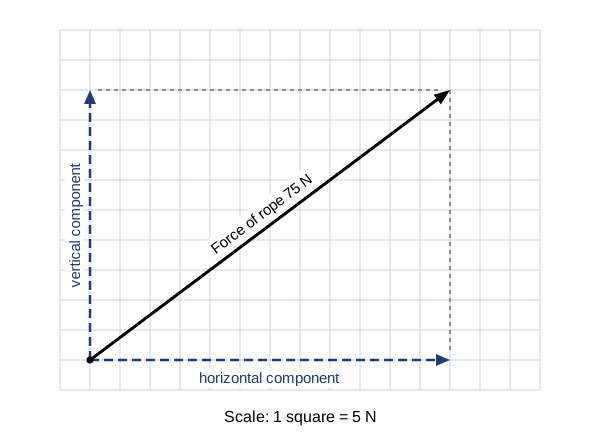
The rope pulls on the sledge with a force of 75 N at an angle to the horizontal. The scale drawing shows this force and its horizontal and vertical components.

The weight of the sledge and its load is 200 N.

Use the scale drawing to determine:
• the friction force on the sledge
• the normal contact force of the snow on the sledge.

Explain your answers.

A scale drawing on a square grid with the caption 'Scale: 1 square = 5 N'. A solid arrow labelled 'Force of rope 75 N' starts at a point near the bottom left of the grid and goes up and to the right. From the same starting point, a dashed arrow labelled 'horizontal component' runs horizontally to the right, and a dashed arrow labelled 'vertical component' runs vertically upwards. Thin dashed lines join the ends of the two components to the tip of the force arrow, completing a rectangle.

Model answer

Horizontal component of the pull = 12 squares × 5 N = 60 N.
Vertical component of the pull = 9 squares × 5 N = 45 N.
The sledge moves at a constant velocity, so the resultant force on it is zero (Newton's first law).
Horizontally: friction balances the horizontal component, so friction = 60 N.
Vertically: normal contact force + 45 N = 200 N, so the normal contact force = 200 − 45 = 155 N.

Explanation

Resolving the pull into horizontal and vertical components lets you balance the forces in each direction separately. Only the horizontal part of the pull (60 N) balances the friction, and the upward part of the pull (45 N) supports some of the weight, so the snow pushes up with less than the full 200 N. Common errors are to use the whole 75 N as the friction or to add the vertical component to the weight.

Mark scheme
  1. 1 mark

    friction = horizontal component of the pull = 12 squares × 5 N = 60 N; or a correct final answer of 60 N (58 to 62 N) for the friction and 155 N (153 to 157 N) for the normal contact force with no working

    An answer of 60 N (or any answer from 58 to 62 N) for the friction and 155 N (or any answer from 153 to 157 N) for the normal contact force with no working scores marking points 1, 2 and 3; marking point 4 needs the explanation. ALLOW 58 to 62 N for the friction (reading of the horizontal component). DO NOT ALLOW 75 N for the friction (the whole pull).

  2. 1 mark

    vertical component of the pull = 9 squares × 5 N = 45 N; or a correct final answer of 60 N (58 to 62 N) for the friction and 155 N (153 to 157 N) for the normal contact force with no working

    ALLOW 43 to 47 N (reading of the vertical component). ALLOW 45 N seen in the working.

  3. 1 mark

    evaluation: normal contact force = 200 − 45 = 155 (N)

    ALLOW 153 to 157 N. ALLOW ECF from a wrong vertical component. DO NOT ALLOW 245 N (component added to the weight) or 200 N.

  4. 1 mark

    explanation: the sledge moves at a constant velocity, so the resultant force is zero / the forces are balanced: friction balances the horizontal component of the pull, and the normal contact force plus the vertical component of the pull balance the weight

    ALLOW 'the forces are balanced horizontally and vertically (Newton's first law)'. ALLOW the rope lifts the sledge partly, so the snow needs to push up less. The idea of zero resultant force / balanced forces is needed.

Ready to try the rest? Every answer you write is marked against the mark scheme, so you can see exactly where the marks are.

Study Helper Hints first, answers after you try

Stuck on this one? Ask for a hint and I’ll point you in the right direction, without giving the answer away. Once you’ve checked your answer, I’ll show you how the marks are awarded.