
Level:
Correct: 0
Incorrect: 0
Marks: 0/0
Exam Practice
Course:
Topics:
OCR GCSE Physics (Paper 3) Smart practice A mixed round aimed at your weak spots
Unit 1
Matter
Unit 2
Forces
Unit 3
Electricity
Unit 4
Magnetism and magnetic fields
Unit 9
Practical skills
Avg
score:
–
Topics
done:
0/36

Current and charge

Practise 15 exam-style questions on Current and charge for OCR GCSE Physics (Paper 3). Write your answer as you would in the exam and get it marked in seconds against the mark scheme, point by point, with the Study Helper on hand if you get stuck.

  • 15 questions
  • 1–6 marks each
  • Instant marking
  • No sign-up needed
15 questions, marked as you go

Sample questions with model answers

Here are 4 of the questions in this topic, each with a model answer, an explanation of why it earns the marks and the mark scheme an examiner would use.

Question 1

1 mark

The battery in a heart pacemaker supplies a mean current of 12 μA.

How much charge flows from the battery in one day (24 hours)?

Use the equation: charge flow = current × time

Choose your answer.

  • A 2.9 × 10⁻⁴ C
  • B 1.0 C
  • C 1.0 × 10³ C
  • D 1.0 × 10⁶ C

Model answer

B

Explanation

Convert to SI units before using the equation: 12 μA = 1.2 × 10⁻⁵ A and 24 hours = 86 400 s. Then charge flow = 1.2 × 10⁻⁵ × 86 400 = 1.04 C. Each wrong option comes from missing one of these conversions, which is the most common error in charge calculations.

Mark scheme
  1. 1 mark

    B / 1.0 C

    The only correct answer is B: 12 μA = 12 × 10⁻⁶ A and 24 hours = 24 × 3600 = 86 400 s, so charge flow = 12 × 10⁻⁶ × 86 400 = 1.04 C, which is 1.0 C to 2 significant figures. A is not correct because it uses 24 (hours) instead of 86 400 s for the time; C is not correct because it treats 12 μA as 12 mA (12 × 10⁻³ A); D is not correct because it uses 12 A, ignoring the micro prefix. ALLOW the letter or the option. If more than one option is given, do not award the mark.
Question 2

2 marks

The motor of an electric scooter has a current of 8.0 A while the scooter climbs a hill. The climb takes 150 s.

Calculate the charge that flows through the motor during the climb.

Use the equation: charge flow = current × time

Model answer

charge flow = current × time
= 8.0 × 150
= 1200 C

Explanation

Substitute the current in amperes and the time in seconds into charge flow = current × time; the unit of charge is the coulomb (C). Dividing instead of multiplying is the usual slip: a check is that a current of 8 A for more than a minute must move a lot of charge.

Mark scheme
  1. 1 mark

    substitution: (charge flow =) 8.0 × 150; or a correct final answer of 1200 C with no working

    An answer of 1200 C with no working scores 2 marks. ALLOW 1.2 × 10³ C or 1.2 kC. An answer of 18.75 or 19 (150 ÷ 8.0) or 0.053 (8.0 ÷ 150) scores 0.

  2. 1 mark

    evaluation: 1200 (C)

    IGNORE units unless the question asks for them.

Question 3

3 marks

The US National Weather Service states that a typical lightning flash has a current of about 30 kA.

Assume that one lightning flash transfers a charge of 6.0 C to the ground, and that the current is 30 kA throughout the flash.

Calculate the time for which the flash lasts. Give your answer in seconds.

Model answer

charge flow = current × time, so time = charge flow ÷ current
30 kA = 30 000 A
time = 6.0 ÷ 30 000
= 2.0 × 10⁻⁴ s (0.000 20 s)

Explanation

Rearrange charge flow = current × time to make time the subject, and convert kiloamperes to amperes (1 kA = 1000 A) before substituting. Dividing 6.0 by 30 without converting gives 0.20 s, a thousand times too long. A very large current transfers a modest charge in a fraction of a millisecond.

Mark scheme
  1. 1 mark

    recall and rearrangement: time = charge flow ÷ current (t = Q ÷ I); or a correct final answer of 2.0 × 10⁻⁴ s with no working

    An answer of 2.0 × 10⁻⁴ s with no working scores 3 marks. ALLOW charge flow = current × time with the correct values substituted. ALLOW 2 marks for 0.20 s or another power-of-ten error from converting kA to A. An answer of 180 000 s (6.0 × 30 000) or 5000 s (30 000 ÷ 6.0) scores 0.

  2. 1 mark

    substitution: (time =) 6.0 ÷ 30 000; or a correct final answer of 2.0 × 10⁻⁴ s with no working

    ALLOW 6.0 = 30 000 × t. 30 kA = 30 000 A = 3.0 × 10⁴ A.

  3. 1 mark

    evaluation: 2.0 × 10⁻⁴ (s) / 0.000 20 (s)

    ALLOW 2 × 10⁻⁴ s, 0.0002 s or typed forms such as 2E-4. ALLOW 0.20 ms for this mark.

Question 4

5 marks

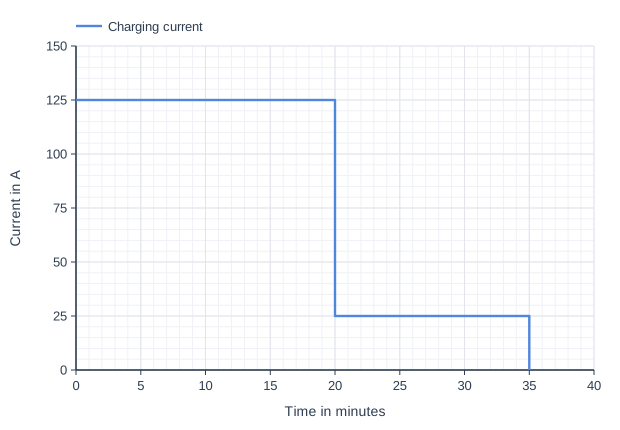
An electric car is charged at a rapid-charging point. The graph is a simplified graph of the current in the charging cable during the 35 minutes of charging.

Use the graph to calculate the total charge that flows into the car's battery in the 35 minutes.

Use the equation: charge flow = current × time

Give your answer in standard form, to 2 significant figures.

Line graph of Current in A (y-axis, 0 to 150) against time in minutes (x-axis, 0 to 40). "Charging current" joins the points (0, 125), (20, 125), (20, 25), (35, 25), (35, 0).

Model answer

From 0 to 20 minutes the current is constant at 125 A.
time = 20 × 60 = 1200 s
charge = 125 × 1200 = 150 000 C
From 20 to 35 minutes the current is constant at 25 A.
time = 15 × 60 = 900 s
charge = 25 × 900 = 22 500 C
Total charge = 150 000 + 22 500 = 172 500 C
= 1.7 × 10⁵ C (2 significant figures)

Explanation

Split the charging into the two parts where the current is constant, read each current from the graph and convert each time to seconds, then use charge flow = current × time for each part and add. Leaving the times in minutes gives 2.9 × 10³ C, and using 125 A for the whole 35 minutes gives 2.6 × 10⁵ C. The final mark needs standard form to 2 significant figures.

Mark scheme
  1. 1 mark

    conversion of times: 20 minutes = 1200 s and 15 minutes = 900 s; or a correct final answer of 1.7 × 10⁵ C (or 172 500 C) with no working

    An answer of 1.7 × 10⁵ C with no working scores 5 marks. An answer of 172 500 C with no working scores 4 marks. ALLOW 3 marks for 2875 C or 2.9 × 10³ C (times left in minutes). ALLOW 2 marks for 262 500 C or 2.6 × 10⁵ C (125 A used for the whole 35 minutes). ALLOW the two parts in either order.

  2. 1 mark

    charge in the first 20 minutes: 125 × 1200 = 150 000 (C); or a correct final answer of 1.7 × 10⁵ C (or 172 500 C) with no working

    ALLOW 1.5 × 10⁵ C.

  3. 1 mark

    charge in the last 15 minutes: 25 × 900 = 22 500 (C); or a correct final answer of 1.7 × 10⁵ C (or 172 500 C) with no working

    ALLOW 2.25 × 10⁴ C or 2.3 × 10⁴ C.

  4. 1 mark

    total charge: 150 000 + 22 500 = 172 500 (C); or a correct final answer of 1.7 × 10⁵ C with no working

    ALLOW ECF from errors in the two parts shown in the working. ALLOW the same total found as the area under the graph (two rectangles).

  5. 1 mark

    1.7 × 10⁵ (C)

    Standard form to 2 significant figures is needed for this mark. ALLOW typed forms such as 1.7E5 or 1.7 times 10 to the power 5. ALLOW ECF for this mark from a wrong total shown in the working, correctly given in standard form to 2 significant figures.

Ready to try the rest? Every answer you write is marked against the mark scheme, so you can see exactly where the marks are.

Study Helper Hints first, answers after you try

Stuck on this one? Ask for a hint and I’ll point you in the right direction, without giving the answer away. Once you’ve checked your answer, I’ll show you how the marks are awarded.