
Level:
Correct: 0
Incorrect: 0
Marks: 0/0
Exam Practice
Course:
Topics:
OCR GCSE Physics (Paper 3) Smart practice A mixed round aimed at your weak spots
Unit 1
Matter
Unit 2
Forces
Unit 3
Electricity
Unit 4
Magnetism and magnetic fields
Unit 9
Practical skills
Avg
score:
–
Topics
done:
0/36

Deforming objects: elastic and plastic deformation

Practise 13 exam-style questions on Deforming objects: elastic and plastic deformation for OCR GCSE Physics (Paper 3). Write your answer as you would in the exam and get it marked in seconds against the mark scheme, point by point, with the Study Helper on hand if you get stuck.

  • 13 questions
  • 1–6 marks each
  • Instant marking
  • No sign-up needed
13 questions, marked as you go

Sample questions with model answers

Here are 4 of the questions in this topic, each with a model answer, an explanation of why it earns the marks and the mark scheme an examiner would use.

Question 1

1 mark

A student hangs a load from a copper wire. She measures the length of the wire before the load is added, while the load is on and after the load is removed.

Length before the load is added = 1.500 m
Length with the load on = 1.506 m
Length after the load is removed = 1.504 m

Which answer describes the deformation of the wire and its permanent extension?

Choose your answer.

  • A elastic, 0 mm
  • B plastic, 2 mm
  • C plastic, 4 mm
  • D plastic, 6 mm

Model answer

C: permanent extension = 1.504 − 1.500 = 0.004 m = 4 mm, so the deformation is plastic.

Explanation

The permanent extension is found by comparing the length after the load is removed with the original length. Any permanent extension means that the wire has been deformed plastically. A common error is to use the extension while the load is on (6 mm), or to think the deformation was elastic because the wire got a little shorter when the load was removed.

Mark scheme
  1. 1 mark

    C / plastic, 4 mm

    The only correct answer is C: the wire does not return to its original length of 1.500 m when the load is removed, so it has been deformed plastically, and its permanent extension is 1.504 m − 1.500 m = 0.004 m = 4 mm. A is not correct because the wire is still 4 mm longer than at the start, so the deformation was not only elastic, even though the wire got shorter when the load was removed; B is not correct because 2 mm (1.506 m − 1.504 m) is the part of the extension that disappeared when the load was removed; D is not correct because 6 mm (1.506 m − 1.500 m) is the extension while the load was on, not the permanent extension. ALLOW the letter or the option. If more than one option is given, do not award the mark.
Question 2

2 marks

In a car factory, a flat sheet of steel is pressed between two shaped steel blocks to make the curved door panel of a car.

Explain why the steel sheet must be deformed plastically and not elastically.

Model answer

Plastic deformation is permanent: when the force from the press is removed, the steel does not return to its original shape. So the panel keeps its curved shape. If the steel were only deformed elastically, it would spring back to a flat sheet as soon as the press opened.

Explanation

Elastic deformation disappears when the forces are removed; plastic deformation stays. Manufacturing processes such as pressing, bending and rolling metal rely on plastic deformation so that the product keeps its new shape. Answers need to link the type of deformation to what happens to the shape of the panel after the press is removed.

Mark scheme
  1. 1 mark

    plastic deformation is permanent / the steel does not return to its original shape when the force is removed

    ALLOW ORA (allow the reverse argument): elastic deformation is not permanent / an elastically deformed object returns to its original shape when the force is removed.

  2. 1 mark

    so the panel keeps its curved shape when the press opens / if the steel were deformed elastically it would spring back to a flat sheet

    The answer must be applied to the panel or sheet for this mark. IGNORE references to the strength of the panel.

Question 3

3 marks

Two students each have a spring. The springs are identical.

Student A hooks one end of her spring onto a hook in a wall and pulls the other end with a force of 20 N.

Student B and a friend hold one end each of the other spring and pull in opposite directions, each with a force of 20 N.

Both springs are at rest.

Student B says:

'My spring is stretched by a total force of 40 N, so it has twice the extension of Student A's spring.'

Explain why Student B is wrong.

Model answer

Spring A is at rest, so the hook must pull on it with a force of 20 N in the opposite direction to the student's 20 N pull. So both springs have the same pair of forces on them: 20 N pulling at each end. The forces on spring B do not add to make 40 N of stretching; the force stretching each spring is 20 N. So both springs have the same extension.

Explanation

A spring can only be stretched when forces pull on both ends. When one end is fixed to a hook, the hook supplies the second force, and because the spring is at rest this force is equal and opposite to the pull (20 N). The common error is to add the two 20 N forces: they act in opposite directions on the same spring, and each one is the force at one end.

Mark scheme
  1. 1 mark

    the hook (wall) pulls on spring A with a force of 20 N (in the opposite direction to the student's pull)

    ALLOW 'spring A is at rest, so the hook must exert an equal and opposite force of 20 N'. ALLOW Newton's third law used correctly to explain the 20 N from the hook.

  2. 1 mark

    so each spring is stretched by the same pair of forces: 20 N at each end / both springs have equal and opposite 20 N forces on them

    ALLOW 'the force stretching each spring is 20 N, not 40 N'. DO NOT ALLOW 'the forces on spring B add up to 40 N'.

  3. 1 mark

    so the two springs have the same extension

    ALLOW 'both springs stretch by the same amount'. This mark needs a reason (marking point 1 or 2); a bare statement that the extensions are equal scores 0.

Question 4

4 marks

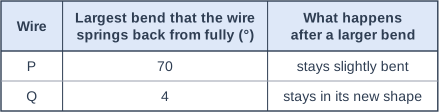
A company tests two types of wire, P and Q. Each wire is bent through different angles and then released.

The table shows the results.

The company wants to use one wire for the frames of children's glasses. It wants to use the other wire for garden wire, which gardeners bend around plant stems to hold the stems in a new position.

Which wire should be used for each product? Explain your answers.

Table with columns "Wire", "Largest bend that the wire springs back from fully (°)", "What happens after a larger bend". Wire: P; Largest bend that the wire springs back from fully (°): 70; What happens after a larger bend: stays slightly bent | Wire: Q; Largest bend that the wire springs back from fully (°): 4; What happens after a larger bend: stays in its new shape.

Model answer

Wire P should be used for the glasses frames. P deforms elastically even when it is bent through angles up to 70°, so if a child bends or sits on the glasses, the frames spring back to their original shape.

Wire Q should be used for the garden wire. Q deforms plastically after a bend of only a few degrees (more than 4°), so the gardener can bend it easily and it stays in the shape it is bent into, holding the stem in its new position.

Explanation

Choose the material by asking whether the product needs to return to its shape (elastic deformation) or keep a new shape (plastic deformation). Glasses frames should recover after being bent, so they need a wire that stays elastic for large bends; garden wire must keep the shape it is bent into, so it needs a wire that deforms plastically easily. Each choice must be backed up with data from the table.

Mark scheme
  1. 1 mark

    P for the frames of the glasses

    Each reason mark depends on the correct choice of wire for that product (marking point 2 depends on marking point 1, and marking point 4 on marking point 3). If both wires are named for one product, do not award that choice (contradictory responses score 0).

  2. 1 mark

    P deforms elastically even after large bends (up to 70°), so the frames return to their original shape if they are bent or sat on

    ALLOW 'P springs back to its original shape' for 'elastically'. The answer must link to the frames (keeping their shape) for this mark.

  3. 1 mark

    Q for the garden wire

    IGNORE extra reasons about cost or strength.

  4. 1 mark

    Q deforms plastically after small bends (more than 4°), so it stays in the shape it is bent into and holds the stem in place

    ALLOW 'Q keeps its new shape / is permanently bent' for 'plastically'. The answer must link to holding the plant stem (keeping the bent shape) for this mark.

Ready to try the rest? Every answer you write is marked against the mark scheme, so you can see exactly where the marks are.

Study Helper Hints first, answers after you try

Stuck on this one? Ask for a hint and I’ll point you in the right direction, without giving the answer away. Once you’ve checked your answer, I’ll show you how the marks are awarded.