
Level:
Correct: 0
Incorrect: 0
Marks: 0/0
Exam Practice
Course:
Topics:
OCR GCSE Physics (Paper 3) Smart practice A mixed round aimed at your weak spots
Unit 1
Matter
Unit 2
Forces
Unit 3
Electricity
Unit 4
Magnetism and magnetic fields
Unit 9
Practical skills
Avg
score:
–
Topics
done:
0/36

Current, potential difference and resistance

Practise 16 exam-style questions on Current, potential difference and resistance for OCR GCSE Physics (Paper 3). Write your answer as you would in the exam and get it marked in seconds against the mark scheme, point by point, with the Study Helper on hand if you get stuck.

  • 16 questions
  • 1–6 marks each
  • Instant marking
  • No sign-up needed
16 questions, marked as you go

Sample questions with model answers

Here are 4 of the questions in this topic, each with a model answer, an explanation of why it earns the marks and the mark scheme an examiner would use.

Question 1

1 mark

A student tests a coil of very thin tungsten wire.

• When the current in the coil is 0.10 A, the potential difference across it is 2.0 V.
• When the current in the coil is 0.20 A, the potential difference across it is 6.0 V.

Which statement about the resistance of the coil is correct?

Choose your answer.

  • A It decreases from 30 Ω to 20 Ω.
  • B It increases from 0.2 Ω to 1.2 Ω.
  • C It increases from 20 Ω to 30 Ω.
  • D It stays the same at 20 Ω.

Model answer

C. At 0.10 A: R = 2.0 ÷ 0.10 = 20 Ω. At 0.20 A: R = 6.0 ÷ 0.20 = 30 Ω. The resistance increases from 20 Ω to 30 Ω.

Explanation

Work out R = V ÷ I separately for each pair of readings. If the resistance were constant, doubling the current would double the p.d. to 4.0 V, but it trebles to 6.0 V, so the resistance has increased: the thin wire gets hotter as the current increases. Multiplying V by I gives power, not resistance.

Mark scheme
  1. 1 mark

    C / it increases from 20 Ω to 30 Ω

    The only correct answer is C: resistance = potential difference ÷ current, which is 2.0 ÷ 0.10 = 20 Ω at 0.10 A and 6.0 ÷ 0.20 = 30 Ω at 0.20 A. A is not correct because the resistance rises as the current rises: 30 Ω is the value at the larger current; B is not correct because 0.2 and 1.2 come from multiplying the current by the p.d. (0.10 × 2.0 and 0.20 × 6.0) instead of dividing; D is not correct because doubling the current more than doubled the p.d., so the resistance is not constant. ALLOW the letter or the option. If more than one option is given, do not award the mark.
Question 2

2 marks

The heating pad in a heated glove has a resistance of 2.4 Ω.

The potential difference across the heating pad is 3.6 V.

Calculate the current in the heating pad.

Use the equation: potential difference = current × resistance

Model answer

current = potential difference ÷ resistance
current = 3.6 ÷ 2.4 = 1.5 A

Explanation

Rearrange V = I × R to I = V ÷ R, then substitute. Check that the answer is sensible: 1.5 A × 2.4 Ω = 3.6 V. The common errors are multiplying the two values (8.64) or dividing the resistance by the p.d. (0.67).

Mark scheme
  1. 1 mark

    rearrangement and substitution: (current =) 3.6 ÷ 2.4; or a correct final answer of 1.5 A with no working

    An answer of 1.5 A with no working scores 2 marks. ALLOW 3.6 = current × 2.4. DO NOT ALLOW 3.6 × 2.4 (= 8.64) or 2.4 ÷ 3.6 (= 0.67): these wrong rearrangements score 0.

  2. 1 mark

    evaluation: 1.5 (A)

    IGNORE units unless the question asks for them.

Question 3

3 marks

A resistor on the control board of a robot vacuum cleaner has a resistance of 330 Ω.

The resistor overheats if the current in it is more than 27 mA.

Calculate the largest potential difference that can be connected across the resistor.

Use the equation: potential difference = current × resistance

Give your answer to 2 significant figures.

Model answer

current = 27 mA = 0.027 A
potential difference = current × resistance = 0.027 × 330 = 8.91 V
= 8.9 V (to 2 significant figures)

Explanation

Change milliamperes to amperes (÷ 1000) before multiplying by the resistance in ohms. Round only at the end: 8.91 V to 2 significant figures is 8.9 V. Leaving the current in mA gives 8910, an answer a thousand times too large.

Mark scheme
  1. 1 mark

    substitution with conversion: (potential difference =) 0.027 × 330; or a correct final answer of 8.9 V (or 8.91 V) with no working

    An answer of 8.9 V with no working scores 3 marks. ALLOW 2 marks for 8.91 V (not given to 2 significant figures). ALLOW 1 mark for 8900 (current not converted from mA to A, but given to 2 significant figures). A wrong rearrangement, for example 330 ÷ 0.027, scores 0.

  2. 1 mark

    8.91 (V); or a correct final answer of 8.9 V with no working

    ALLOW 8.910.

  3. 1 mark

    evaluation: 8.9 (V) (to 2 significant figures)

    ALLOW ECF for the significant-figure mark from a valid calculation.

Question 4

5 marks

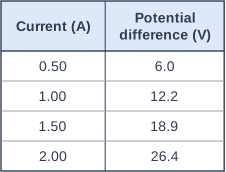
An engineer tests the copper coil of an electromagnet.

For each current, she waits until the temperature of the coil has stopped changing. Then she measures the potential difference across the coil.

The table shows her results.

Her colleague says:

'The resistance of the coil increases by the same amount for each extra 0.50 A of current.'

Use calculations of resistance to evaluate this statement.

Explain why the resistance of the coil increases as the current increases.

Table with columns "Current (A)", "Potential difference (V)". Current (A): 0.50; Potential difference (V): 6.0 | Current (A): 1.00; Potential difference (V): 12.2 | Current (A): 1.50; Potential difference (V): 18.9 | Current (A): 2.00; Potential difference (V): 26.4.

Model answer

Resistance = p.d. ÷ current:
0.50 A: 6.0 ÷ 0.50 = 12.0 Ω
1.00 A: 12.2 ÷ 1.00 = 12.2 Ω
1.50 A: 18.9 ÷ 1.50 = 12.6 Ω
2.00 A: 26.4 ÷ 2.00 = 13.2 Ω
For each extra 0.50 A the resistance increases by 0.2 Ω, then 0.4 Ω, then 0.6 Ω. The increase gets larger each time, so the colleague's statement is not correct.

The current heats the coil, and a larger current makes it hotter. In a hotter metal the ions in the lattice vibrate more, so the electrons that carry the current collide with them more often. It is harder for the electrons to pass through the wire, so the resistance of the coil is larger.

Explanation

Work out R = V ÷ I for every row, then compare the changes from one row to the next: the first and last values alone cannot test a claim about equal steps. Each extra 0.50 A heats the coil more than the step before, so the resistance rises by more each time. Common errors are multiplying V by I (which gives the power, not the resistance) and saying that the electrons, rather than the ions, vibrate more.

Mark scheme
  1. 1 mark

    resistance = potential difference ÷ current (R = V ÷ I) used to find at least two resistances correctly, for example 6.0 ÷ 0.50 = 12 (Ω) and 26.4 ÷ 2.00 = 13.2 (Ω); or at least two correct resistances (for example 12 Ω and 13.2 Ω) with no working

    Correct resistances given with no working score marking points 1 and 2. ALLOW 12.0 Ω. ALLOW V = I × R rearranged. DO NOT ALLOW values found by multiplying the p.d. by the current (for example 6.0 × 0.50 = 3.0).

  2. 1 mark

    all four resistances correct: 12 Ω (at 0.50 A), 12.2 Ω (at 1.00 A), 12.6 Ω (at 1.50 A) and 13.2 Ω (at 2.00 A)

    ALLOW 12.0 Ω and 12.60 Ω.

  3. 1 mark

    the increases are 0.2 Ω, 0.4 Ω and 0.6 Ω / the resistance increases by more for each extra 0.50 A, so the statement is not correct

    The judgement must be supported by resistance values or increases. ALLOW ECF from wrong resistances in marking points 1 and 2 if the judgement follows from them. ALLOW the resistance increases faster / by larger amounts at larger currents, so the colleague is wrong. DO NOT ALLOW 'the statement is wrong because the resistance increases' with no comparison of the increases.

  4. 1 mark

    the current heats the coil / the temperature of the coil increases as the current increases

    ALLOW the coil gets hotter at larger currents. IGNORE 'the potential difference increases'.

  5. 1 mark

    (in the hotter coil) the ions vibrate more, so the electrons collide with them more (often) / it is harder for the electrons to pass through the wire

    ALLOW atoms or particles for ions. DO NOT ALLOW 'the electrons vibrate more', 'there are more electrons so there are more collisions' or 'the electrons collide with each other'.

Ready to try the rest? Every answer you write is marked against the mark scheme, so you can see exactly where the marks are.

Study Helper Hints first, answers after you try

Stuck on this one? Ask for a hint and I’ll point you in the right direction, without giving the answer away. Once you’ve checked your answer, I’ll show you how the marks are awarded.