
Level:
Correct: 0
Incorrect: 0
Marks: 0/0
Exam Practice
Course:
Topics:
OCR GCSE Physics (Paper 3) Smart practice A mixed round aimed at your weak spots
Unit 1
Matter
Unit 2
Forces
Unit 3
Electricity
Unit 4
Magnetism and magnetic fields
Unit 9
Practical skills
Avg
score:
–
Topics
done:
0/36

Measuring motion, speed and vectors

Practise 16 exam-style questions on Measuring motion, speed and vectors for OCR GCSE Physics (Paper 3). Write your answer as you would in the exam and get it marked in seconds against the mark scheme, point by point, with the Study Helper on hand if you get stuck.

  • 16 questions
  • 1–6 marks each
  • Instant marking
  • No sign-up needed
16 questions, marked as you go

Sample questions with model answers

Here are 4 of the questions in this topic, each with a model answer, an explanation of why it earns the marks and the mark scheme an examiner would use.

Question 1

1 mark

Ships measure speed in knots. A speed of 1 knot is equal to 1.852 km/h.

A ferry crosses the Solent at a speed of 20 knots.

What is the speed of the ferry in m/s?

Choose your answer.

  • A 3.0 m/s
  • B 10 m/s
  • C 37 m/s
  • D 133 m/s

Model answer

B (10 m/s)
20 knots = 20 × 1.852 = 37.04 km/h
37.04 km/h = 37 040 m ÷ 3600 s = 10.3 m/s

Explanation

Convert in steps using the ratio given: knots to km/h, then km/h to m/s. To change km/h to m/s, change km to m (× 1000) and hours to seconds (× 3600), which is the same as dividing by 3.6. Common errors are dividing by 1.852 instead of multiplying, and multiplying by 3.6 instead of dividing.

Mark scheme
  1. 1 mark

    B / 10 m/s

    The only correct answer is B: 20 × 1.852 = 37.04 km/h = 37 040 m ÷ 3600 s = 10.3 m/s, which rounds to 10 m/s. A is not correct because it comes from dividing 20 by 1.852 instead of multiplying (10.8 km/h, then ÷ 3.6); C is not correct because 37 is the speed in km/h, not converted to m/s; D is not correct because it comes from multiplying 37.04 km/h by 3.6 instead of dividing by 3.6. ALLOW the letter or the option. If more than one option is given, do not award the mark.
Question 2

2 marks

A student watches an ant walking along the top of a garden wall. The ant walks 45 cm in 1 minute 15 seconds.

Calculate the speed of the ant in m/s.

Use the equation: distance travelled = speed × time

Model answer

distance = 45 cm = 0.45 m
time = 1 min 15 s = 60 + 15 = 75 s
speed = distance ÷ time = 0.45 ÷ 75 = 0.006 m/s (6.0 × 10⁻³ m/s)

Explanation

Convert to SI units before calculating: centimetres to metres (÷ 100) and minutes and seconds to seconds. Then rearrange distance = speed × time to speed = distance ÷ time. Common errors are leaving the distance in cm (giving 0.6) and writing 1 minute 15 seconds as 1.15 minutes or 115 s.

Mark scheme
  1. 1 mark

    conversion and substitution: speed = 0.45 ÷ 75; or a correct final answer of 0.006 m/s with no working

    An answer of 0.006 m/s with no working scores 2 marks. ALLOW 45 cm = 0.45 m and 1 min 15 s = 75 s seen. ALLOW 1 mark for 0.6 (distance left in cm: 45 ÷ 75) or 0.36 (time left in minutes: 0.45 ÷ 1.25).

  2. 1 mark

    evaluation: 0.006 (m/s)

    ALLOW 0.0060, 6 × 10⁻³ or 6.0 × 10⁻³ m/s, and typed forms such as 6E-3 or 6 times 10 to the power -3.

Question 3

3 marks

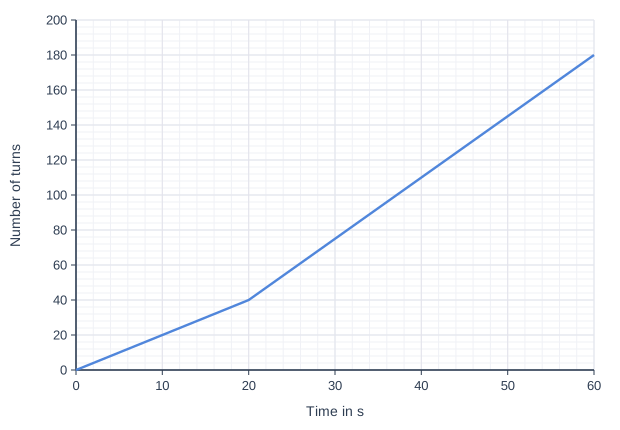
A cycle computer counts the number of turns of a bicycle's front wheel. The graph shows the total number of turns of the wheel against time during part of a ride.

The bicycle moves forward 2.1 m each time the wheel turns once.

Calculate the speed of the bicycle between 20 s and 60 s.

Use the equation: distance travelled = speed × time

Line graph of number of turns (y-axis, 0 to 200) against time in s (x-axis, 0 to 60). The line joins the points (0, 0), (20, 40), (60, 180).

Model answer

From the graph: at 20 s the wheel has turned 40 times; at 60 s it has turned 180 times.
Turns between 20 s and 60 s = 180 − 40 = 140
Distance = 140 × 2.1 = 294 m
Time = 60 − 20 = 40 s
Speed = distance ÷ time = 294 ÷ 40 = 7.35 m/s

Explanation

The gradient of this graph is the number of turns per second, and each turn moves the bicycle 2.1 m, so the speed is the gradient multiplied by 2.1 m. Read both values from the straight section of the line between 20 s and 60 s. A common error is to use the readings from 0 s, which gives the average speed for the whole 60 s instead.

Mark scheme
  1. 1 mark

    number of turns between 20 s and 60 s = 180 − 40 = 140 / gradient = 140 ÷ 40 = 3.5 turns per second; or a correct final answer of 7.35 m/s with no working

    An answer of 7.35 m/s with no working scores 3 marks. ALLOW 7.3 m/s or 7.4 m/s. ALLOW 1 mark for 3.5 (turns per second, not multiplied by 2.1) or for 6.3 m/s (the average speed over the whole 60 s: 180 × 2.1 ÷ 60).

  2. 1 mark

    distance = 140 × 2.1 = 294 m / speed = 3.5 × 2.1; or a correct final answer of 7.35 m/s with no working

    ALLOW ECF from a wrong number of turns.

  3. 1 mark

    evaluation: speed = 294 ÷ 40 = 7.35 (m/s)

    ALLOW 7.3 or 7.4. ALLOW ECF from a wrong distance divided by 40 s.

Question 4

4 marks

A freight train is 450 m long. It travels through a station at a steady speed.

A student stands at one end of the platform. The front of the train passes her, and the back of the train passes her 18 s later.

She also times the front of the train as it travels from her end of the platform to the other end. This takes 6.0 s.

Calculate the speed of the train in km/h, and the length of the platform.

Model answer

While the train passes the student, it travels its own length, 450 m, in 18 s.
Speed = distance ÷ time = 450 ÷ 18 = 25 m/s
In km/h: 25 × 3600 ÷ 1000 = 90 km/h
Length of the platform = speed × time = 25 × 6.0 = 150 m

Explanation

The key step is to see that between the front and the back passing one point, the train travels a distance equal to its own length. A common error is to divide the length of the train by the 6.0 s. To convert m/s to km/h, multiply by 3600 (the seconds in an hour) and divide by 1000 (the metres in a kilometre), which is the same as multiplying by 3.6.

Mark scheme
  1. 1 mark

    speed = distance ÷ time = 450 ÷ 18 = 25 (m/s); or a correct final answer of 90 km/h and 150 m with no working

    Answers of 90 km/h and 150 m with no working score 4 marks. An answer of 90 km/h alone with no working scores marking points 1 and 2; an answer of 150 m alone with no working scores marking points 3 and 4. Max 2 if the speed is worked out as 450 ÷ 6 = 75 m/s (the wrong time). ECF from 75 m/s (270 km/h; 75 × 6.0 = 450 m) can score up to this maximum. The train moves its own length (450 m) while it passes the student. ALLOW the speed worked out directly in km/h, 0.450 km ÷ (18 ÷ 3600) h = 90 km/h, for marking points 1 and 2.

  2. 1 mark

    conversion: 25 × 3600 ÷ 1000 / 25 × 3.6 = 90 (km/h); or a correct final answer of 90 km/h and 150 m with no working

    ALLOW ECF from a wrong speed in m/s. 25 ÷ 3.6 = 6.9 (km/h) does not score this mark.

  3. 1 mark

    length of the platform = speed × time = 25 × 6.0; or a correct final answer of 90 km/h and 150 m with no working

    ALLOW ECF from a wrong speed in m/s. ALLOW 90 × (6.0 ÷ 3600) km. ALLOW proportional reasoning: 450 × (6.0 ÷ 18) / 450 ÷ 3.

  4. 1 mark

    150 (m)

    ALLOW 0.15 km.

Ready to try the rest? Every answer you write is marked against the mark scheme, so you can see exactly where the marks are.

Study Helper Hints first, answers after you try

Stuck on this one? Ask for a hint and I’ll point you in the right direction, without giving the answer away. Once you’ve checked your answer, I’ll show you how the marks are awarded.