Question 1
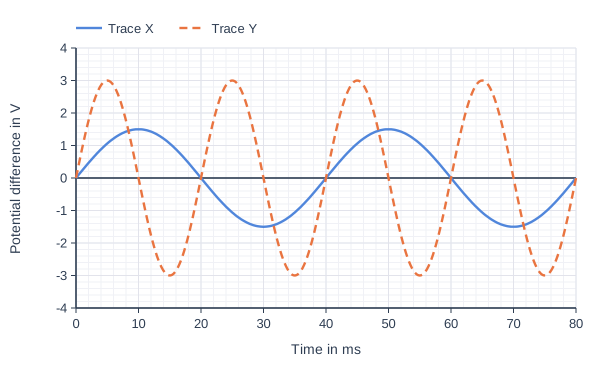
1 markA student turns the coil of a simple alternator at a steady speed. She displays the output potential difference on an oscilloscope. Trace X on the graph shows the output.
She then makes one change to the alternator, and the output becomes trace Y.
Which change did she make?
Choose your answer.
- A She turned the coil at half the speed.
- B She turned the coil at twice the speed.
- C She used a coil with twice as many turns.
- D She used a stronger magnet.
Model answer
B (trace Y has double the peak p.d. and double the frequency of trace X; only turning the coil faster changes both)
Explanation
Compare two features of the traces: the peak p.d. (3 V for Y, 1.5 V for X) and the time for one cycle (20 ms for Y, 40 ms for X). A stronger magnet or more turns on the coil changes only the peak p.d., but the speed of the coil changes both, because a faster coil makes the field through it change faster and completes more cycles each second. A common error is to notice only that trace Y is taller and choose C or D.
Mark scheme
-
1 mark
B / she turned the coil at twice the speed
The only correct answer is B: trace Y has twice the peak p.d. of trace X (3 V instead of 1.5 V) and repeats in half the time (every 20 ms instead of every 40 ms), so its frequency is twice as high (50 Hz instead of 25 Hz). Turning the coil faster makes the magnetic field through the coil change faster, which induces a larger p.d., and the p.d. goes through one cycle for each turn of the coil, so twice as many turns each second doubles the frequency. A is not correct because half the speed would halve both the peak p.d. and the frequency; C and D are not correct because more turns or a stronger magnet would increase the peak p.d. but would not change the time for one cycle, which depends only on how fast the coil turns. ALLOW the letter or the option. If more than one option is given, do not award the mark.