
Level:
Correct: 0
Incorrect: 0
Marks: 0/0
Exam Practice
Course:
Topics:
Edexcel GCSE Business (Paper 1) Smart practice A mixed round aimed at your weak spots
Unit 1
Enterprise and entrepreneurship
The dynamic nature of business
Risk and reward
Risk and reward
Unit 2
Spotting a business opportunity
Unit 3
Putting a business idea into practice
Unit 4
Making the business effective
The options for start-up and small businesses
Limited liability and types of business ownership
Franchising
Business location
Business location
The marketing mix
The marketing mix
Business plans
Business plans
Unit 5
Understanding external influences on business
Business stakeholders
Technology and business
Legislation and business
The economy and business
Avg
score:
–
Topics
done:
0/24

The role of business enterprise and entrepreneurship

Practise 19 exam-style questions on The role of business enterprise and entrepreneurship for Edexcel GCSE Business (Paper 1). Write your answer as you would in the exam and get it marked in seconds against the mark scheme, point by point, with the Study Helper on hand if you get stuck.

  • 19 questions
  • 1–12 marks each
  • Instant marking
  • No sign-up needed
19 questions, marked as you go

Sample questions with model answers

Here are 4 of the questions in this topic, each with a model answer, an explanation of why it earns the marks and the mark scheme an examiner would use.

Question 1

1 mark

Which one of the following is a purpose of business activity?

Choose your answer.

  • A To buy shares in other businesses
  • B To meet customer needs
  • C To pay the highest possible wages
  • D To spend as much as possible on advertising

Model answer

B - To meet customer needs

Explanation

The specification gives three purposes of business activity: to produce goods or services, to meet customer needs and to add value. Paying wages and advertising are things businesses do along the way, not the reasons business activity exists. Buying shares in other businesses is a way of investing or growing, not a purpose.

Mark scheme
  1. 1 mark

    B - To meet customer needs

    The only correct answer is B. A is not correct because buying shares in other businesses is a way some firms invest or grow, not the purpose of business activity. C is not correct because businesses pay wages to employ staff, but paying the highest possible wages is not why business activity takes place. D is not correct because advertising is one way of promoting products, and spending as much as possible on it is not a purpose of business. Accept the letter or the words of the option. If more than one option is given, award 0.
Question 2

2 marks

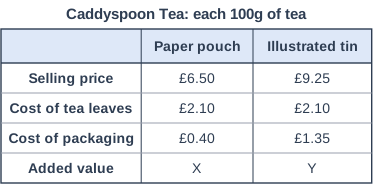
Lin runs Caddyspoon Tea, a small business in Bath that blends loose-leaf tea and sells it online. At present she sells 100g of each blend in a plain paper pouch. She plans to sell the same blends in a metal tin with an illustrated label designed by a local artist, at a higher price.

The table shows information about each 100g of tea in the two types of packaging.

Work out the values of X and Y in the table.

Caddyspoon Tea: each 100g of tea. Table with columns (row headings), "Paper pouch", "Illustrated tin". Selling price; Paper pouch: £6.50; Illustrated tin: £9.25 | Cost of tea leaves; Paper pouch: £2.10; Illustrated tin: £2.10 | Cost of packaging; Paper pouch: £0.40; Illustrated tin: £1.35 | Added value; Paper pouch: X; Illustrated tin: Y.

Model answer

X = £6.50 - (£2.10 + £0.40) = £4.00
Y = £9.25 - (£2.10 + £1.35) = £5.80

Explanation

Added value is the selling price minus the cost of the bought-in materials, here the tea leaves and the packaging. The tin costs 95p more than the pouch but lets Lin charge £2.75 more, so the added value of each 100g rises by £1.80. A common error is to leave out the packaging cost.

Mark scheme
  1. 1 mark

    X = £4.00

    Answers of £4.00 for X and £5.80 for Y with no working score 2 marks. 1 mark for each correct value. Accept £4, 4 or 4.00 for X. Do not accept £2.50 for X (the total bought-in cost of the tea and the pouch) or £4.40 (the packaging not taken off).

  2. 1 mark

    Y = £5.80

    Accept £5.8, 5.8 or 5.80. Do not accept £3.45 (the total bought-in cost of the tea and the tin), £7.15 (the packaging not taken off) or £1.80 (the increase in added value, not the added value of the tin).

Question 3

3 marks

Explain one way a small business could use design to add value to its products.

Model answer

The business could give its product a more attractive and distinctive design. This makes customers see it as better than rivals' plainer products. Therefore they are willing to pay a higher price, which is more than the small extra cost of the design, so the value added to each product increases.

Explanation

The explanation must show how design adds value: customers see the product as better, so they pay a price that is higher than the extra cost of the design. Ending with 'so the business gets more customers' does not show added value. The third mark usually comes from the link between a higher price and costs.

Mark scheme
  1. 1 mark

    Award 1 mark for identification of a way a small business could use design to add value to its products.

    Answers that list more than one way with no explanation will be awarded a maximum of 1 mark. Accept any other appropriate response. Valid ways include: making the product look more attractive or stylish; making it work better or easier to use, such as lighter, folding or longer-lasting; giving it a distinctive design that rivals do not have; designing more attractive packaging. Added value is a financial idea: a strand that reaches the money side (customers willing to pay a higher price than the extra cost of the design, so the gap between the price and the cost of materials widens) is needed for 3 marks: max 2 if no strand reaches the money side. This is a 'way' question: strands that say only why a business adds value, such as 'more customers', 'more sales' or 'more profit', are not credited.

  2. 2 marks

    Award up to 2 further marks for explaining this way (1 mark for each linked strand of development).

    Examples: The business could give its product a more attractive and distinctive design (1). This makes customers see it as better than rivals' plainer products (1). Therefore they are willing to pay a higher price, which is more than the small extra cost of the design, so the value added to each product increases (1). / The business could design the product to be easier to use, for example by making it lighter or able to fold away (1). This solves a problem that customers have with rival products (1). As a result, customers will pay a higher price for it while the cost of the materials stays much the same, so the gap between the price and the costs grows (1). A restatement of the way, a definition of added value or an example on its own is not a strand.

Question 4

6 marks

Bethan runs Tussock Alpaca Walks on her family's farm in the Peak District. Visitors lead an alpaca on a 90-minute walk across the hills with a guide, then feed the herd and take photographs. A walk costs £45 per person, and Bethan believes no other farm within 30 miles offers anything similar. Many free walking routes in the area are also popular with visitors.

Most customers book online as a birthday treat or a gift, and many post their photos on social media. Bethan's costs for each walk are low, mainly the guide's wages and the animals' food, because the family already owned the land.

Analyse the benefit to Tussock Alpaca Walks of its unique selling point.

Model answer

Leading an animal on a 90-minute walk and then feeding the herd is an experience that Bethan believes no other farm within 30 miles offers, so it stands out from the many free walking routes in the area. Because visitors cannot get this experience anywhere nearby, Bethan can charge £45 per person even though they could walk the hills for free. Her costs for each walk are low, mainly the guide's wages and the animals' food, because the family already owned the land. Therefore the price is far above the cost of providing each walk, so every booking adds a lot of value and earns a high profit.

The USP also helps the business to promote itself cheaply. Most customers book the walks as a birthday treat or a gift, and many post their photos on social media. This means their friends see an unusual experience they would like to try, so the photos act as free promotion. As a result, Bethan can attract more bookings, including gift bookings, without spending much on advertising, which keeps her costs low as the business grows.

Explanation

A top answer explains, in linked steps, how the USP lets Bethan charge £45 when her costs per walk are low, and how the unusual experience spreads through customers' photos. Context such as the free walking routes, the gift bookings and the low costs must appear throughout. An answer that would fit any business with a USP cannot score more than 3 marks.

Mark scheme
  1. 6 marks

    Levels of response (6 marks).
    Level 3 (5-6 marks): Detailed application of knowledge and understanding of business concepts and issues to the business context throughout (AO2). Deconstructs business information and/or issues, finding detailed interconnected points with logical chains of reasoning (AO3a).
    Level 2 (3-4 marks): Sound application of knowledge and understanding of business concepts and issues to the business context although there may be some inconsistencies (AO2). Deconstructs business information and/or issues, finding interconnected points with chains of reasoning, although there may be some logical inconsistencies (AO3a).
    Level 1 (1-2 marks): Limited application of knowledge and understanding of business concepts and issues to the business context (AO2). Attempts to deconstruct business information and/or issues, finding limited connections between points (AO3a).
    0 marks: No rewardable material.

    Indicative content (not a checklist; credit other valid points):
    - Leading an animal on a 90-minute walk and feeding the herd is an experience that Bethan believes no other farm within 30 miles offers, so it stands out from the free walking routes in the area (AO2).
    - Customers book it as a birthday treat or a gift, and many post their photos on social media (AO2).
    - Because the experience is unique, Bethan can charge £45 per person even though visitors could walk the hills for free. Her costs per walk are low (the guide's wages and the animals' food, with the land already owned), so the price is far above the cost of each walk. Therefore each booking adds a lot of value and earns a high profit (AO3a).
    - Customers' photos on social media act as free promotion for an unusual experience. As a result, more people hear about the walks and book them as gifts, so Bethan can fill more walks without spending much on advertising (AO3a).
    - With no similar business nearby, customers cannot easily switch to a rival, so Bethan is less likely to have to cut her price (AO3a).
    Marking notes: only the best two points are credited; Level 3 for AO3a needs about five linked strands from one or two points. The word 'alpaca' is in the business name, so it does not count as application on its own; context such as the £45 price, the 90-minute walk, feeding the herd, gifts and birthdays, social media photos, the free walking routes, the 30 miles, the low costs or the Peak District does. Copying the case is not application. A generic answer about USPs with no application cannot score more than 3 marks. Evaluation is not required and is not credited.

Ready to try the rest? Every answer you write is marked against the mark scheme, so you can see exactly where the marks are.

Study Helper Hints first, answers after you try

Stuck on this one? Ask for a hint and I’ll point you in the right direction, without giving the answer away. Once you’ve checked your answer, I’ll show you how the marks are awarded.