
Level:
Correct: 0
Incorrect: 0
Marks: 0/0
Exam Practice
Course:
Topics:
Edexcel GCSE Business (Paper 1) Smart practice A mixed round aimed at your weak spots
Unit 1
Enterprise and entrepreneurship
The dynamic nature of business
Risk and reward
Risk and reward
Unit 2
Spotting a business opportunity
Unit 3
Putting a business idea into practice
Unit 4
Making the business effective
The options for start-up and small businesses
Limited liability and types of business ownership
Franchising
Business location
Business location
The marketing mix
The marketing mix
Business plans
Business plans
Unit 5
Understanding external influences on business
Business stakeholders
Technology and business
Legislation and business
The economy and business
Avg
score:
–
Topics
done:
0/24

Cash-flow forecasts

Practise 21 exam-style questions on Cash-flow forecasts for Edexcel GCSE Business (Paper 1). Write your answer as you would in the exam and get it marked in seconds against the mark scheme, point by point, with the Study Helper on hand if you get stuck.

  • 21 questions
  • 1–12 marks each
  • Instant marking
  • No sign-up needed
20 questions, marked as you go

Sample questions with model answers

Here are 4 of the questions in this topic, each with a model answer, an explanation of why it earns the marks and the mark scheme an examiner would use.

Question 1

1 mark

Yealm & Ligger Thatching is a partnership in Dorchester that re-thatches and repairs thatched roofs. Customers pay when each job is finished. The table sets out the partners' forecast of cash coming in and going out from July to December. They expect to have £1,200 in the bank at the start of July.

Using the information in the table, identify the first month in which Yealm & Ligger Thatching will need to use an overdraft.
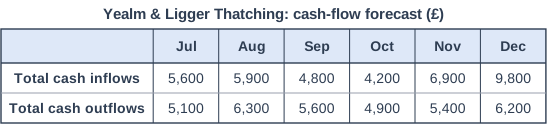
Yealm & Ligger Thatching: cash-flow forecast (£). Table with columns (row headings), "Jul", "Aug", "Sep", "Oct", "Nov", "Dec". Total cash inflows; Jul: 5,600; Aug: 5,900; Sep: 4,800; Oct: 4,200; Nov: 6,900; Dec: 9,800 | Total cash outflows; Jul: 5,100; Aug: 6,300; Sep: 5,600; Oct: 4,900; Nov: 5,400; Dec: 6,200.

Model answer

October

Explanation

A business needs an overdraft when its closing balance falls below zero, not simply when its net cash flow is negative. Working forward from the £1,200 opening balance, the balance falls to £500 at the end of September and to (£200) at the end of October. August and September have negative net cash flows, but the earlier cash in the bank covers them.

Mark scheme
  1. 1 mark

    October

    Closing balances: July £1,700, August £1,300, September £500, October (£200), November £1,300, December £4,900, so October is the first month with a negative closing balance. Accept 'Oct'. Do not accept August (the first month with a negative net cash flow, but the closing balance is still £1,300) or September (the largest negative net cash flow, (£800), but the closing balance is still £500). Only one answer may be given; if more than one month is given, award 0.
Question 2

2 marks

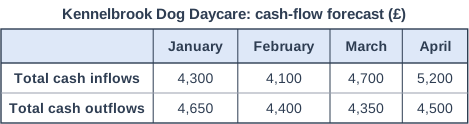
Kirsty runs Kennelbrook Dog Daycare, a sole trader business in Bath that looks after dogs while their owners are at work. Owners pay at the end of each week. Kirsty's forecast of total cash inflows and outflows for January to April is given in the table, and she expects to start January with £850 in the bank.

Kirsty also plans to pay £1,800 in March for new fencing around the dogs' play area. This payment is not yet in her figures.

Calculate Kennelbrook Dog Daycare's bank balance at the end of April, according to the forecast, once the fencing is paid for. You are advised to show your workings.

Kennelbrook Dog Daycare: cash-flow forecast (£). Table with columns (row headings), "January", "February", "March", "April". Total cash inflows; January: 4,300; February: 4,100; March: 4,700; April: 5,200 | Total cash outflows; January: 4,650; February: 4,400; March: 4,350; April: 4,500.

Model answer

Net cash flows: January (£350), February (£300), March £350, April £700
Closing balance for April before the fencing = £850 - £350 - £300 + £350 + £700 = £1,250
Including the fencing: £1,250 - £1,800 = (£550)

Explanation

Each month's net cash flow is added to the opening balance to give the closing balance, which then becomes the next month's opening balance. The fencing is an extra cash outflow in March, so it lowers every closing balance from March onwards, and April ends at (£550) instead of £1,250. This shows how a single large payment can turn a positive forecast negative.

Mark scheme
  1. 1 mark

    Fully correct working, e.g. £850 + (£18,300 - £17,900) - £1,800; or a correct final answer of (£550) with no working

    An answer of (£550) with no working scores 2 marks. If the final answer is wrong, award this mark only for fully correct working (e.g. closing balances £500, £200, then March (£1,250) once the fencing is included, then April (£550); or net cash flows (£350), (£300), £350, £700 added to £850 and the £1,800 taken away); a formula alone or partly correct working scores 0. If several different final answers are given, award 0.

  2. 1 mark

    (£550) / -£550

    Accept (550), -550, minus £550, or £550 described as overdrawn or negative. Do not accept £1,250 (the fencing left out), (£1,400) (the opening balance left out), £550 with nothing to show it is negative, or £3,050 (the fencing added instead of taken away).

Question 3

2 marks

Ivydesk Office Plants is a small business in Peterborough owned by Gemma. It supplies and looks after the plants in the offices of 30 business clients, visiting each office every two weeks to water, feed and replace plants. Each client receives a bill on the last day of the month and pays it 60 days later. Ivydesk's suppliers of plants and compost give it 30 days to pay.

Gemma's cash-flow forecast shows a closing balance of (£2,600) for March. This is mainly because she plans to pay £4,000 in March for 50 large floor-standing planters.

Outline one action Ivydesk Office Plants could take to improve its forecast closing balance for March.

Model answer

Gemma could delay buying the £4,000 floor-standing planters until later in the year. This would move the payment out of March, so the forecast closing balance would rise from (£2,600) to about £1,400.

Explanation

An action improves the closing balance only if it brings more cash in during March or sends less cash out. Delaying the planters, getting clients to pay sooner or getting longer credit from suppliers all do this. An overdraft lets the balance go below zero, but it does not improve the balance itself.

Mark scheme
  1. 2 marks

    Award up to 2 marks for linked points outlining one action Ivydesk Office Plants could take to improve its forecast closing balance for March. Award a maximum of 1 mark if points are not linked.

    Max 1 if the answer has no application to the case (a valid point with no application scores 1 mark). 1 mark for a valid action and 1 further mark for a linked development showing how it improves the March balance. To award 2 marks there must be linked development and evidence of application (use of the case, e.g. the 30 business clients, monthly bills, 60 days, plants and compost, 30 days' credit, the £4,000 floor-standing planters, Gemma, the (£2,600) balance). The name of the business (including 'office plants' on its own) and the words 'closing balance' and 'March' do not count as application. Award any other valid answer. Examples: Gemma could delay buying the £4,000 planters until later in the year (1), so the cash outflow moves out of March and the closing balance becomes positive, about £1,400 (1). / Gemma could ask her 30 clients to pay within 30 days instead of 60 days (1), so cash for the plant care done in January arrives in March instead of April, adding to March's cash inflows (1). / Gemma could ask the suppliers of plants and compost for 60 days' credit (1), so payments for plants and compost bought in February move out of March, reducing that month's outflows (1). Do not accept 'arrange an overdraft', which allows a negative balance but does not improve it, or actions with no link to cash (e.g. 'increase profit').

Question 4

6 marks

Heatherbank Glamping is a partnership near Alnwick in Northumberland, run by Isobel and Tariq. It rents out six shepherd's huts to holidaymakers, and most of its bookings are between April and October. The partners repay £900 a month on the bank loan they used to buy the huts. Their bank has agreed an overdraft of up to £1,000.

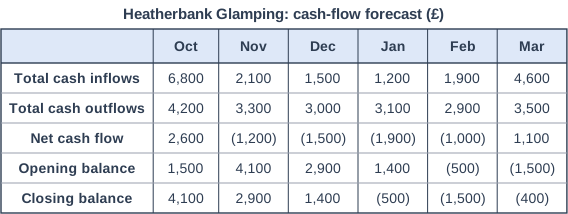
The partners' forecast of cash inflows and outflows for October to March is set out in the table, where bracketed figures are negative. Isobel and Tariq had planned to spend £2,500 in February repainting the huts and replacing the mattresses before the summer season. This spending is not included in the forecast.

Analyse the impact on Heatherbank Glamping of the negative closing balances in its forecast for January to March.

Heatherbank Glamping: cash-flow forecast (£). Table with columns (row headings), "Oct", "Nov", "Dec", "Jan", "Feb", "Mar". Total cash inflows; Oct: 6,800; Nov: 2,100; Dec: 1,500; Jan: 1,200; Feb: 1,900; Mar: 4,600 | Total cash outflows; Oct: 4,200; Nov: 3,300; Dec: 3,000; Jan: 3,100; Feb: 2,900; Mar: 3,500 | Net cash flow; Oct: 2,600; Nov: (1,200); Dec: (1,500); Jan: (1,900); Feb: (1,000); Mar: 1,100 | Opening balance; Oct: 1,500; Nov: 4,100; Dec: 2,900; Jan: 1,400; Feb: (500); Mar: (1,500) | Closing balance; Oct: 4,100; Nov: 2,900; Dec: 1,400; Jan: (500); Feb: (1,500); Mar: (400).

Model answer

The forecast shows that the business will be overdrawn from January to March, reaching (£1,500) in February. This is because winter bookings bring in only £1,200 to £1,900 a month, while outflows, including the £900 loan repayment for the huts, are around £3,000. Therefore Isobel and Tariq will have to use their overdraft, and they will pay interest on it, which adds to their costs and reduces the profit from the huts. February's balance is also beyond the £1,000 overdraft limit, so the bank may charge them extra fees or refuse to make payments such as the loan repayment.

The cash shortage also means the partners may not be able to pay for the £2,500 repainting and new mattresses in February. If they delay this work, the shepherd's huts may be in poorer condition when the summer season starts. As a result, holidaymakers may leave worse reviews, so fewer people may book between April and October, which would reduce cash inflows in the busy months the business relies on.

Explanation

A strong answer reads the table accurately (the overdrawn months and the (£1,500) low point compared with the £1,000 limit) and links it through several steps to costs, profit or future bookings. Context such as the shepherd's huts, the £900 loan repayment and the repainting should appear in both paragraphs. A generic answer about overdrafts cannot score more than 3 marks.

Mark scheme
  1. 6 marks

    Levels of response (6 marks).
    Level 3 (5-6 marks): Detailed application of knowledge and understanding of business concepts and issues to the business context throughout (AO2). Deconstructs business information and/or issues, finding detailed interconnected points with logical chains of reasoning (AO3a).
    Level 2 (3-4 marks): Sound application of knowledge and understanding of business concepts and issues to the business context although there may be some inconsistencies (AO2). Deconstructs business information and/or issues, finding interconnected points with chains of reasoning, although there may be some logical inconsistencies (AO3a).
    Level 1 (1-2 marks): Limited application of knowledge and understanding of business concepts and issues to the business context (AO2). Attempts to deconstruct business information and/or issues, finding limited connections between points (AO3a).
    0 marks: No rewardable material.

    Indicative content (not a checklist; credit other valid points):
    - The forecast shows closing balances of (£500) in January, (£1,500) in February and (£400) in March, because winter inflows of £1,200 to £1,900 a month do not cover outflows of about £3,000, which include the £900 monthly loan repayment (AO2).
    - February's (£1,500) is beyond the £1,000 overdraft limit, even before the £2,500 repainting and new mattresses are paid for (AO2).
    - The partners must use their overdraft from January to March. Therefore they will pay interest on it, which adds to costs and reduces the profit made from the huts; if they go beyond the £1,000 limit the bank may charge more or refuse payments, such as the loan repayment (AO3a).
    - Isobel and Tariq may have to delay the £2,500 repainting and mattresses to save cash. As a result, the huts may be in poorer condition when the summer season starts, so reviews and bookings could fall, reducing cash inflows from April onwards; alternatively they could offer early-booking discounts or ask for deposits for summer stays to bring cash in sooner, which lowers the revenue from each booking (AO3a).
    Marking notes: only the best two points are credited; Level 3 for AO3a needs about five linked strands from one or two points. Context only counts inside a valid point, and copying the case or the table or using the business name or words from the question is not application. A generic answer with no application to Heatherbank Glamping cannot score more than 3 marks. Evaluation is not required and is not credited.

Ready to try the rest? Every answer you write is marked against the mark scheme, so you can see exactly where the marks are.

Study Helper Hints first, answers after you try

Stuck on this one? Ask for a hint and I’ll point you in the right direction, without giving the answer away. Once you’ve checked your answer, I’ll show you how the marks are awarded.