
Level:
Correct: 0
Incorrect: 0
Marks: 0/0
Exam Practice
Course:
Topics:
Edexcel GCSE Business (Paper 1) Smart practice A mixed round aimed at your weak spots
Unit 1
Enterprise and entrepreneurship
The dynamic nature of business
Risk and reward
Risk and reward
Unit 2
Spotting a business opportunity
Unit 3
Putting a business idea into practice
Unit 4
Making the business effective
The options for start-up and small businesses
Limited liability and types of business ownership
Franchising
Business location
Business location
The marketing mix
The marketing mix
Business plans
Business plans
Unit 5
Understanding external influences on business
Business stakeholders
Technology and business
Legislation and business
The economy and business
Avg
score:
–
Topics
done:
0/24

Market segmentation and market mapping

Practise 18 exam-style questions on Market segmentation and market mapping for Edexcel GCSE Business (Paper 1). Write your answer as you would in the exam and get it marked in seconds against the mark scheme, point by point, with the Study Helper on hand if you get stuck.

  • 18 questions
  • 1–12 marks each
  • Instant marking
  • No sign-up needed
18 questions, marked as you go

Sample questions with model answers

Here are 4 of the questions in this topic, each with a model answer, an explanation of why it earns the marks and the mark scheme an examiner would use.

Question 1

1 mark

Mags runs Slipstone Clay Studio, a pottery studio in Stoke-on-Trent. She runs weekday morning classes for retired people and a cheaper Thursday evening club for people on low incomes, who are referred to her by local charities. On Saturdays she runs workshops for people who want a relaxing, creative hobby away from their phones and screens, and on Sunday mornings she runs family sessions for parents with young children. Most of her customers live within 15 minutes' drive of the studio, so she advertises in local community groups online.

State one way, other than by age, that Slipstone Clay Studio segments its market.

Model answer

By income: the cheaper Thursday evening club is aimed at people on low incomes.

Explanation

A 'State' question needs the answer to be applied to the case, so 'income' on its own scores 0 but linking it to the cheaper Thursday club scores 1 mark. Age is excluded because the weekday classes for retired people are segmented by age. No development is needed.

Mark scheme
  1. 1 mark

    Award 1 mark for stating one way, other than by age, that Slipstone Clay Studio segments its market.

    To award 1 mark there must be evidence of application. Examples that score: by income, such as the cheaper Thursday evening club for people on low incomes (1); by lifestyle, such as the Saturday workshops for people who want a relaxing, creative hobby away from screens (1); by location, such as targeting people who live within 15 minutes' drive of the studio or in Stoke-on-Trent (1); by demographics, such as family type: the Sunday sessions for parents with young children (1). 'Demographics' linked to the low-income club also scores, because income is a demographic feature (1). Do not accept a type of segmentation with no link to the case, such as 'income', 'lifestyle' or 'location' on its own (0). Do not accept age, the classes for retired people or the age of the children at the Sunday sessions, which are age segmentation and are excluded by the question. The name of the business does not count as application.
Question 2

2 marks

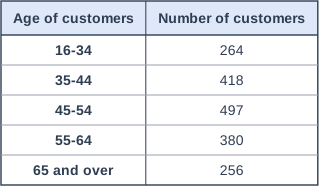
Eilidh runs Skeinhouse Knitwear, a sole trader business in Lerwick that sells hand-knitted wool jumpers through its website. She is deciding whether to aim her next advertising campaign at older customers. The table shows the number of customers Skeinhouse Knitwear had last year in each age group.

Using the information in the table, calculate, to 2 decimal places, the percentage of Skeinhouse Knitwear's customers last year who were aged 55 and over. You are advised to show your workings.

Table with columns "Age of customers", "Number of customers". Age of customers: 16-34; Number of customers: 264 | Age of customers: 35-44; Number of customers: 418 | Age of customers: 45-54; Number of customers: 497 | Age of customers: 55-64; Number of customers: 380 | Age of customers: 65 and over; Number of customers: 256.

Model answer

Customers aged 55 and over = 380 + 256 = 636
Total customers = 264 + 418 + 497 + 380 + 256 = 1,815
636 ÷ 1,815 × 100 = 35.04%

Explanation

Add the two age groups that are 55 and over, divide by the total number of customers (found by adding all five groups) and multiply by 100. A common error is to include the 45-54 group, which gives 62.42%. The answer must be given to 2 decimal places, so 35.0% scores only 1 mark.

Mark scheme
  1. 1 mark

    Fully correct working, e.g. (380 + 256) ÷ (264 + 418 + 497 + 380 + 256) × 100 / 636 ÷ 1,815 × 100; or a correct final answer of 35.04% with no working

    An answer of 35.04% with no working scores 2 marks. A correct answer that is not given to 2 decimal places (35.0% or 35%) scores 1 mark, with or without working. If the final answer is wrong, award this mark only for fully correct working; a formula alone or partly correct working scores 0. If several different final answers are given, award 0.

  2. 1 mark

    35.04%

    Accept 35.04 without the % sign. Common wrong answers that score 0 for this mark: 62.42% (the 45-54 group included); 14.10% (only the 65 and over group); 20.93% or 20.94% (only the 55-64 group); 0.35 (not multiplied by 100).

Question 3

3 marks

Explain one benefit to a small business of targeting a market segment based on lifestyle.

Model answer

A small business that targets a lifestyle segment can design products around that group's interests, such as gluten-free cakes for people who follow a gluten-free diet. These customers may find it hard to buy products that meet their needs elsewhere. Therefore they may be willing to pay a higher price, which increases the profit the business makes on each sale.

Explanation

One mark is for the benefit and two more are for two linked strands that explain its effect on the business, joined with words such as 'therefore' or 'as a result'. Listing several benefits earns only 1 mark, and a definition of segmentation earns nothing. The benefit must come from targeting a lifestyle group, not from segmentation in general.

Mark scheme
  1. 1 mark

    Award 1 mark for identification of a benefit to a small business of targeting a market segment based on lifestyle.

    Answers that list more than one benefit with no explanation will be awarded a maximum of 1 mark. Accept any other appropriate response. Valid benefits include: products can be designed around the interests or habits of that group (such as a vegan diet or a hobby); promotion can be placed where that group already gathers or looks for information; customers with a strong interest may pay a premium price for specialist products; customers who share a lifestyle may be loyal and recommend the business to each other. Do not accept a benefit with no link to lifestyle, such as 'it gets more customers' on its own.

  2. 2 marks

    Award up to 2 further marks for explaining this benefit (1 mark for each linked strand of development).

    Examples: The business can design products around the interests of that group, such as gluten-free cakes for people who follow a gluten-free diet (1). These customers may find it hard to buy products that meet their needs elsewhere (1). Therefore they may be willing to pay a higher price, increasing the profit made on each sale (1). / The business can promote its products where that group already gathers, such as running clubs or vegan social media pages (1). This means its adverts reach people who are very likely to buy (1). As a result, less of its promotion budget is wasted on people with no interest in the product (1). A restatement of the benefit, a definition of market segmentation or an example on its own is not a strand. Vague endings such as 'the business will be more successful' are not credited.

Question 4

6 marks

Aisha is planning to open Cragloft Climbing, a bouldering centre in Derby. Bouldering is climbing on low walls without ropes, so customers need very little equipment.

Before signing the lease on a unit, Aisha drew a market map of four climbing centres within 30 minutes' drive that she sees as her competitors, using price and how suitable each centre is for beginners. The map showed that all four centres charge between £14 and £18 a visit and are aimed mainly at experienced climbers, with tall walls that need ropes. None of them offers low-cost sessions for beginners.

Aisha plans to charge £9 a visit, run free taster sessions for first-time climbers and target students at the local university and families with teenage children.

Analyse the benefit to Cragloft Climbing of drawing a market map before opening.

Model answer

The market map showed Aisha a gap in the market, because none of the four centres within 30 minutes' drive offers low-cost sessions for beginners. Therefore Cragloft can be the only centre charging £9 a visit for first-time climbers, so students and families with teenagers have no close alternative. This means Cragloft is likely to attract customers without having to compete on price, so its sales should build quickly after opening. As a result, Aisha is less likely to struggle to pay the rent on a unit she has committed to with a lease.

The map also showed Aisha exactly who her competitors are: centres charging £14 to £18 that are aimed at experienced climbers with tall roped walls. Because she knows this, she can make Cragloft different, with low bouldering walls and free taster sessions. This means she can aim her promotion at university students and families rather than at experienced climbers, so her small marketing budget is spent on people who are most likely to visit.

Explanation

A top answer develops one or two benefits, such as finding the gap for low-cost beginners' sessions and knowing the competitors, through about five linked strands. Context such as the £9 price, the four centres at £14 to £18, the lease and the students and families must be used in every paragraph. Drawbacks of market maps are not credited because 'Analyse' does not test evaluation.

Mark scheme
  1. 6 marks

    Levels of response (6 marks).
    Level 3 (5-6 marks): Detailed application of knowledge and understanding of business concepts and issues to the business context throughout (AO2). Deconstructs business information and/or issues, finding detailed interconnected points with logical chains of reasoning (AO3a).
    Level 2 (3-4 marks): Sound application of knowledge and understanding of business concepts and issues to the business context although there may be some inconsistencies (AO2). Deconstructs business information and/or issues, finding interconnected points with chains of reasoning, although there may be some logical inconsistencies (AO3a).
    Level 1 (1-2 marks): Limited application of knowledge and understanding of business concepts and issues to the business context (AO2). Attempts to deconstruct business information and/or issues, finding limited connections between points (AO3a).
    0 marks: No rewardable material.

    Indicative content (not a checklist; credit other valid points):
    - The map showed a gap in the market: none of the four centres within 30 minutes' drive offers low-cost sessions for beginners, so Aisha can position Cragloft at £9 a visit for first-time climbers (AO2).
    - The map showed where the four competitors are positioned (£14 to £18 a visit, aimed at experienced climbers with roped walls), so Aisha knows which businesses she is competing with (AO2).
    - Because Cragloft will be the only low-price centre for beginners, students and families with teenagers have no close alternative. Therefore it is likely to attract customers without a price war, so sales should build quickly. As a result, Aisha has less risk of failing after committing to the lease (AO3a).
    - Knowing the competitors' prices and target market lets Aisha make Cragloft different, for example with free taster sessions and low walls with no ropes. This means she can aim her promotion at the university students and families rather than experienced climbers, so her marketing budget is not wasted competing head-on with established centres (AO3a).
    Marking notes: only the best two points are credited; Level 3 for AO3a needs about five linked strands from one or two points. Context only counts inside a valid point, and copying the case or using the business name or words from the question is not application. A generic answer with no application to Cragloft Climbing cannot score more than 3 marks. Evaluation, such as the limitations of market maps, is not required and is not credited.

Ready to try the rest? Every answer you write is marked against the mark scheme, so you can see exactly where the marks are.

Study Helper Hints first, answers after you try

Stuck on this one? Ask for a hint and I’ll point you in the right direction, without giving the answer away. Once you’ve checked your answer, I’ll show you how the marks are awarded.