
Level:
Correct: 0
Incorrect: 0
Marks: 0/0
Exam Practice
Course:
Topics:
Edexcel GCSE Business (Paper 1) Smart practice A mixed round aimed at your weak spots
Unit 1
Enterprise and entrepreneurship
The dynamic nature of business
Risk and reward
Risk and reward
Unit 2
Spotting a business opportunity
Unit 3
Putting a business idea into practice
Unit 4
Making the business effective
The options for start-up and small businesses
Limited liability and types of business ownership
Franchising
Business location
Business location
The marketing mix
The marketing mix
Business plans
Business plans
Unit 5
Understanding external influences on business
Business stakeholders
Technology and business
Legislation and business
The economy and business
Avg
score:
–
Topics
done:
0/24

Break even and margin of safety

Practise 23 exam-style questions on Break even and margin of safety for Edexcel GCSE Business (Paper 1). Write your answer as you would in the exam and get it marked in seconds against the mark scheme, point by point, with the Study Helper on hand if you get stuck.

  • 23 questions
  • 1–12 marks each
  • Instant marking
  • No sign-up needed
20 questions, marked as you go

Sample questions with model answers

Here are 4 of the questions in this topic, each with a model answer, an explanation of why it earns the marks and the mark scheme an examiner would use.

Question 1

1 mark

Clackhaus is a small business in Reading that sells kits for building mechanical computer keyboards. It sells three kits, and each kit has its own fixed costs, such as the moulds for its case and its own advertising. The table shows information about each kit for one month.

Using the information in the table, identify the kit with the lowest break-even level of output.
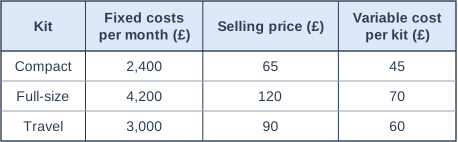
Table with columns "Kit", "Fixed costs per month (£)", "Selling price (£)", "Variable cost per kit (£)". Kit: Compact; Fixed costs per month (£): 2,400; Selling price (£): 65; Variable cost per kit (£): 45 | Kit: Full-size; Fixed costs per month (£): 4,200; Selling price (£): 120; Variable cost per kit (£): 70 | Kit: Travel; Fixed costs per month (£): 3,000; Selling price (£): 90; Variable cost per kit (£): 60.

Model answer

Full-size

Explanation

The break-even output depends on fixed costs and on how much each kit adds above its variable cost, not on fixed costs alone. The Full-size kit has the highest fixed costs, but each one covers £50 of them, so it breaks even at only 84 kits. The Compact kit has the lowest fixed costs but covers only £20 per kit, so it needs 120 sales.

Mark scheme
  1. 1 mark

    Full-size

    Break-even outputs: Compact £2,400 ÷ (£65 - £45) = 120 kits; Full-size £4,200 ÷ (£120 - £70) = 84 kits; Travel £3,000 ÷ (£90 - £60) = 100 kits. Accept 'Full-size' or 'the full-size kit' on its own; working is not needed. Do not accept Compact (it has the lowest fixed costs but the highest break-even output, 120 kits). If more than one kit is given, award 0.
Question 2

2 marks

Rhian runs Lawn Giants Games Hire in Rhyl, hiring out giant garden games, such as giant Jenga, four-in-a-row and skittles, for parties, weddings and fun days. She charges £85 for each booking. Each booking costs her £25 for fuel, cleaning and checking the games for damage. Her fixed costs, including rent for a storage unit, insurance and the lease of her van, are £1,800 a month.

Calculate the revenue Lawn Giants Games Hire needs each month to break even. You are advised to show your workings.

Model answer

Break-even output = £1,800 ÷ (£85 - £25) = £1,800 ÷ £60 = 30 bookings
Break-even revenue = 30 × £85 = £2,550

Explanation

First find the break-even output in bookings, then multiply it by the price to find the revenue needed to break even. At 30 bookings, revenue of £2,550 exactly covers the £1,800 of fixed costs and £750 of variable costs. A common error is to stop at 30 bookings when the question asks for revenue.

Mark scheme
  1. 1 mark

    Fully correct working, e.g. £1,800 ÷ (£85 - £25) = 30 bookings; 30 × £85; or a correct final answer of £2,550 with no working

    An answer of £2,550 with no working scores 2 marks. If the final answer is wrong, award this mark only for fully correct working (break-even output of 30 bookings multiplied by the £85 price); a formula alone or partly correct working scores 0. If several different final answers are given, award 0.

  2. 1 mark

    £2,550

    Accept 2550 or 2,550 without the £ sign, and £2,550.00. Do not accept 30 or 30 bookings (break-even output in bookings, not revenue), £750 (30 multiplied by the variable cost) or £1,800 (30 multiplied by £60, which is just the fixed costs).

Question 3

2 marks

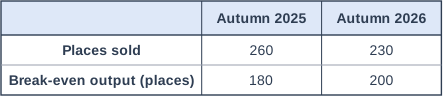
Lucia runs Palabrita, which offers evening Spanish classes for adults in Bath. Students book a place on a ten-week course. Lucia hires rooms at a community centre, which increased its charge for room hire this year. The table shows information about the autumn term in 2025 and in 2026.

Outline one reason why Palabrita's margin of safety fell between autumn 2025 and autumn 2026.

Table with columns (row headings), "Autumn 2025", "Autumn 2026". Places sold; Autumn 2025: 260; Autumn 2026: 230 | Break-even output (places); Autumn 2025: 180; Autumn 2026: 200.

Model answer

The community centre raised its charge for room hire, which is a fixed cost for Palabrita. This raised the break-even output from 180 to 200 places, so even before the fall in places sold, the margin of safety was smaller.

Explanation

The margin of safety is places sold minus break-even output, so it falls when sales fall or when the break-even output rises; here both happened, and it fell from 80 to 30 places. Two marks need one reason, a linked development and use of the case, such as the room hire or the figures in the table. An answer that uses nothing from the case scores at most 1 mark.

Mark scheme
  1. 2 marks

    Award up to 2 marks for linked points outlining one reason why Palabrita's margin of safety fell between autumn 2025 and autumn 2026. Award a maximum of 1 mark if points are not linked.

    Max 1 if the answer has no application to the case (a valid point with no application scores 1 mark). 1 mark for a valid reason and 1 further mark for a linked development of it. To award 2 marks there must be linked development and evidence of application (use of the case or table, e.g. room hire, the community centre, places sold falling from 260 to 230, break-even output rising from 180 to 200, the margin of safety falling from 80 to 30 places, ten-week courses, evening classes, Lucia). The name of the business and the words 'margin of safety', '2025' and '2026' do not count as application because they are in the question. Award any other valid answer. Examples: The community centre increased its charge for room hire, which is a fixed cost (1), so Palabrita's break-even output rose from 180 to 200 places, leaving less room between break-even and sales (1). / Lucia sold 30 fewer places, 230 instead of 260 (1), so with break-even output also higher, the margin of safety fell from 80 places to 30 places (1). Do not accept answers that treat room hire as a variable cost, or that say the margin of safety fell because revenue rose.

Question 4

6 marks

Kerry runs Gilded Tips, a nail studio in Sunderland, as a sole trader. She charges £30 for each appointment and carries out about 450 appointments a month.

This year the rent for her studio has gone up and she has taken on a part-time receptionist, so her fixed costs have increased from £7,200 to £8,800 a month. Her supplier has also raised the price of gel polish, so the variable cost of each appointment has risen from £6 to £8. As a result, Gilded Tips' break-even output has risen from 300 to 400 appointments a month. Several new nail bars have opened in the city centre, some of them offering lower prices.

Analyse the impact on Gilded Tips of the increase in its break-even output.

Model answer

Gilded Tips' break-even output has risen from 300 to 400 appointments a month, so Kerry now needs 100 more appointments just to cover her costs. Because she carries out about 450 appointments, her margin of safety has fallen from 150 to only 50 appointments. This means her profit falls sharply, from about £3,600 to about £1,100 a month, as her revenue of £13,500 stays the same while her total costs rise to £12,400. Therefore Kerry has much less money to reinvest in the studio, for example in new equipment, or to take as her own income.

With a margin of safety of only 50 appointments, Gilded Tips is now close to making a loss. Several new nail bars have opened in the city centre, some charging less than £30. If even a few of Kerry's customers try them, her appointments could fall below 400, so the studio would make a loss. As a result Kerry may feel she has to raise her price to cover the higher gel polish and rent costs, but this could drive even more customers to the cheaper nail bars, so her sales and margin of safety could fall further.

Explanation

Top answers use the case figures, such as the rise from 300 to 400 appointments and the fall in the margin of safety to 50, and link them to profit and to the risk from the new nail bars in about five steps. A generic answer about break-even with nothing from the case cannot score more than 3 marks. Evaluation is not needed in an 'Analyse' question.

Mark scheme
  1. 6 marks

    Levels of response (6 marks).
    Level 3 (5-6 marks): Detailed application of knowledge and understanding of business concepts and issues to the business context throughout (AO2). Deconstructs business information and/or issues, finding detailed interconnected points with logical chains of reasoning (AO3a).
    Level 2 (3-4 marks): Sound application of knowledge and understanding of business concepts and issues to the business context although there may be some inconsistencies (AO2). Deconstructs business information and/or issues, finding interconnected points with chains of reasoning, although there may be some logical inconsistencies (AO3a).
    Level 1 (1-2 marks): Limited application of knowledge and understanding of business concepts and issues to the business context (AO2). Attempts to deconstruct business information and/or issues, finding limited connections between points (AO3a).
    0 marks: No rewardable material.

    Indicative content (not a checklist; credit other valid points):
    - Break-even output has risen from 300 to 400 appointments a month; with about 450 appointments, Kerry's margin of safety has fallen from 150 to only 50 appointments (AO2).
    - New nail bars in the city centre, some charging less than £30, could take some of Gilded Tips' customers (AO2).
    - Kerry now needs 100 more appointments a month just to cover her costs. Therefore her profit falls, from about £3,600 to about £1,100 a month (revenue £13,500; total costs up from £9,900 to £12,400), leaving less to reinvest in the studio or to live on (AO3a).
    - With a margin of safety of only 50 appointments, a small fall in bookings, for example customers trying the new nail bars, would push Gilded Tips into a loss. As a result Kerry may have to raise her price above £30 or cut costs such as the receptionist's hours, but a higher price could lose even more customers to cheaper rivals (AO3a).
    Marking notes: only the best two points are credited; Level 3 for AO3a needs about five linked strands from one or two points. Context only counts inside a valid point, and copying the case or using the business name or words from the question is not application. A generic answer with no application to Gilded Tips cannot score more than 3 marks. Evaluation is not required and is not credited. Do not credit answers that confuse the margin of safety with profit or with cash.

Ready to try the rest? Every answer you write is marked against the mark scheme, so you can see exactly where the marks are.

Study Helper Hints first, answers after you try

Stuck on this one? Ask for a hint and I’ll point you in the right direction, without giving the answer away. Once you’ve checked your answer, I’ll show you how the marks are awarded.