Level:
Correct: 0
Incorrect: 0
Marks: 0/0
Exam Practice
Course:
Topics:
Edexcel GCSE Business (Paper 1) Smart practice A mixed round aimed at your weak spots
Unit 1
Enterprise and entrepreneurship
The dynamic nature of business
Risk and reward
Risk and reward
Unit 2
Spotting a business opportunity
Unit 3
Putting a business idea into practice
Unit 4
Making the business effective
The options for start-up and small businesses
Limited liability and types of business ownership
Franchising
Business location
Business location
The marketing mix
The marketing mix
Business plans
Business plans
Unit 5
Understanding external influences on business
Business stakeholders
Technology and business
Legislation and business
The economy and business
Avg
score:
–
Topics
done:
0/24

Sources of finance for a start-up or small business

Practise 21 exam-style questions on Sources of finance for a start-up or small business for Edexcel GCSE Business (Paper 1). Write your answer as you would in the exam and get it marked in seconds against the mark scheme, point by point, with the Study Helper on hand if you get stuck.

  • 21 questions
  • 1–12 marks each
  • Instant marking
  • No sign-up needed
20 questions, marked as you go

Sample questions with model answers

Here are 4 of the questions in this topic, each with a model answer, an explanation of why it earns the marks and the mark scheme an examiner would use.

Question 1

1 mark

Define the term 'venture capital'.

Model answer

Venture capital is money invested in a new or small business with high growth potential by specialist investors, who receive a share of the ownership of the business in return.

Explanation

The key ideas are that venture capitalists invest in small, often risky businesses and that they receive part of the ownership (shares) rather than interest. It is not a loan, so it does not have to be repaid, but the owners give up some control and a share of future profits.

Mark scheme
  1. 1 mark

    A definition showing that venture capital is finance (money) provided by investors to a new or small business, often one seen as risky or with high growth potential, in return for a share of the business (its ownership or shares).

    Award 1 mark for a correct definition. The answer must include both the idea of investment in a (new, small or risky) business and the idea that the investor receives a share of the ownership (shares or a stake) in return. Accept e.g. 'money invested in a small or start-up business by specialist investors in exchange for part of the business'. Do not accept 'money lent to a business' or 'a loan from an investor' (venture capital is not a loan), or 'money from investors' with no mention of the share of ownership they receive.

Question 2

2 marks

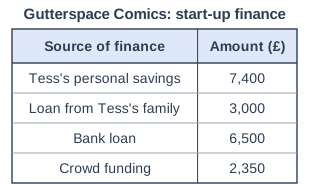
Gutterspace Comics is a new shop in Barnstaple that sells comics, graphic novels and collectable figures. The table shows how the owner, Tess, financed the start-up.

Using the information in the table, calculate, to 2 decimal places, the percentage of the total start-up finance that came from Tess's personal savings.

Gutterspace Comics: start-up finance. Table with columns "Source of finance", "Amount (£)". Source of finance: Tess's personal savings; Amount (£): 7,400 | Source of finance: Loan from Tess's family; Amount (£): 3,000 | Source of finance: Bank loan; Amount (£): 6,500 | Source of finance: Crowd funding; Amount (£): 2,350.

Model answer

Total start-up finance = £7,400 + £3,000 + £6,500 + £2,350 = £19,250
Percentage from personal savings = £7,400 ÷ £19,250 × 100 = 38.44%

Explanation

A percentage of a total is the part divided by the whole, multiplied by 100, so first add up all four sources to find the total of £19,250. Dividing by the total of the other sources instead of the whole gives the wrong answer of 62.45%. The answer must be written to 2 decimal places, as the question asks.

Mark scheme
  1. 1 mark

    Fully correct working, e.g. £7,400 ÷ (£7,400 + £3,000 + £6,500 + £2,350) × 100; or a correct final answer of 38.44% with no working

    An answer of 38.44% with no working scores 2 marks. If the final answer is wrong, award this mark only for fully correct working (£7,400 ÷ £19,250 × 100); a formula alone or partly correct working scores 0. If several different final answers are given, award 0. Max 1 if the answer is not given to 2 decimal places (e.g. 38.4% or 38%).

  2. 1 mark

    38.44%

    Accept 38.44 without the % sign. Do not accept 61.56% (the share from the other sources), 62.45% (savings divided by the other sources instead of the total), 54.03% (the family loan added to the savings) or 113.85% (savings divided by the bank loan).

Question 3

3 marks

Explain one disadvantage to a sole trader of using personal savings to start a business.

Model answer

The owner risks losing their own money if the business fails. This is because a new business may not attract enough customers to cover its costs. As a result, the owner could lose savings they had put aside for something else, such as a deposit on a home.

Explanation

Personal savings cost no interest and do not have to be repaid, so the disadvantages are about risk and amount: the owner can lose their own money, and they may not have enough of it. Points about interest or repayments describe loans, not savings, so they score 0. Two linked strands after the disadvantage are needed for 3 marks.

Mark scheme
  1. 1 mark

    Award 1 mark for identification of a disadvantage to a sole trader of using personal savings to start a business.

    Answers that list more than one disadvantage with no explanation will be awarded a maximum of 1 mark. Accept any other appropriate response. Valid disadvantages include: the owner risks losing their own money if the business fails; the owner may not have enough savings, so the business may be too small or need other finance as well; the savings are no longer available for personal emergencies; the owner loses the interest the savings could have earned (an opportunity cost). Do not accept disadvantages that apply to borrowing, such as 'interest must be paid' or 'it must be repaid', or confusion with limited liability.

  2. 2 marks

    Award up to 2 further marks for explaining this disadvantage (1 mark for each linked strand of development).

    Examples: The owner risks losing their own money if the business fails (1). This is because a new business may not attract enough customers to cover its costs (1). As a result, the owner could lose money they had saved for something else, such as a deposit on a home (1). / The owner may not have enough savings to pay for everything the business needs (1). This means they may have to start on a smaller scale, for example with less stock or equipment (1). Therefore the business may not be able to meet demand, so it earns less revenue than it could (1). A restatement of the disadvantage, a definition or an example is not a strand. Vague endings such as 'the business will be less successful' are not credited.

Question 4

9 marks

Amara and Luke are starting Spoke & Parcel Deliveries, a partnership in Oxford that will use electric cargo bikes to deliver parcels for independent shops in the city centre. They need £24,000 for four cargo bikes and a small storage unit. Eighteen local shops have said they would use the service, and the business's Instagram account already has 900 followers.

A crowd funding website could raise the £24,000 from members of the public. Supporters would receive rewards, such as discount vouchers from the shops that use the service. The website keeps 5% of the money raised, and if the target is not reached in 30 days the money is returned to supporters. Running the campaign would take up much of the partners' time for two months.

Their bank would lend them £24,000 over five years, repaid at about £500 a month. It has asked to see their business plan first. Amara and Luke have no other borrowing.

In order to finance the start-up costs, Spoke & Parcel Deliveries is considering two options:
Option 1: raise the money through crowd funding
Option 2: take out a bank loan.

Justify which one of these two options Spoke & Parcel Deliveries should choose.

Model answer

Spoke & Parcel Deliveries should choose Option 1, crowd funding.

With crowd funding, supporters receive rewards such as discount vouchers from local shops, so Amara and Luke have no loan to repay. This means about £500 a month that would have gone on loan repayments stays in the business. Therefore, in the first months, when the cargo bikes are only just starting deliveries for the eighteen shops, their cash outflows are much lower. As a result, they are less likely to run short of cash and need an expensive overdraft while they build up customers.

However, the website keeps 5% of the money raised, so they would need to raise about £25,300 to end up with £24,000. If they miss the target within 30 days, they receive nothing, and they would have spent two months on the campaign instead of preparing to launch.

Overall, crowd funding is the better choice, because a new delivery service with uncertain sales is safer without £500 of fixed repayments every month for five years. It depends, though, on whether their support turns into money. The 900 Instagram followers and eighteen shops are a good start, but if the shops also promote the campaign to their own customers, the target is much more likely to be reached; if after the first two weeks the campaign is far from its target, the partners should go back to the bank and use the business plan they have prepared to take the loan instead.

Explanation

A strong answer chooses one option, uses the case to explain its main benefit (no repayments, or certain and full finance) and weighs a real drawback (the 5% fee and all-or-nothing target, or five years of repayments). The conclusion should add something new, such as how the partners could make the campaign succeed or when they should switch to the loan. Either option can score full marks.

Mark scheme
  1. 9 marks

    Levels of response (9 marks).
    Level 3 (7-9 marks): Detailed application of knowledge and understanding of business concepts and issues to the business context throughout (AO2). Deconstructs business information and/or issues, finding detailed interconnected points with logical chains of reasoning (AO3a). Makes a judgement, providing a clear justification based on a thorough evaluation of business information and issues relevant to the choice made (AO3b).
    Level 2 (4-6 marks): Sound application of knowledge and understanding of business concepts and issues to the business context although there may be some inconsistencies (AO2). Deconstructs business information and/or issues, finding interconnected points with chains of reasoning, although there may be some logical inconsistencies (AO3a). Makes a judgement, providing a justification based on sound evaluation of business information and issues relevant to the choice made (AO3b).
    Level 1 (1-3 marks): Limited application of knowledge and understanding of business concepts and issues to the business context (AO2). Attempts to deconstruct business information and/or issues, finding limited connections between points (AO3a). Makes a judgement, providing a simple justification based on limited evaluation of business information and issues relevant to the choice made (AO3b).
    0 marks: No rewardable material.

    Indicative content (not a checklist; credit other valid points):
    - Option 1: crowd funding raises the £24,000 in return for rewards such as discount vouchers, so there are no repayments; the campaign can use the 900 Instagram followers and the eighteen local shops (AO2).
    - Option 2: the bank loan provides the full £24,000 for the cargo bikes and storage unit once the business plan is accepted, with fixed repayments of about £500 a month over five years (AO2).
    - Option 1: with no loan repayments, the partners keep about £500 a month in the business. Therefore their cash outflows are lower in the first months, when deliveries for the eighteen shops are only just starting, so they are less likely to run short of cash and need an overdraft (AO3a).
    - Option 2: once the bank accepts the business plan, the full £24,000 is certain, with no 5% fee and no risk of missing a target. As a result, Amara and Luke know exactly when the money will arrive and can buy the cargo bikes on time, rather than spending two months on a campaign, so they can start earning revenue from deliveries sooner (AO3a).
    - However, with Option 1 the website keeps 5% (about £1,200), so the partners would need to raise more than £24,000, and if the target is missed they receive nothing after spending two months on the campaign (AO3b).
    - However, with Option 2 the business must pay about £500 a month for five years, including interest, whatever happens to its sales; if fewer shops use the service than expected, the repayments could cause a cash shortage (AO3b).
    Marking notes: either option can score full marks. Only the best two points are credited; Level 3 for AO3a needs about five linked strands. Context only counts inside a valid point; copying the case or using the business name or words from the question is not application. The strongest answers choose one option and weigh its benefits and drawbacks. Covering the benefits of both options with no contrast, or only the drawbacks of the rejected option, gives no evaluation (AO3b). A one-sided answer cannot reach Level 2 for AO3b. Level 3 needs a conclusion that adds something new, such as a developed 'it depends' factor (e.g. how many Instagram followers would actually give money, or how many of the eighteen shops sign contracts), and uses the context. Do not credit points that treat reward crowd funding as a loan, or claim the bank loan has no cost.

Ready to try the rest? Every answer you write is marked against the mark scheme, so you can see exactly where the marks are.

Study Helper Hints first, answers after you try

Stuck on this one? Ask for a hint and I’ll point you in the right direction, without giving the answer away. Once you’ve checked your answer, I’ll show you how the marks are awarded.