
Level:
Correct: 0
Incorrect: 0
Marks: 0/0
Exam Practice
Course:
Topics:
Edexcel GCSE Business (Paper 1) Smart practice A mixed round aimed at your weak spots
Unit 1
Enterprise and entrepreneurship
The dynamic nature of business
Risk and reward
Risk and reward
Unit 2
Spotting a business opportunity
Unit 3
Putting a business idea into practice
Unit 4
Making the business effective
The options for start-up and small businesses
Limited liability and types of business ownership
Franchising
Business location
Business location
The marketing mix
The marketing mix
Business plans
Business plans
Unit 5
Understanding external influences on business
Business stakeholders
Technology and business
Legislation and business
The economy and business
Avg
score:
–
Topics
done:
0/24

The economy and business

Practise 23 exam-style questions on The economy and business for Edexcel GCSE Business (Paper 1). Write your answer as you would in the exam and get it marked in seconds against the mark scheme, point by point, with the Study Helper on hand if you get stuck.

  • 23 questions
  • 1–12 marks each
  • Instant marking
  • No sign-up needed
20 questions, marked as you go

Sample questions with model answers

Here are 4 of the questions in this topic, each with a model answer, an explanation of why it earns the marks and the mark scheme an examiner would use.

Question 1

1 mark

Which one of the following is a tax paid on the profits of a private limited company?

Choose your answer.

  • A Business rates
  • B Corporation tax
  • C Income tax
  • D Value Added Tax (VAT)

Model answer

B - Corporation tax

Explanation

A private limited company is a separate legal entity, so it pays corporation tax on its profits. Income tax is paid by individuals, including sole traders on their business profit, and VAT is added to the prices customers pay. A common error is to think that VAT is a tax on a business's profit.

Mark scheme
  1. 1 mark

    B - Corporation tax

    The only correct answer is B - Corporation tax. A is not correct because business rates are a tax on the property a business uses, not on its profits. C is not correct because income tax is paid by people on their income (such as employees' wages or a sole trader's profit), not by a limited company. D is not correct because VAT is a tax on spending that is added to the price of most goods and services. Accept the letter or the words of the option. If more than one option is given, award 0.
Question 2

2 marks

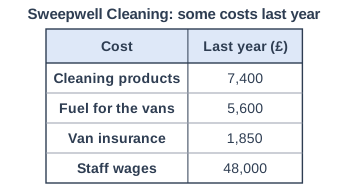
Shona owns Sweepwell Cleaning, a domestic cleaning business in Milton Keynes. Her staff drive to customers' homes in two vans. The table shows some of the business's costs last year.

Suppose that next year the price of cleaning products rises by 8% and the price of fuel rises by 5%, while the other costs in the table stay the same.

Using the information in the table, calculate the total increase in Sweepwell Cleaning's annual costs. You are advised to show your workings.

Sweepwell Cleaning: some costs last year. Table with columns "Cost", "Last year (£)". Cost: Cleaning products; Last year (£): 7,400 | Cost: Fuel for the vans; Last year (£): 5,600 | Cost: Van insurance; Last year (£): 1,850 | Cost: Staff wages; Last year (£): 48,000.

Model answer

Cleaning products: £7,400 × 8% = £592
Fuel: £5,600 × 5% = £280
Total increase = £592 + £280 = £872

Explanation

Each percentage rise must be applied to its own cost, and the two increases are then added; the insurance and wages in the table are not needed. Adding the percentages to get 13% of both costs gives £1,690, which is wrong because the two costs rise at different rates.

Mark scheme
  1. 1 mark

    Fully correct working, e.g. (£7,400 × 8%) + (£5,600 × 5%) = £592 + £280; or a correct final answer of £872 with no working

    An answer of £872 with no working scores 2 marks. Also accept as fully correct working (£7,400 × 1.08 + £5,600 × 1.05) - (£7,400 + £5,600) = £13,872 - £13,000. If the final answer is wrong, award this mark only for fully correct working; a formula alone or partly correct working scores 0. If several different final answers are given, award 0.

  2. 1 mark

    £872

    Accept 872 or £872.00, with or without the £ sign. Do not accept £592 or £280 (only one cost increased), £1,690 (13% of both costs), £13,872 (the new total of the two costs, not the increase) or answers that apply the rises to insurance or wages.

Question 3

3 marks

Explain one disadvantage to a small business of an increase in the rate of Value Added Tax (VAT).

Model answer

If the business passes the higher VAT on to customers, the prices they pay will rise. This means some customers may buy fewer of its products or switch to cheaper rivals. As a result, the business may make fewer sales and its sales revenue will fall.

Explanation

One mark is for the disadvantage, such as higher prices for customers or a lower profit margin if the tax is absorbed, and two more are for two linked steps that explain its effect, joined by words such as 'therefore'. VAT is a tax on spending added to prices, not a tax on profits, so answers about paying more tax on profit score 0.

Mark scheme
  1. 1 mark

    Award 1 mark for identification of a disadvantage to a small business of an increase in the rate of VAT.

    Answers that list more than one disadvantage with no explanation will be awarded a maximum of 1 mark. Accept any other appropriate response. Valid disadvantages include: prices for customers rise if the business passes the higher VAT on; customers may buy less or switch to cheaper alternatives; if the business keeps its prices the same it must absorb the extra tax, so it keeps less revenue from each sale; price lists, menus or the till system have to be changed; a business that is not VAT-registered cannot reclaim VAT, so the supplies it buys from VAT-registered suppliers cost more. Do not accept answers that treat VAT as a tax on profits or on wages, or that confuse it with corporation tax or income tax.

  2. 2 marks

    Award up to 2 further marks for explaining this disadvantage (1 mark for each linked strand of development).

    Examples: The prices customers pay will rise if the business passes the higher VAT on to them (1). This means some customers may buy fewer of its products or switch to cheaper rivals (1). As a result, the number of sales may fall, reducing the business's sales revenue (1). / If the business keeps its prices the same so that it does not lose customers, it has to absorb the extra VAT itself (1). This means it receives less revenue from each sale after paying the VAT to the government (1). Therefore its profit margin on each item falls, leaving less retained profit to reinvest (1). A restatement of the disadvantage, a definition of VAT or an example is not a strand. Vague endings such as 'the business will fail' or 'the business will be less successful' are not credited.

Question 4

6 marks

Deji runs Bouncewick Party Hire, a business in Sunderland that hires out bouncy castles and soft-play equipment for children's parties. He and two employees deliver the equipment in a van, set it up and collect it afterwards. A full party package, with a bouncy castle, soft play and a party host, costs £180. A bouncy castle on its own costs £70. Most of Deji's customers are working families.

Many customers have told Deji that their pay has not kept up with rising prices, so they have less money left to spend after paying for food, energy and housing. Several regular customers have changed from the full package to a bouncy castle on its own, and some now hold parties at home with no hired equipment. At the same time, Deji's fuel and van insurance costs have risen.

Analyse the impact on Bouncewick Party Hire of the fall in its customers' disposable income.

Model answer

Hiring a bouncy castle is not an essential purchase, so when working families have less disposable income they cut back on it. Several regular customers have already switched from the £180 full package to a £70 bouncy castle on its own, so Bouncewick receives £110 less from each of those parties. Therefore, even if Deji takes the same number of bookings, his revenue will fall. As each booking still needs a van journey to deliver and collect the equipment, the profit he makes on each booking falls as well.

At the same time, Deji's fuel and van insurance costs have risen, and he still has to pay his two employees. This means his profit is squeezed from both sides: revenue is falling while costs are rising. As a result, he may have to cut his employees' hours to save money. If he raised his prices instead, more families might hold parties at home with no hired equipment, which would reduce his bookings even further.

Explanation

The best answers use the case figures, such as customers switching from the £180 package to the £70 castle, and explain the chain from lower disposable income to lower revenue and profit. Rising fuel and insurance costs make the squeeze on profit worse, and good answers link the two. An answer that would fit any business cannot score more than 3 marks.

Mark scheme
  1. 6 marks

    Levels of response (6 marks).
    Level 3 (5-6 marks): Detailed application of knowledge and understanding of business concepts and issues to the business context throughout (AO2). Deconstructs business information and/or issues, finding detailed interconnected points with logical chains of reasoning (AO3a).
    Level 2 (3-4 marks): Sound application of knowledge and understanding of business concepts and issues to the business context although there may be some inconsistencies (AO2). Deconstructs business information and/or issues, finding interconnected points with chains of reasoning, although there may be some logical inconsistencies (AO3a).
    Level 1 (1-2 marks): Limited application of knowledge and understanding of business concepts and issues to the business context (AO2). Attempts to deconstruct business information and/or issues, finding limited connections between points (AO3a).
    0 marks: No rewardable material.

    Indicative content (not a checklist; credit other valid points):
    - Hiring party equipment is a non-essential service, so working families cut it back first when their disposable income falls: some customers have switched from the £180 full package to the £70 bouncy castle, and some hold parties at home with no hired equipment (AO2).
    - Deji's costs are rising at the same time: fuel and insurance for the van, and the wages of his two employees, do not fall when bookings fall (AO2).
    - When a regular customer switches from the full package to a bouncy castle on its own, revenue from that party falls by £110. Therefore, even if the number of bookings stays the same, Bouncewick's total revenue falls, and as each booking still needs a van journey to deliver and collect the equipment, the profit made on each booking falls (AO3a).
    - Because costs such as fuel and insurance are rising while revenue is falling, Bouncewick's profit is squeezed from both sides. As a result, Deji may have to cut his employees' hours or raise his prices, but higher prices could lead more families to hold parties without hired equipment, reducing bookings further (AO3a).
    Marking notes: only the best two points are credited; Level 3 for AO3a needs about five linked strands from one or two points. Context only counts inside a valid point, and copying the case or using the business name or words from the question is not application. A generic answer with no application to Bouncewick Party Hire cannot score more than 3 marks. Evaluation is not required and is not credited. Do not credit a strand that treats a fall in revenue as the same fall in profit (a castle-only booking also needs less equipment and no party host, so profit falls by less than £110 a booking).

Ready to try the rest? Every answer you write is marked against the mark scheme, so you can see exactly where the marks are.

Study Helper Hints first, answers after you try

Stuck on this one? Ask for a hint and I’ll point you in the right direction, without giving the answer away. Once you’ve checked your answer, I’ll show you how the marks are awarded.