
Level:
Correct: 0
Incorrect: 0
Marks: 0/0
Exam Practice
Course:
Topics:
Edexcel GCSE Business (Paper 1) Smart practice A mixed round aimed at your weak spots
Unit 1
Enterprise and entrepreneurship
The dynamic nature of business
Risk and reward
Risk and reward
Unit 2
Spotting a business opportunity
Unit 3
Putting a business idea into practice
Unit 4
Making the business effective
The options for start-up and small businesses
Limited liability and types of business ownership
Franchising
Business location
Business location
The marketing mix
The marketing mix
Business plans
Business plans
Unit 5
Understanding external influences on business
Business stakeholders
Technology and business
Legislation and business
The economy and business
Avg
score:
–
Topics
done:
0/24

Limited liability and types of business ownership

Practise 21 exam-style questions on Limited liability and types of business ownership for Edexcel GCSE Business (Paper 1). Write your answer as you would in the exam and get it marked in seconds against the mark scheme, point by point, with the Study Helper on hand if you get stuck.

  • 21 questions
  • 1–12 marks each
  • Instant marking
  • No sign-up needed
20 questions, marked as you go

Sample questions with model answers

Here are 4 of the questions in this topic, each with a model answer, an explanation of why it earns the marks and the mark scheme an examiner would use.

Question 1

1 mark

Which one of the following must a private limited company do?

Choose your answer.

  • A File its accounts with Companies House each year
  • B Have at least ten shareholders
  • C Sell its shares on the stock exchange
  • D Share its profit equally between its employees

Model answer

A - File its accounts with Companies House each year

Explanation

A private limited company must register with Companies House and file its accounts there every year, where the public can look at them. This is one of the drawbacks of becoming a company, because a sole trader's accounts stay private. Students often think a company needs many shareholders or must sell shares on the stock exchange, but that describes a public limited company.

Mark scheme
  1. 1 mark

    A - File its accounts with Companies House each year

    The only correct answer is A. B is not correct because a private limited company can be set up with just one shareholder. C is not correct because the shares of a private limited company cannot be sold to the general public on the stock exchange; only a public limited company can do this. D is not correct because the profit belongs to the company's shareholders, who may receive some of it as dividends; employees are paid wages or salaries. Accept the letter or the words of the option. If more than one option is given, award 0.
Question 2

2 marks

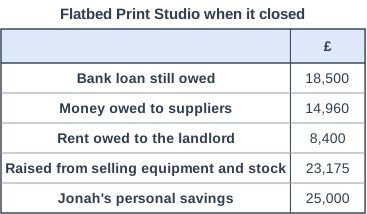
Jonah ran Flatbed Print Studio, a business printing T-shirts and bags in Hastings, as a sole trader. Sales fell sharply and in September he closed the business. The table shows the money the business owed when it closed and the amount raised by selling its equipment and stock.

Using the information in the table, calculate the amount Jonah will have to pay from his personal assets to clear the business's debts. You are advised to show your workings.

Flatbed Print Studio when it closed. Table with columns (row headings), "£". Bank loan still owed; £: 18,500 | Money owed to suppliers; £: 14,960 | Rent owed to the landlord; £: 8,400 | Raised from selling equipment and stock; £: 23,175 | Jonah's personal savings; £: 25,000.

Model answer

Total debts = £18,500 + £14,960 + £8,400 = £41,860
Amount still owed = £41,860 - £23,175 = £18,685
Jonah must pay £18,685 from his personal assets.

Explanation

As a sole trader Jonah has unlimited liability, so any debts that the business's assets cannot cover must be paid from his personal assets. Add up all three debts to get £41,860, then take off the £23,175 raised, which leaves £18,685. His savings are surplus data: they show he can pay, but they are not part of the calculation.

Mark scheme
  1. 1 mark

    Fully correct working, e.g. (£18,500 + £14,960 + £8,400) - £23,175; or a correct final answer of £18,685 with no working

    An answer of £18,685 with no working scores 2 marks. If the final answer is wrong, award this mark only for fully correct working (total debts of £41,860 minus the £23,175 raised); a formula alone or partly correct working scores 0. If several different final answers are given, award 0.

  2. 1 mark

    £18,685

    Accept 18685 or 18,685 without the £ sign. Do not accept £41,860 (the total debts, with the £23,175 raised not taken off), £10,285 (the rent owed left out) or any answer that uses Jonah's savings in the calculation.

Question 3

3 marks

Explain one advantage to a small business of being set up as a partnership rather than as a sole trader.

Model answer

Each partner can invest their own money in a partnership. This means the business starts with more capital than one owner could provide on their own. As a result, it can buy the equipment it needs without borrowing, so it avoids paying interest.

Explanation

The advantage must come from having more than one owner: more capital, more skills or shared work. The two further marks need two linked steps showing how this helps the business. Saying partners have limited liability is wrong and scores nothing.

Mark scheme
  1. 1 mark

    Award 1 mark for identification of an advantage of being a partnership rather than a sole trader.

    Answers that list more than one advantage with no explanation will be awarded a maximum of 1 mark. Accept any other appropriate response. Valid advantages include: more capital, because each partner can invest; a wider range of skills and experience; the workload and responsibility are shared; more ideas when making decisions; losses and risks are shared between more owners. Do not accept limited liability (partners in an ordinary partnership normally have unlimited liability), 'it can sell shares' or 'it makes more profit' with no reason linked to being a partnership.

  2. 2 marks

    Award up to 2 further marks for explaining this advantage (1 mark for each linked strand of development).

    Examples: Each partner can invest their own money in the business (1). This means the business starts with more capital than one owner could provide (1). As a result, it can buy the equipment or premises it needs without borrowing, so it avoids interest payments (1). / The partners can share the workload (1). This means the business can keep operating when one partner is ill or on holiday (1). Therefore it does not lose customers and revenue while one owner is away, which is a problem for many sole traders (1). A restatement of the advantage, a definition of a partnership or an example is not a strand of development. Vague endings such as 'the business will be more successful' are not credited.

Question 4

6 marks

Rosa is a British Sign Language (BSL) interpreter in Nottingham. She works as a sole trader under the name Handwise Interpreting, and interprets for deaf clients at hospital appointments, job interviews and college lectures. She charges £45 an hour. Because she works from home and her main costs are travel and professional insurance, she needed only about £600 to start the business.

Rosa decides which bookings to accept, so she keeps every Wednesday free to study for an advanced qualification in medical interpreting. Last year Handwise Interpreting made a profit of £31,500, all of which Rosa kept. She has no plans to employ anyone or to borrow money.

Analyse the benefit to Rosa of operating Handwise Interpreting as a sole trader.

Model answer

As a sole trader, Rosa keeps all of the profit, which was £31,500 last year, rather than sharing it with partners or shareholders. This means the full reward from her £45-an-hour fees goes to her. Therefore she can afford to pay for her advanced qualification in medical interpreting. As a result, she may be able to take more hospital bookings and charge a higher hourly rate once she qualifies, so her income from Handwise Interpreting rises further.

Rosa also has full control of the business. She can decide which bookings to accept without asking anyone, so she can keep Wednesdays free for her studies. This means she can still accept short-notice hospital appointments on other days, so her deaf clients are likely to keep booking her. As her costs are low and she has no plans to borrow, being the only owner gives her this freedom with little financial risk.

Explanation

Good answers take one or two benefits, such as keeping all the profit and having full control, and develop each through linked strands using Rosa's details: the £31,500 profit, the £45 fee, the Wednesday study day and the hospital bookings. A list of sole-trader advantages with no link to Rosa cannot score more than 3 marks. Drawbacks such as unlimited liability are not credited in an Analyse question.

Mark scheme
  1. 6 marks

    Levels of response (6 marks).
    Level 3 (5-6 marks): Detailed application of knowledge and understanding of business concepts and issues to the business context throughout (AO2). Deconstructs business information and/or issues, finding detailed interconnected points with logical chains of reasoning (AO3a).
    Level 2 (3-4 marks): Sound application of knowledge and understanding of business concepts and issues to the business context although there may be some inconsistencies (AO2). Deconstructs business information and/or issues, finding interconnected points with chains of reasoning, although there may be some logical inconsistencies (AO3a).
    Level 1 (1-2 marks): Limited application of knowledge and understanding of business concepts and issues to the business context (AO2). Attempts to deconstruct business information and/or issues, finding limited connections between points (AO3a).
    0 marks: No rewardable material.

    Indicative content (not a checklist; credit other valid points):
    - Rosa keeps all of the £31,500 profit herself, rather than sharing it with partners or shareholders (AO2).
    - Rosa has full control: she chooses which bookings to accept, so she can keep Wednesdays free for her medical interpreting qualification (AO2).
    - Because she keeps all of the profit from her £45-an-hour fees, she can afford to pay for her advanced qualification. Once qualified in medical interpreting, she may be able to take more hospital bookings and charge a higher hourly rate, so her income rises further (AO3a).
    - Because she makes every decision herself, she can accept a short-notice hospital appointment or turn down a booking without asking anyone. This means she can fit her work around her studies while still meeting her clients' needs, so they are likely to book her again (AO3a).
    - Setting up as a sole trader was quick and cheap: about £600, with no need to register with Companies House. With low costs and no borrowing, her unlimited liability is a small risk, so the simplest form of ownership suits her small business (AO3a).
    - Her financial information stays private, as she does not have to file accounts at Companies House, so other interpreters cannot see how much she earns (AO2).
    Marking notes: only the best two points are credited; Level 3 for AO3a needs about five linked strands from one or two points. Context only counts inside a valid point, and copying the case or using the business name or words from the question is not application. A generic answer with no application to Rosa or Handwise Interpreting cannot score more than 3 marks. Evaluation (drawbacks of being a sole trader) is not required and is not credited. Do not credit limited liability, which a sole trader does not have.

Ready to try the rest? Every answer you write is marked against the mark scheme, so you can see exactly where the marks are.

Study Helper Hints first, answers after you try

Stuck on this one? Ask for a hint and I’ll point you in the right direction, without giving the answer away. Once you’ve checked your answer, I’ll show you how the marks are awarded.