
Level:
Correct: 0
Incorrect: 0
Marks: 0/0
Exam Practice
Course:
Topics:
Edexcel GCSE Business (Paper 1) Smart practice A mixed round aimed at your weak spots
Unit 1
Enterprise and entrepreneurship
The dynamic nature of business
Risk and reward
Risk and reward
Unit 2
Spotting a business opportunity
Unit 3
Putting a business idea into practice
Unit 4
Making the business effective
The options for start-up and small businesses
Limited liability and types of business ownership
Franchising
Business location
Business location
The marketing mix
The marketing mix
Business plans
Business plans
Unit 5
Understanding external influences on business
Business stakeholders
Technology and business
Legislation and business
The economy and business
Avg
score:
–
Topics
done:
0/24

Legislation and business

Practise 21 exam-style questions on Legislation and business for Edexcel GCSE Business (Paper 1). Write your answer as you would in the exam and get it marked in seconds against the mark scheme, point by point, with the Study Helper on hand if you get stuck.

  • 21 questions
  • 1–12 marks each
  • Instant marking
  • No sign-up needed
20 questions, marked as you go

Sample questions with model answers

Here are 4 of the questions in this topic, each with a model answer, an explanation of why it earns the marks and the mark scheme an examiner would use.

Question 1

1 mark

Owen owns Maquette Model Makers, a small business in Cambridge that makes scale models of buildings for architects and property developers. He employs three model makers in a workshop where they use laser cutters, spray paints and strong glues, which give off fumes all day.

State one cost to Maquette Model Makers of meeting health and safety law.

Model answer

A fume extraction system for the workshop where the staff use spray paints and strong glues.

Explanation

Employers must protect the health and safety of their employees, so the costs of meeting the law include safety equipment, training, risk assessments and keeping machines safe. The answer must be linked to this business: 'safety equipment' alone scores 0, but 'masks to protect the staff from the glue fumes' scores 1. A fine is a cost of breaking the law, not of meeting it.

Mark scheme
  1. 1 mark

    Award 1 mark for stating one cost to Maquette Model Makers of meeting health and safety law.

    To award 1 mark there must be evidence of application. Examples that score: a fume extraction system for the workshop (1); masks to protect the staff from the glue or paint fumes (1); a spray booth for painting the models (1); goggles or gloves for using the laser cutters, spray paints or glues (1); training the staff to use the laser cutters safely (1); covers or guards for the laser cutters (1); servicing or checking the laser cutters (1); paying for a risk assessment of the workshop (1); a first aid kit for the workshop (1). Do not accept generic answers such as 'safety equipment', 'training' or 'risk assessments' with no link to the case ('training' = 0; 'training the staff to use the laser cutters' = 1). A word taken only from the business name, such as 'models' on its own, does not count as application. Do not accept costs that are not linked to health and safety, such as card, plastic or the staff's wages, or fines (a fine is a cost of not meeting the law).
Question 2

2 marks

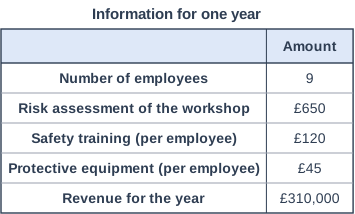
The table shows the costs that a small business making garden furniture expects to pay in one year to meet its health and safety obligations, and some other information about the business.

Using the information in the table, calculate the total cost to the business of meeting its health and safety obligations for the year. You are advised to show your workings.

Information for one year. Table with columns (row headings), "Amount". Number of employees; Amount: 9 | Risk assessment of the workshop; Amount: £650 | Safety training (per employee); Amount: £120 | Protective equipment (per employee); Amount: £45 | Revenue for the year; Amount: £310,000.

Model answer

Cost per employee = £120 + £45 = £165
Cost for 9 employees = 9 × £165 = £1,485
Total cost = £1,485 + £650 = £2,135

Explanation

The training and protective equipment are paid for each employee, so they are multiplied by 9, while the risk assessment of the workshop is paid only once. The usual errors are working out the cost for one employee only, which gives £815, or multiplying the risk assessment by 9 as well. The revenue is extra information that is not needed.

Mark scheme
  1. 1 mark

    Fully correct working, e.g. £650 + 9 × (£120 + £45); or a correct final answer of £2,135 with no working

    An answer of £2,135 with no working scores 2 marks. If the final answer is wrong, award this mark only for fully correct working (e.g. training 9 × £120 = £1,080, protective equipment 9 × £45 = £405, then £650 + £1,080 + £405); a formula alone or partly correct working scores 0. If several different final answers are given, award 0.

  2. 1 mark

    £2,135

    Accept £2,135.00, 2135 or 2,135 without the £ sign. Do not accept £815 (the costs for one employee only), £1,485 (the risk assessment left out), £7,335 (the risk assessment counted once for every employee) or any answer that includes the revenue.

Question 3

3 marks

Explain one impact on a small business that sells online of customers having the right to cancel their orders within 14 days of delivery.

Model answer

Customers know they can send goods back if they change their mind. This makes them more confident about buying products they have not seen in person. Therefore, more people may order from the business's website, which increases its sales.

Explanation

The right to cancel most online orders within 14 days of delivery can cost a business money through refunds and returns, but it also makes customers more willing to buy online. Either kind of impact can score if it is developed in two linked strands. Describing the law itself does not count as development.

Mark scheme
  1. 1 mark

    Award 1 mark for identification of an impact on a small business that sells online of customers having the right to cancel within 14 days of delivery.

    Answers that list more than one impact with no explanation will be awarded a maximum of 1 mark. Accept any other appropriate response. The impact may be negative or positive. Valid impacts include: some sales have to be refunded, so revenue and cash inflows fall; returned goods may be damaged or out of season and cannot be sold again at full price; staff time is needed to check, repack and restock returns; the business cannot be sure a sale is final for some time, which makes cash flow and stock harder to plan; customers feel more confident buying goods they have not seen, so they may buy more. Do not accept impacts on customers that are not brought back to the business, or answers that confuse this right with the rights for faulty goods only.

  2. 2 marks

    Award up to 2 further marks for explaining this impact (1 mark for each linked strand of development).

    Examples: Some customers will send items back and must be given a refund (1). This means the business cannot be sure a sale is final until the 14 days have passed (1). As a result, its cash inflows are harder to forecast, so it may be short of cash when it has to pay its suppliers (1). / Customers know they can send goods back if they change their mind (1). This makes them more confident about buying products they have not seen in person (1). Therefore, more people may order from the business's website, increasing its sales (1). A restatement of the impact or a description of the law is not a strand. Vague endings such as 'the business will be less successful' are not credited.

Question 4

6 marks

Steve owns Putlog Scaffolding, a small business in Darlington that puts up and takes down scaffolding for builders and roofers. He employs four scaffolders. The three men are each paid £16.50 an hour. Ellie, who joined two years ago, has the same qualifications and does the same work, but she is paid £14.80 an hour. An adviser has told Steve that this breaks equal pay law.

Ellie works 40 hours a week. She has asked Steve to raise her pay to £16.50 and to pay her the money she has missed over the last two years, or she will take her case to an employment tribunal. The other scaffolders have heard about the dispute. The business's profit last year was £52,000, and Steve has found it hard to recruit qualified scaffolders.

Analyse the impact on Putlog Scaffolding of paying Ellie less than the male scaffolders for the same work.

Model answer

Paying Ellie £1.70 an hour less than the male scaffolders for the same work breaks equal pay law, so Putlog Scaffolding may have to pay her the money she has missed. At 40 hours a week this is about £3,536 a year, or about £7,072 for the last two years. Therefore Steve faces a large, unplanned cost, and if Ellie takes the case to an employment tribunal there would also be legal costs and possibly compensation. As a result, the business's profit could fall well below last year's £52,000, and paying a large sum at once could leave Steve short of cash to pay for fuel for the lorries or new scaffold tubes.

The dispute could also affect the business's staff. Ellie may decide to leave because she feels unfairly treated, and Steve already finds it hard to recruit qualified scaffolders. This means fewer jobs could be taken on for builders and roofers each week, so revenue would fall and some builders may turn to another scaffolding firm. The other scaffolders have heard about the dispute, so they may lose trust in Steve, which could reduce their motivation and make the business less attractive to new scaffolders.

Explanation

A top answer shows that paying a woman less than a man for the same work is unlawful, then takes one or two impacts through about five linked strands using the case: the £1.70 gap, the possible tribunal, the £52,000 profit and the difficulty of recruiting scaffolders. Both the cost of putting it right and the effect on staff are valid impacts. Saying the lower pay is lawful because Ellie accepted it is wrong.

Mark scheme
  1. 6 marks

    Levels of response (6 marks).
    Level 3 (5-6 marks): Detailed application of knowledge and understanding of business concepts and issues to the business context throughout (AO2). Deconstructs business information and/or issues, finding detailed interconnected points with logical chains of reasoning (AO3a).
    Level 2 (3-4 marks): Sound application of knowledge and understanding of business concepts and issues to the business context although there may be some inconsistencies (AO2). Deconstructs business information and/or issues, finding interconnected points with chains of reasoning, although there may be some logical inconsistencies (AO3a).
    Level 1 (1-2 marks): Limited application of knowledge and understanding of business concepts and issues to the business context (AO2). Attempts to deconstruct business information and/or issues, finding limited connections between points (AO3a).
    0 marks: No rewardable material.

    Indicative content (not a checklist; credit other valid points):
    - Ellie is paid £1.70 an hour less than the male scaffolders for the same work; at 40 hours a week that is about £3,536 a year (£1.70 × 40 × 52), or about £7,072 over two years (AO2).
    - Ellie may take the business to an employment tribunal, the other scaffolders know about the dispute, and qualified scaffolders are hard to recruit (AO2).
    - Paying the missed money (about £7,072) and raising Ellie's pay (about £3,536 a year) add to costs, and a tribunal case would bring legal costs and possibly compensation. Therefore the business's profit falls from last year's £52,000, and paying a large sum at once could leave Steve short of cash (AO3a).
    - If Ellie feels unfairly treated she may leave, and Steve would struggle to replace a qualified scaffolder. As a result fewer jobs could be taken on for builders and roofers, so revenue falls, and the other scaffolders may lose trust in Steve, which could reduce their motivation and the business's reputation as an employer (AO3a).
    Marking notes: only the best two points are credited; Level 3 for AO3a needs about five linked strands from one or two points. Context only counts inside a valid point, and copying the case or using the business name or words from the question is not application. A generic answer with no application to Putlog Scaffolding cannot score more than 3 marks. Evaluation is not required and is not credited. Do not credit the claim that the lower pay is lawful because Ellie agreed to it when she started: equal pay for equal work is required by law.

Ready to try the rest? Every answer you write is marked against the mark scheme, so you can see exactly where the marks are.

Study Helper Hints first, answers after you try

Stuck on this one? Ask for a hint and I’ll point you in the right direction, without giving the answer away. Once you’ve checked your answer, I’ll show you how the marks are awarded.