
Level:
Correct: 0
Incorrect: 0
Marks: 0/0
Exam Practice
Course:
Topics:
Edexcel GCSE Business (Paper 1) Smart practice A mixed round aimed at your weak spots
Unit 1
Enterprise and entrepreneurship
The dynamic nature of business
Risk and reward
Risk and reward
Unit 2
Spotting a business opportunity
Unit 3
Putting a business idea into practice
Unit 4
Making the business effective
The options for start-up and small businesses
Limited liability and types of business ownership
Franchising
Business location
Business location
The marketing mix
The marketing mix
Business plans
Business plans
Unit 5
Understanding external influences on business
Business stakeholders
Technology and business
Legislation and business
The economy and business
Avg
score:
–
Topics
done:
0/24

Revenue, costs, profit and interest

Practise 22 exam-style questions on Revenue, costs, profit and interest for Edexcel GCSE Business (Paper 1). Write your answer as you would in the exam and get it marked in seconds against the mark scheme, point by point, with the Study Helper on hand if you get stuck.

  • 22 questions
  • 1–12 marks each
  • Instant marking
  • No sign-up needed
20 questions, marked as you go

Sample questions with model answers

Here are 4 of the questions in this topic, each with a model answer, an explanation of why it earns the marks and the mark scheme an examiner would use.

Question 1

1 mark

In March a small business sold 800 units at £9 each. That month it paid fixed costs of £2,400, and each unit had a variable cost of £6.75.

Which one of the following shows the business's profit or loss in March?

Choose your answer.

  • A A loss of £600
  • B A profit of £600
  • C A profit of £1,800
  • D A profit of £4,800

Model answer

A - A loss of £600

Explanation

Profit is total revenue minus total costs, and total costs include both fixed and variable costs. Here total costs of £7,800 are higher than revenue of £7,200, so the business made a loss of £600. Leaving out one type of cost makes the business look profitable when it is not.

Mark scheme
  1. 1 mark

    A - A loss of £600

    The only correct answer is A: revenue = 800 × £9 = £7,200; total costs = £2,400 + (800 × £6.75) = £7,800; £7,200 - £7,800 = -£600, a loss of £600. B is not correct because it takes revenue away from total costs the wrong way round, so the loss is shown as a profit; C is not correct because it leaves out the fixed costs (£7,200 - £5,400); D is not correct because it leaves out the variable costs (£7,200 - £2,400). Accept the letter or the words of the option. If more than one option is given, award 0.
Question 2

2 marks

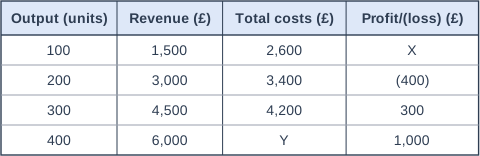
A small business sells its product for £15 per unit. Its fixed costs are £1,800 a month and its variable cost is £8 per unit. The table shows its revenue, total costs and profit or loss for one month at four different levels of output. Losses are shown in brackets.

Work out the values of X and Y in the table.

Table with columns "Output (units)", "Revenue (£)", "Total costs (£)", "Profit/(loss) (£)". Output (units): 100; Revenue (£): 1,500; Total costs (£): 2,600; Profit/(loss) (£): X | Output (units): 200; Revenue (£): 3,000; Total costs (£): 3,400; Profit/(loss) (£): (400) | Output (units): 300; Revenue (£): 4,500; Total costs (£): 4,200; Profit/(loss) (£): 300 | Output (units): 400; Revenue (£): 6,000; Total costs (£): Y; Profit/(loss) (£): 1,000.

Model answer

X: revenue £1,500 - total costs £2,600 = -£1,100, so X = (1,100), a loss of £1,100
Y: fixed costs £1,800 + variable costs (400 × £8 = £3,200) = £5,000
Check: £6,000 - £5,000 = £1,000 profit

Explanation

Profit or loss is revenue minus total costs; when costs are higher than revenue the result is a loss, shown in brackets. Total costs are fixed costs plus variable costs, so at 400 units they are £1,800 + £3,200 = £5,000. A common error is to write the loss at 100 units as a positive number.

Mark scheme
  1. 1 mark

    X = (1,100) / a loss of £1,100

    Answers of (£1,100) for X and £5,000 for Y with no working score 2 marks. Each value is marked on its own. For X accept (1,100), (£1,100), -1,100, -£1,100 or 'a loss of £1,100'. Do not accept 1,100 or £1,100 written as a profit (with no brackets, minus sign or the word 'loss').

  2. 1 mark

    Y = 5,000 / £5,000

    Accept 5000, 5,000 or £5,000. Do not accept £3,200 (variable costs only), £1,800 (fixed costs only) or £7,000 (revenue plus profit).

Question 3

2 marks

Ailsa runs Steambothy Mobile Sauna in Aberdeen. Her wood-fired sauna is built into a trailer that she parks on the beach. Customers book 45-minute sessions online. For each session Ailsa burns firewood and provides freshly laundered towels. She pays a fixed monthly fee for her beach pitch licence and for the online booking system, and she insures the trailer. Sessions are much more popular in winter: Ailsa ran 160 sessions in January but only 60 sessions in July.

Outline one reason why Steambothy Mobile Sauna's total costs were higher in January than in July.

Model answer

Ailsa ran 100 more sessions in January than in July. Each session uses firewood and freshly laundered towels, which are variable costs, so her total costs rose even though fixed costs such as the beach pitch licence stayed the same.

Explanation

Two marks need a reason, a linked development and use of the case: here, more sessions in January meant more firewood and towel laundry, which are variable costs. Fixed costs such as the pitch licence and the trailer insurance do not change with the number of sessions. An answer that uses nothing from the case can score only 1 mark.

Mark scheme
  1. 2 marks

    Award up to 2 marks for linked points outlining one reason why Steambothy Mobile Sauna's total costs were higher in January than in July. Award a maximum of 1 mark if points are not linked.

    Max 1 if the answer has no application to the case (a valid point with no application scores 1 mark). 1 mark for a valid reason and 1 further mark for a linked development of it. To award 2 marks there must be linked development and evidence of application (use of the case, e.g. firewood, towels or laundry, the 160 and 60 sessions, the beach pitch licence, the booking system, the trailer, winter, Ailsa). The name of the business, and the words 'total costs', 'January' and 'July', do not count as application because they are in the question. Award any other valid answer. Examples: Ailsa ran 100 more sessions in January than in July (1), so she had to burn much more firewood and launder more towels, which are variable costs that rise with every session (1). / Variable costs such as firewood rise with the number of sessions (1), while fixed costs such as the pitch licence and the trailer insurance stay the same, so all of the extra cost in January came from the extra sessions (1). Do not accept answers that say fixed costs such as the pitch licence or the insurance were higher in January, and do not accept answers about revenue.

Question 4

6 marks

Shabnam owns Seam Street Alterations, a clothes alteration and repair shop in Wolverhampton. She shortens trousers, takes in dresses and replaces zips, charging an average of £16 for each job. The thread, zips and other materials for each job cost her about £2. She completes about 320 jobs a month.

Shabnam has just heard from her landlord: from next month the shop's rent goes up from £850 to £1,100 a month. Her other fixed costs, including the wages of a part-time assistant, are £1,400 a month. A dry cleaner on the same street also offers alterations, at slightly lower prices than Shabnam.

Analyse the impact on Seam Street Alterations of the increase in its rent.

Model answer

Rent is a fixed cost, so it must be paid however many alterations Shabnam does. It will rise by £250 a month, so with 320 jobs a month her total costs rise from £2,890 to £3,140. Her revenue stays at about 320 × £16 = £5,120, so her profit falls from about £2,230 to about £1,980 a month, a fall of over 11%. Therefore Shabnam has £3,000 a year less to reinvest in the shop or to take as her own income. As a result, in a quiet month the shop is now closer to making a loss.

To cover the extra £250, Shabnam needs about 18 more jobs a month, because each job brings in about £14 above the cost of its thread and zips. If she cannot find these extra customers, she may raise her average price above £16. However, the dry cleaner on the same street already charges slightly less, so some customers may take their trousers and dresses there instead. This means the number of jobs could fall below 320 a month, so her revenue would fall. Therefore her profit could fall by even more than the £250 rent increase.

Explanation

Top answers apply figures from the case, such as the £250 rise, the 320 jobs and the nearby dry cleaner, and develop about five linked strands from one or two impacts. A generic answer about rent rising, with nothing from the case, cannot score more than 3 marks. Evaluation is not needed in an 'Analyse' question.

Mark scheme
  1. 6 marks

    Levels of response (6 marks).
    Level 3 (5-6 marks): Detailed application of knowledge and understanding of business concepts and issues to the business context throughout (AO2). Deconstructs business information and/or issues, finding detailed interconnected points with logical chains of reasoning (AO3a).
    Level 2 (3-4 marks): Sound application of knowledge and understanding of business concepts and issues to the business context although there may be some inconsistencies (AO2). Deconstructs business information and/or issues, finding interconnected points with chains of reasoning, although there may be some logical inconsistencies (AO3a).
    Level 1 (1-2 marks): Limited application of knowledge and understanding of business concepts and issues to the business context (AO2). Attempts to deconstruct business information and/or issues, finding limited connections between points (AO3a).
    0 marks: No rewardable material.

    Indicative content (not a checklist; credit other valid points):
    - Rent is a fixed cost, and it rises by £250 a month (£3,000 a year). With 320 jobs a month, Shabnam's total costs rise from £2,890 (£640 materials + £850 + £1,400) to £3,140 a month (AO2).
    - To keep her profit the same, Shabnam might raise her average price above £16, but the dry cleaner on the same street already charges slightly less for alterations (AO2).
    - Revenue stays at about 320 × £16 = £5,120 a month, so profit falls from about £2,230 to about £1,980 a month, a fall of over 11%. Therefore Shabnam has less profit to reinvest in the shop or to take as income, and the shop is closer to making a loss in a quiet month (AO3a).
    - Each job adds about £14 above its materials cost, so Shabnam needs about 18 more jobs a month just to cover the extra £250. If she raises prices instead, some customers may take their trousers and dresses to the dry cleaner. As a result the number of jobs could fall below 320, so revenue falls and profit could fall by more than £250 a month (AO3a).
    Marking notes: only the best two points are credited; Level 3 for AO3a needs about five linked strands from one or two points. Context only counts inside a valid point, and copying the case or using the business name or words from the question is not application. A generic answer with no application to Seam Street Alterations cannot score more than 3 marks. Evaluation is not required and is not credited. Do not credit answers that treat rent as a variable cost or that say revenue falls because the rent rises.

Ready to try the rest? Every answer you write is marked against the mark scheme, so you can see exactly where the marks are.

Study Helper Hints first, answers after you try

Stuck on this one? Ask for a hint and I’ll point you in the right direction, without giving the answer away. Once you’ve checked your answer, I’ll show you how the marks are awarded.