
Level:
Correct: 0
Incorrect: 0
Marks: 0/0
Exam Practice
Course:
Topics:
Edexcel GCSE Business (Paper 1) Smart practice A mixed round aimed at your weak spots
Unit 1
Enterprise and entrepreneurship
The dynamic nature of business
Risk and reward
Risk and reward
Unit 2
Spotting a business opportunity
Unit 3
Putting a business idea into practice
Unit 4
Making the business effective
The options for start-up and small businesses
Limited liability and types of business ownership
Franchising
Business location
Business location
The marketing mix
The marketing mix
Business plans
Business plans
Unit 5
Understanding external influences on business
Business stakeholders
Technology and business
Legislation and business
The economy and business
Avg
score:
–
Topics
done:
0/24

Business aims and objectives

Practise 18 exam-style questions on Business aims and objectives for Edexcel GCSE Business (Paper 1). Write your answer as you would in the exam and get it marked in seconds against the mark scheme, point by point, with the Study Helper on hand if you get stuck.

  • 18 questions
  • 1–12 marks each
  • Instant marking
  • No sign-up needed
18 questions, marked as you go

Sample questions with model answers

Here are 4 of the questions in this topic, each with a model answer, an explanation of why it earns the marks and the mark scheme an examiner would use.

Question 1

1 mark

Leanne runs Rosin & Scroll Repairs, a musical instrument repair workshop in Keighley. She restrings and repairs guitars, violins and keyboards and refurbishes second-hand instruments, so that they can be played again instead of being thrown away. Leanne grew up in the area and wants the business to help local people as well as make a profit. Two local secondary schools have asked whether she could repair their music departments' instruments and show pupils how to look after them.

State one social objective that Rosin & Scroll Repairs could set.

Model answer

To show pupils at the two local secondary schools how to look after their instruments.

Explanation

A social objective is a target to benefit people or the environment rather than to make money. The answer must fit this business, such as helping the local schools' music departments or reducing the number of instruments thrown away; 'help the community' on its own is too general to score. Profit and sales are financial objectives, so they do not answer the question.

Mark scheme
  1. 1 mark

    Award 1 mark for stating one social objective that Rosin & Scroll Repairs could set.

    To award 1 mark there must be evidence of application. Examples that score: to show pupils at the two local schools how to look after their instruments (1); to repair the two schools' music department instruments free or at a low price (1); to refurbish a set number of second-hand instruments each year so they are not thrown away (1); to cut the number of instruments sent to landfill in Keighley (1); to lend or give refurbished instruments to local children from families on low incomes (1); to train or employ young people from the area as apprentice repairers (1). Do not accept a generic answer with no link to the case, such as 'help the community' or 'help the environment' on its own (0). Do not accept financial objectives, such as increasing profit or sales. The name of the business does not count as application.
Question 2

2 marks

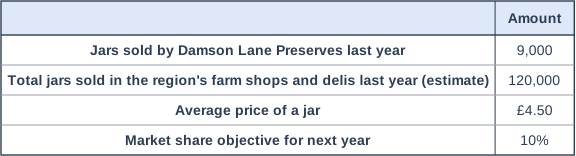
Harriet runs Damson Lane Preserves, a small business in Somerset that makes chutneys and jams and sells them to farm shops and delis in the South West. Her objective for next year is to reach a 10% share of the market for chutneys and jams sold through farm shops and delis in the region. The table shows information from her research. Harriet expects the total size of the market to stay the same next year.

Using the information in the table, calculate, to 2 decimal places, the percentage increase in Damson Lane Preserves' sales, in jars, needed to meet its market share objective.

Table with columns (row headings), "Amount". Jars sold by Damson Lane Preserves last year; Amount: 9,000 | Total jars sold in the region's farm shops and delis last year (estimate); Amount: 120,000 | Average price of a jar; Amount: £4.50 | Market share objective for next year; Amount: 10%.

Model answer

Target sales = 10% × 120,000 = 12,000 jars
Increase needed = 12,000 - 9,000 = 3,000 jars
3,000 ÷ 9,000 × 100 = 33.33%

Explanation

First find the sales needed for a 10% share of a market of 120,000 jars (12,000 jars), then work out the increase as a percentage of current sales of 9,000 jars. Dividing by 12,000 instead of 9,000 gives 25%, a common error. The price per jar is not needed because the objective is measured in jars.

Mark scheme
  1. 1 mark

    Fully correct working, e.g. 10% × 120,000 = 12,000 jars; (12,000 - 9,000) ÷ 9,000 × 100; or a correct final answer of 33.33% with no working

    An answer of 33.33% with no working scores 2 marks. A correct answer that is not given to 2 decimal places (33.3% or 33%) scores 1 mark, with or without working. If the final answer is wrong, award this mark only for fully correct working; a formula alone or partly correct working scores 0. If several different final answers are given, award 0.

  2. 1 mark

    33.33%

    Accept 33.33 without the % sign. Common wrong answers that score 0 for this mark: 25% (the increase divided by the target of 12,000 instead of current sales); 3,000 (the increase in jars, not a percentage); 2.5 (the change in market share in percentage points, from 7.5% to 10%).

Question 3

3 marks

Explain one benefit to a small business owner of setting objectives that can be measured.

Model answer

A measurable objective, such as increasing sales by 10% in a year, lets the owner check whether the business is on track. If sales are below target part-way through the year, the owner will notice early. This means they can take action, such as extra promotion, before the shortfall becomes too large to recover.

Explanation

One mark is for the benefit, such as being able to check progress, and two more are for two linked strands that show how this helps the business. A definition of an objective, or an example of one, is not a strand. Each strand must add a new step, such as spotting a problem early and then acting on it.

Mark scheme
  1. 1 mark

    Award 1 mark for identification of a benefit to a small business owner of setting objectives that can be measured.

    Answers that list more than one benefit with no explanation will be awarded a maximum of 1 mark. Accept any other appropriate response. Valid benefits include: the owner can check whether the business is on track; problems are spotted early so action can be taken; objectives give the owner and any staff a clear target to work towards; they help the owner plan resources such as stock, staff and finance; they help when explaining plans to a bank or investor. Do not accept a definition of an objective on its own.

  2. 2 marks

    Award up to 2 further marks for explaining this benefit (1 mark for each linked strand of development).

    Examples: A measurable objective, such as increasing sales by 10% in a year, lets the owner check whether the business is on track (1). If sales are below target part-way through the year, the owner will notice early (1). This means they can take action, such as extra promotion, before the shortfall becomes too large to recover (1). / Measurable objectives give any staff a clear target to aim for (1). This can motivate them, because they can see their progress (1). As a result, they may work harder to win sales, increasing the business's revenue (1). A restatement of the benefit, a definition or an example on its own is not a strand. Vague endings such as 'the business will be more successful' are not credited.

Question 4

6 marks

Imogen opened Trailshare Outdoor Hire, a shop in Matlock that hires out camping and hiking kit, two years ago. Customers hire tents, rucksacks, sleeping bags and walking boots for a weekend or a week instead of buying them, so less kit is bought for one trip and then thrown away. Imogen has set two social objectives: to keep 5,000 items of kit in use each year by repairing them rather than throwing them away, and to buy at least half of the shop's kit from UK makers. She also gives a 10% discount to customers on low incomes.

UK makers charge Imogen more than overseas wholesalers do. Last year Trailshare made a profit of £14,000 on revenue of £96,000. The shop was featured in a local newspaper article about cutting waste in outdoor sports, and many customers say they hire from it because of what it stands for.

Analyse the impact on Trailshare Outdoor Hire of its social objectives.

Model answer

Imogen's objective of buying at least half of Trailshare's kit from UK makers raises the shop's costs, because UK makers charge more than overseas wholesalers. She also gives customers on low incomes a 10% discount, which reduces the revenue from some hires. Therefore the profit on each tent or rucksack she hires out is lower. As a result, Trailshare's profit of £14,000 on revenue of £96,000 is lower than it could be, leaving Imogen less retained profit to buy more kit or expand the shop.

However, Trailshare's aim of keeping 5,000 items of kit in use each year gives it a clear unique selling point that outdoor shops selling new kit do not offer. This means walkers and campers who care about waste choose Trailshare and come back for each trip, and many say they hire from it because of what it stands for. It has also brought free publicity through the local newspaper article. Therefore Trailshare can attract new customers while spending less on advertising, which supports its revenue.

Explanation

A top answer develops one or two impacts, such as higher costs from UK makers and a loyal customer base from the waste-cutting USP, through about five linked strands. Context such as the UK makers, the 5,000 items of kit, the 10% discount, the £14,000 profit and the newspaper article must be used in every paragraph. An impact can be positive or negative, but evaluation is not credited in an 'Analyse' question.

Mark scheme
  1. 6 marks

    Levels of response (6 marks).
    Level 3 (5-6 marks): Detailed application of knowledge and understanding of business concepts and issues to the business context throughout (AO2). Deconstructs business information and/or issues, finding detailed interconnected points with logical chains of reasoning (AO3a).
    Level 2 (3-4 marks): Sound application of knowledge and understanding of business concepts and issues to the business context although there may be some inconsistencies (AO2). Deconstructs business information and/or issues, finding interconnected points with chains of reasoning, although there may be some logical inconsistencies (AO3a).
    Level 1 (1-2 marks): Limited application of knowledge and understanding of business concepts and issues to the business context (AO2). Attempts to deconstruct business information and/or issues, finding limited connections between points (AO3a).
    0 marks: No rewardable material.

    Indicative content (not a checklist; credit other valid points):
    - Imogen buys at least half of her kit from UK makers, who charge more than overseas wholesalers, and gives a 10% discount to customers on low incomes (AO2).
    - Trailshare's aim of keeping 5,000 items of kit in use each year led to a local newspaper article, and many customers hire from it because of what it stands for (AO2).
    - Buying tents and rucksacks from more expensive UK makers raises the cost of the kit Trailshare hires out, and repairing kit to keep it in use takes staff time and materials. The 10% discount also reduces the revenue from some hires. Therefore the profit on each hire is lower, so profit (£14,000 on revenue of £96,000) is lower than it could be, leaving less retained profit to buy more kit or expand (AO3a).
    - The social objectives give Trailshare a unique selling point that outdoor shops selling new kit do not offer. This attracts walkers and campers who care about waste and makes them loyal, so they come back for each trip. As a result, it gets free publicity, such as the newspaper article, so it can attract customers while spending less on advertising, which helps its revenue (AO3a).
    - Kit bought from UK makers may be better made and last longer, so each tent or rucksack can be hired out more times before it has to be replaced, which lowers Trailshare's costs over time (AO3a).
    Marking notes: an 'impact' can be positive, negative or both. Only the best two points are credited; Level 3 for AO3a needs about five linked strands from one or two points. Context only counts inside a valid point, and copying the case or using the business name or words from the question is not application. A generic answer with no application to Trailshare Outdoor Hire cannot score more than 3 marks. Evaluation is not required and is not credited.

Ready to try the rest? Every answer you write is marked against the mark scheme, so you can see exactly where the marks are.

Study Helper Hints first, answers after you try

Stuck on this one? Ask for a hint and I’ll point you in the right direction, without giving the answer away. Once you’ve checked your answer, I’ll show you how the marks are awarded.