
Level:
Correct: 0
Incorrect: 0
Marks: 0/0
Exam Practice
Course:
Topics:
Edexcel GCSE Business (Paper 1) Smart practice A mixed round aimed at your weak spots
Unit 1
Enterprise and entrepreneurship
The dynamic nature of business
Risk and reward
Risk and reward
Unit 2
Spotting a business opportunity
Unit 3
Putting a business idea into practice
Unit 4
Making the business effective
The options for start-up and small businesses
Limited liability and types of business ownership
Franchising
Business location
Business location
The marketing mix
The marketing mix
Business plans
Business plans
Unit 5
Understanding external influences on business
Business stakeholders
Technology and business
Legislation and business
The economy and business
Avg
score:
–
Topics
done:
0/24

Technology and business

Practise 19 exam-style questions on Technology and business for Edexcel GCSE Business (Paper 1). Write your answer as you would in the exam and get it marked in seconds against the mark scheme, point by point, with the Study Helper on hand if you get stuck.

  • 19 questions
  • 1–12 marks each
  • Instant marking
  • No sign-up needed
19 questions, marked as you go

Sample questions with model answers

Here are 4 of the questions in this topic, each with a model answer, an explanation of why it earns the marks and the mark scheme an examiner would use.

Question 1

1 mark

Freya runs Purl & Pompom, a business in Kendal that sells hand-knitted baby clothes and blankets. Until now she has sold them only at craft fairs in Cumbria, where customers pay in cash or by card. Freya has paid a web designer to set up a website so that customers anywhere in the UK can order her knitwear online.

State one cost, other than setting up the website, that Purl & Pompom will have from selling its products online.

Model answer

Postage to send the baby clothes to customers who order online.

Explanation

Selling online brings new costs, such as postage, packaging and payment fees for each order. The answer must be linked to this business, so 'postage' alone scores 0 but 'postage for the baby clothes' scores 1. The cost of setting up the website is excluded by the question.

Mark scheme
  1. 1 mark

    Award 1 mark for stating one cost, other than setting up the website, that Purl & Pompom will have from selling its products online.

    To award 1 mark there must be evidence of application. Examples that score: postage to send the baby clothes or blankets to customers (1); packaging such as mailing bags or tissue paper for the knitwear (1); a fee on each online card payment for the baby clothes (1); a monthly fee to keep the online shop for the knitwear running (1); photographing the blankets and baby clothes for the website (1); refunds or return postage for baby clothes sent back by online customers (1). Do not accept a generic answer with no link to the case, such as 'delivery', 'packaging' or 'payment fees' alone ('postage for sending the blankets' = 1). Do not accept the cost of setting up or designing the website, which the question excludes, or costs that do not come from selling online, such as wool or stall fees at craft fairs.
Question 2

2 marks

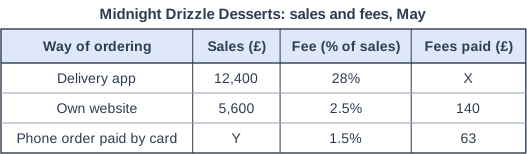
Midnight Drizzle Desserts is a dessert parlour in Omagh owned by Rania and her brother Sami. It sells waffles, crêpes and milkshakes. Customers can order through a food delivery app, through the parlour's own website, or by phoning and paying by card. Each way of ordering charges the business a fee, shown as a percentage of the sales made that way.

The table shows the parlour's sales and fees for May.

Work out the values of X and Y in the table. You are advised to show your workings.

Midnight Drizzle Desserts: sales and fees, May. Table with columns "Way of ordering", "Sales (£)", "Fee (% of sales)", "Fees paid (£)". Way of ordering: Delivery app; Sales (£): 12,400; Fee (% of sales): 28%; Fees paid (£): X | Way of ordering: Own website; Sales (£): 5,600; Fee (% of sales): 2.5%; Fees paid (£): 140 | Way of ordering: Phone order paid by card; Sales (£): Y; Fee (% of sales): 1.5%; Fees paid (£): 63.

Model answer

X = £12,400 × 28% = £12,400 × 0.28 = £3,472
Y = £63 ÷ 1.5% = £63 ÷ 0.015 = £4,200

Explanation

X is 28% of the delivery app sales of £12,400. Y works the other way round: the £63 fee is 1.5% of the phone sales, so the sales are £63 ÷ 0.015 = £4,200 (1% of the sales is £42, so 100% is £4,200). The website row shows the same method, as 2.5% of £5,600 is £140.

Mark scheme
  1. 1 mark

    X = £3,472 (e.g. £12,400 × 28 ÷ 100)

    Answers of £3,472 for X and £4,200 for Y with no working score 2 marks. Each value is marked on its own. Accept 3472 or 3,472 without the £ sign. Do not accept £8,928 (the sales left after the fee is taken off), £347.20 (2.8% used instead of 28%) or £442.86 (£12,400 ÷ 28).

  2. 1 mark

    Y = £4,200 (e.g. £63 ÷ 1.5 × 100)

    Accept 4200 or 4,200 without the £ sign. Do not accept £42 (£63 ÷ 1.5, not multiplied by 100), £0.95 or £94.50 (the fee multiplied by the percentage) or £4,263 (the fee added to the sales).

Question 3

3 marks

Explain one way that using new technology could add to a small business's costs.

Model answer

A small business may need to pay a monthly subscription for software, such as an online booking or accounts system. This is a fixed cost that has to be paid every month, even when sales are low. The fee often rises as more staff use the system, so the cost grows as the business grows.

Explanation

Technology often saves money, but it also brings costs: equipment, subscriptions, payment fees, training and updates. Because this is a 'way' question, the two strands must explain how the cost arises or grows, not what happens to profit afterwards. Listing several costs earns only 1 mark.

Mark scheme
  1. 1 mark

    Award 1 mark for identification of a way that using new technology could add to a small business's costs.

    Answers that list more than one way with no explanation will be awarded a maximum of 1 mark. Accept any other appropriate response. Valid ways include: buying equipment such as card readers, tills, tablets or laptops; monthly subscriptions or fees for software, a website or an app; fees charged on card, online or app payments; training staff to use new systems; repairing, updating or replacing technology that becomes out of date; protecting the business against online fraud or hacking; paying specialists such as a web designer or someone to run social media accounts. Do not accept ways that reduce costs.

  2. 2 marks

    Award up to 2 further marks for explaining this way (1 mark for each linked strand of development).

    Examples: A small business may need to pay a monthly subscription for software, such as an online booking or accounts system (1). This is a fixed cost that has to be paid every month, even when sales are low (1). The fee often rises as more staff use the system, so the cost grows as the business grows (1). / Staff may need training to use new technology such as an online stock system (1). The business has to pay for the training and for the hours staff spend learning rather than working (1). Mistakes are also more likely while staff are learning, such as wrong orders that cost money to put right (1). This is a 'way' question, so strands must explain how the cost arises or grows; endings such as 'so profit falls' or 'the business could fail' are not credited as strands. A restatement of the way or an example of a piece of technology is not a strand.

Question 4

6 marks

Kwahu Kitchen is a Ghanaian takeaway in Croydon owned by Kwame and his wife Abena. It sells dishes such as jollof rice, waakye and grilled tilapia. At present customers order by phone or at the counter and collect their food, and most live within a mile of the takeaway. Last year its revenue was £148,000.

Kwame and Abena have now joined a food delivery app. Customers can browse the menu, order and pay on the app, and a driver working for the app delivers the food. The app takes 30% of the value of each order as commission. Abena has noticed that the kitchen is often quiet between 2 pm and 5 pm and on Monday evenings.

Analyse the impact on Kwahu Kitchen of selling its food through a food delivery app.

Model answer

The delivery app shows Kwahu Kitchen's menu to people across Croydon who have never been to the takeaway, not just the customers who live within a mile. These people can order jollof rice or waakye without having to collect it. Therefore the takeaway can win new customers, and because app orders can come in during quiet times, such as between 2 pm and 5 pm and on Monday evenings, the kitchen is used more fully. As a result, revenue could rise above last year's £148,000 without much extra fixed cost, such as rent, so profit may increase.

However, the app takes 30% of each order as commission, so on a £20 order Kwame and Abena keep only £14. This means the profit margin on every app order is much lower than on a phone order. If regular customers who used to phone and collect switch to the app because it is easier, the takeaway would earn less from the same customers. Therefore its profit could fall even though it is selling more meals, and raising its prices on the app to cover the commission might put some customers off.

Explanation

A top answer develops one or two impacts through about five linked strands and uses the case throughout, such as the 30% commission, the quiet afternoons and the customers within a mile. Selling through an app is e-commerce, so the main impacts are on sales and on costs or profit margins, not on promotion. A generic answer about delivery apps cannot score more than 3 marks.

Mark scheme
  1. 6 marks

    Levels of response (6 marks).
    Level 3 (5-6 marks): Detailed application of knowledge and understanding of business concepts and issues to the business context throughout (AO2). Deconstructs business information and/or issues, finding detailed interconnected points with logical chains of reasoning (AO3a).
    Level 2 (3-4 marks): Sound application of knowledge and understanding of business concepts and issues to the business context although there may be some inconsistencies (AO2). Deconstructs business information and/or issues, finding interconnected points with chains of reasoning, although there may be some logical inconsistencies (AO3a).
    Level 1 (1-2 marks): Limited application of knowledge and understanding of business concepts and issues to the business context (AO2). Attempts to deconstruct business information and/or issues, finding limited connections between points (AO3a).
    0 marks: No rewardable material.

    Indicative content (not a checklist; credit other valid points):
    - The app shows the menu to people across Croydon who have never visited, not only the customers who live within a mile, and lets them order jollof rice or waakye without collecting it (AO2).
    - The app takes 30% of each order as commission, so on a £20 order Kwame and Abena keep only £14 (AO2).
    - New customers, and orders placed in quiet times such as 2 pm to 5 pm and Monday evenings, mean the kitchen and staff are used more fully. Therefore revenue can rise above last year's £148,000 with little extra fixed cost, so profit may increase (AO3a).
    - The commission cuts the profit margin on every app order. As a result, if regular customers who used to phone and collect switch to the app, the takeaway earns less from the same customers, and raising prices on the app to cover the commission could reduce demand (AO3a).
    Marking notes: only the best two points are credited; Level 3 for AO3a needs about five linked strands from one or two points. Context only counts inside a valid point, and copying the case or using the business name or words from the question is not application. A generic answer with no application to Kwahu Kitchen cannot score more than 3 marks. Evaluation is not required and is not credited. Points must be about selling through the app; the app's drivers make the deliveries, so 'the takeaway must employ delivery drivers' is not valid.

Ready to try the rest? Every answer you write is marked against the mark scheme, so you can see exactly where the marks are.

Study Helper Hints first, answers after you try

Stuck on this one? Ask for a hint and I’ll point you in the right direction, without giving the answer away. Once you’ve checked your answer, I’ll show you how the marks are awarded.