
Level:
Correct: 0
Incorrect: 0
Marks: 0/0
Exam Practice
Course:
Topics:
Edexcel GCSE Business (Paper 1) Smart practice A mixed round aimed at your weak spots
Unit 1
Enterprise and entrepreneurship
The dynamic nature of business
Risk and reward
Risk and reward
Unit 2
Spotting a business opportunity
Unit 3
Putting a business idea into practice
Unit 4
Making the business effective
The options for start-up and small businesses
Limited liability and types of business ownership
Franchising
Business location
Business location
The marketing mix
The marketing mix
Business plans
Business plans
Unit 5
Understanding external influences on business
Business stakeholders
Technology and business
Legislation and business
The economy and business
Avg
score:
–
Topics
done:
0/24

Risk and reward

Practise 17 exam-style questions on Risk and reward for Edexcel GCSE Business (Paper 1). Write your answer as you would in the exam and get it marked in seconds against the mark scheme, point by point, with the Study Helper on hand if you get stuck.

  • 17 questions
  • 1–12 marks each
  • Instant marking
  • No sign-up needed
17 questions, marked as you go

Sample questions with model answers

Here are 4 of the questions in this topic, each with a model answer, an explanation of why it earns the marks and the mark scheme an examiner would use.

Question 1

1 mark

Give one reward that an entrepreneur may receive from starting a business.

Model answer

Independence - being your own boss.

Explanation

The specification lists three rewards of enterprise: business success, profit and independence. Close wordings such as 'being your own boss' also score. Revenue is not a reward on its own, because the owner keeps only what is left after costs have been paid.

Mark scheme
  1. 1 mark

    Award 1 mark for giving one reward of starting a business.

    No application is needed. Accept the rewards in the specification or close interpretations of them: business success (e.g. seeing the business grow and succeed); profit (e.g. keeping the profit the business makes); independence (e.g. being your own boss, making your own decisions or choosing your working hours). Award any other close interpretation, such as the satisfaction of building a successful business. Do not accept risks (business failure, financial loss, lack of security), 'revenue' or 'sales' on their own (revenue is not profit), or 'a bank loan'.
Question 2

2 marks

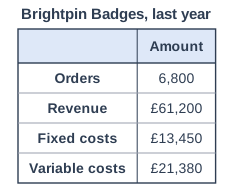
Mia worked as a laboratory technician, earning a salary of £23,900 a year, before she started Brightpin Badges in Lancaster. She now designs enamel pin badges and keyrings full time and sells them online and at comic conventions. The table shows information about the business last year.

Using the information in the table, calculate how much more profit Brightpin Badges made last year than the salary Mia gave up. You are advised to show your workings.

Brightpin Badges, last year. Table with columns (row headings), "Amount". Orders; Amount: 6,800 | Revenue; Amount: £61,200 | Fixed costs; Amount: £13,450 | Variable costs; Amount: £21,380.

Model answer

Total costs = £13,450 + £21,380 = £34,830
Profit = £61,200 - £34,830 = £26,370
Difference = £26,370 - £23,900 = £2,470

Explanation

First work out the profit (revenue minus fixed and variable costs), then compare it with the salary Mia gave up. The number of orders is extra data that is not needed. Revenue is not profit: Mia took in £61,200 but her reward was the £26,370 left after costs.

Mark scheme
  1. 1 mark

    Fully correct working, e.g. £61,200 - (£13,450 + £21,380) - £23,900; or a correct final answer of £2,470 with no working

    An answer of £2,470 with no working scores 2 marks. If the final answer is wrong, award this mark only for fully correct working (profit = £61,200 - £34,830 = £26,370, then £26,370 - £23,900); a formula alone or partly correct working scores 0. If several different final answers are given, award 0.

  2. 1 mark

    £2,470

    Accept 2470 or 2,470 without the £ sign. Do not accept £26,370 (the profit, not the difference), £37,300 (revenue minus the salary, with no costs taken off), £15,920 (fixed costs left out) or £23,850 (variable costs left out).

Question 3

3 marks

Explain one way an entrepreneur could reduce the risk of financial loss when starting a small business.

Model answer

The entrepreneur could carry out market research before spending money on the business. This shows whether enough customers want the product and at what price. Therefore they avoid buying stock or equipment for a product that will not sell, so less of their money is at risk.

Explanation

This is a 'way' question, so the two development marks must explain how the method cuts the amount of money that could be lost. Ending with 'so the business makes more profit' does not answer the question. Three linked sentences are enough for 3 marks.

Mark scheme
  1. 1 mark

    Award 1 mark for identification of a way an entrepreneur could reduce the risk of financial loss when starting a small business.

    Answers that list more than one way with no explanation will be awarded a maximum of 1 mark. Accept any other appropriate response. Valid ways include: carrying out market research before spending money; starting small, for example part-time or online, to test the idea; renting or leasing premises and equipment instead of buying them; taking deposits or pre-orders from customers; keeping some savings back instead of investing them all; setting up as a private limited company so that the owner has limited liability. This is a 'way' question, so the strands must explain how the method reduces the risk of losing money; endings such as 'this increases profit' or 'the business will be successful' are not credited.

  2. 2 marks

    Award up to 2 further marks for explaining this way (1 mark for each linked strand of development).

    Examples: The entrepreneur could carry out market research before spending money on the business (1). This shows whether enough customers want the product and at what price (1). Therefore they avoid buying stock or equipment for a product that will not sell, so less money is at risk (1). / The entrepreneur could set up a private limited company (1). This gives them limited liability, so their personal assets, such as their home, cannot be used to pay the business's debts (1). As a result, the most they can lose is the money they have invested in the company (1). / The entrepreneur could start the business part-time or online first (1). This means they do not have to pay for premises before they know the idea works (1). As a result, if the idea fails, the amount of money they lose is much smaller (1). A restatement of the way, a definition or an example is not a strand.

Question 4

6 marks

Mariam is a science teacher in Stafford. She plans to start Wonderlens VR as a sole trader. The business would take a set of 30 virtual reality (VR) headsets into primary schools, so that pupils can take virtual 'trips' through the solar system, a rainforest and ancient Egypt. She would charge schools £450 for a day of sessions.

The headsets, two laptops and a van would cost £38,000. Mariam would pay £14,000 from her savings and borrow the remaining £24,000 from a bank. She plans to reduce her teaching to two days a week. Schools only book visits during term time, many say their budgets for trips and visits are tight, and two national companies already offer similar VR sessions.

Analyse the impact on Mariam of the risks of starting Wonderlens VR.

Model answer

Mariam would put £14,000 of her savings into the VR headsets, laptops and van and borrow the other £24,000 from the bank. If schools do not book enough days at £450, the business may not earn enough to cover its costs and the loan repayments. Therefore Mariam could lose her savings. As a sole trader she has unlimited liability, so she would still have to repay the loan from her own money, which could put her personal assets at risk.

Mariam also plans to cut her teaching to two days a week, so her regular salary would fall. This means more of her income would depend on bookings, which only happen in term time. As a result, her income would be uncertain from month to month and very low in the school holidays. This lack of security is made worse because many schools say their budgets for visits are tight and two national companies already offer similar VR sessions, so she cannot be sure how many bookings she will get.

Explanation

A top answer takes one or two risks, such as financial loss and lack of security, and develops each through linked steps using the case: the £14,000 of savings, the £24,000 loan, term-time bookings and the cut in teaching days. Remember that the question asks about the impact on Mariam, not just on the business. An answer that would fit anyone starting a business cannot score more than 3 marks.

Mark scheme
  1. 6 marks

    Levels of response (6 marks).
    Level 3 (5-6 marks): Detailed application of knowledge and understanding of business concepts and issues to the business context throughout (AO2). Deconstructs business information and/or issues, finding detailed interconnected points with logical chains of reasoning (AO3a).
    Level 2 (3-4 marks): Sound application of knowledge and understanding of business concepts and issues to the business context although there may be some inconsistencies (AO2). Deconstructs business information and/or issues, finding interconnected points with chains of reasoning, although there may be some logical inconsistencies (AO3a).
    Level 1 (1-2 marks): Limited application of knowledge and understanding of business concepts and issues to the business context (AO2). Attempts to deconstruct business information and/or issues, finding limited connections between points (AO3a).
    0 marks: No rewardable material.

    Indicative content (not a checklist; credit other valid points):
    - Mariam would put £14,000 of her savings into the VR headsets, laptops and van, and borrow the other £24,000 (AO2).
    - She plans to cut her teaching to two days a week, and bookings would only come in term time from schools with tight budgets, where two national companies already offer similar VR sessions (AO2).
    - If schools do not book enough days at £450, the business may not earn enough to cover its costs and repay the £24,000 loan. Therefore Mariam could lose her savings, and as a sole trader with unlimited liability she would still have to repay the loan from her own money, which could put her personal assets at risk (AO3a).
    - Cutting her teaching to two days means her regular salary falls, so more of her income depends on bookings that only happen in term time. As a result her income would be uncertain from month to month and very low in the school holidays, which is a lack of security (AO3a).
    - Tight school budgets and two national rivals mean she cannot be sure of enough bookings, so the risk of business failure is higher; if the business fails, she would be left with debts and a reduced teaching income (AO3a).
    Marking notes: the question asks about the impact on Mariam, so answers should focus on her (savings, personal assets, income, security), not only on the business. Only the best two points are credited; Level 3 for AO3a needs about five linked strands from one or two points. Context only counts inside a valid point, and copying the case or using the business name or words from the question is not application. A generic answer with no application to Mariam's business cannot score more than 3 marks. Answers that read 'lack of security' as physical security are not credited. Evaluation is not required and is not credited.

Ready to try the rest? Every answer you write is marked against the mark scheme, so you can see exactly where the marks are.

Study Helper Hints first, answers after you try

Stuck on this one? Ask for a hint and I’ll point you in the right direction, without giving the answer away. Once you’ve checked your answer, I’ll show you how the marks are awarded.