
Level:
Correct: 0
Incorrect: 0
Marks: 0/0
Exam Practice
Course:
Topics:
Avg
score:
–
Topics
done:
0/17

Variation and evolution

Practise 21 exam-style questions on Variation and evolution for AQA GCSE Combined Science (Foundation Biology Paper 2). Write your answer as you would in the exam and get it marked in seconds against the mark scheme, point by point, with the Study Helper on hand if you get stuck.

  • 21 questions
  • 1–6 marks each
  • Instant marking
  • No sign-up needed
20 questions, marked as you go

Sample questions with model answers

Here are 4 of the questions in this topic, each with a model answer, an explanation of why it earns the marks and the mark scheme an examiner would use.

Question 1

1 mark

Which statement about mutations is correct?

Choose your answer.

  • All mutations are harmful to the organism
  • Most mutations completely change the phenotype
  • Mutations only happen when cells are exposed to radiation
  • Most mutations have no effect on the phenotype

Model answer

Most mutations have no effect on the phenotype

Explanation

All genetic variants arise from mutations. Most mutations have no effect on the phenotype, some influence it, and very few determine it. A common misconception is that mutations are always harmful or always caused by radiation: they occur continuously.

Mark scheme
  1. 1 mark

    Most mutations have no effect on the phenotype

    If more than one option is given, 0 marks. Mutations occur continuously; most have no effect on the phenotype, some influence it and very few determine it. Mutations are not all harmful (a few are useful), very few change the phenotype completely, and they do not happen only after exposure to radiation.
Question 2

2 marks

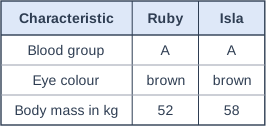
Ruby and Isla are identical twins. Identical twins have the same genes.

The table shows some information about the twins at age 16.

Explain why the twins have the same blood group but different body masses.

Table with columns "Characteristic", "Ruby", "Isla". Characteristic: Blood group; Ruby: A; Isla: A | Characteristic: Eye colour; Ruby: brown; Isla: brown | Characteristic: Body mass in kg; Ruby: 52; Isla: 58.

Model answer

Blood group is controlled only by genes. The twins have identical genes, so they have the same blood group. Body mass is also affected by the environment, for example by diet and the amount of exercise. The twins' genes are the same, so the 6 kg difference in their body masses must be caused by differences in their environment, such as one twin eating more or exercising less.

Explanation

Identical twins have the same genes, so any difference between them must be caused by the environment. Characteristics such as blood group, which are controlled only by genes, are the same in both twins. Name an environmental factor (diet, exercise) rather than just saying 'lifestyle'.

Mark scheme
  1. 1 mark

    blood group is controlled only by genes, and the twins have the same genes

    allow 'blood group is genetic / inherited (and they have identical genes)'.

  2. 1 mark

    body mass is (also) affected by the environment, e.g. the twins have different diets / take different amounts of exercise

    allow 'the difference in mass must be environmental because their genes are the same'. allow any sensible environmental factor (diet, exercise, illness). ignore 'lifestyle' unqualified. do not accept 'they have different genes for mass'.

Question 3

2 marks

Two populations of one species of mouse live in different areas. Over many generations, the two populations have become very different in phenotype.

Describe how scientists could find out whether the two populations have now become two different species.

Model answer

The scientists could mate a mouse from one population with a mouse from the other. If they cannot produce offspring, or if their offspring are infertile and cannot reproduce, the two populations have become two different species.

Explanation

When two populations of one species become so different in phenotype that they can no longer interbreed to produce fertile offspring, they have formed two new species. So the test is a breeding test, including checking whether any offspring are fertile. Comparing appearance is not enough.

Mark scheme
  1. 1 mark

    breed / mate a mouse from one population with a mouse from the other population

    allow 'see if they can interbreed'.

  2. 1 mark

    if they cannot produce offspring, or their offspring are not fertile (cannot reproduce), they are different species

    allow the converse: 'if they produce fertile offspring they are still one species'. allow 'breed the offspring to see if they are fertile'. ignore comparing appearance or DNA.

Question 4

4 marks

Peppered moths can be pale or dark in colour. The colour is inherited. Birds eat peppered moths that rest on tree bark.

After the air in an industrial area became cleaner, the bark on the trees became paler. Over many years, the percentage of pale moths in the population increased.

Explain why the percentage of pale moths increased.

Model answer

On the paler bark, pale moths were camouflaged, so birds found it harder to see them. Fewer pale moths were eaten, while more dark moths were caught. So pale moths were more likely to survive and reproduce, and they passed on the alleles for pale colour to their offspring. Over many generations, the percentage of pale moths in the population increased.

Explanation

This is natural selection: the pale variant was better suited to the new environment, so it was more likely to survive, reproduce and pass on its alleles. Marks are lost for 'survive' without 'reproduce', and for saying that moths changed colour - individual moths cannot change their inherited colour.

Mark scheme
  1. 1 mark

    pale moths were camouflaged / harder for birds to see on the pale bark

    allow 'dark moths were easier to see'.

  2. 1 mark

    so fewer pale moths were eaten (by birds) / more dark moths were eaten

    allow 'pale moths were less likely to be caught'.

  3. 1 mark

    pale moths were more likely to survive and reproduce / breed

    reproduce / breed is needed for this mark; 'survive' alone is not enough.

  4. 1 mark

    (and) pass on the allele(s) / genes for pale colour to their offspring

    allow 'their offspring inherit the pale colour'.

  5. 1 mark

    this happened over many generations

    max 4. do not accept 'the moths changed colour to match the bark' or 'the moths became pale because the bark was pale' (individuals do not change).

Ready to try the rest? Every answer you write is marked against the mark scheme, so you can see exactly where the marks are.

Study Helper Hints first, answers after you try

Stuck on this one? Ask for a hint and I’ll point you in the right direction, without giving the answer away. Once you’ve checked your answer, I’ll show you how the marks are awarded.