Practise 18 exam-style questions on Classification of living organisms for AQA GCSE Combined Science (Foundation Biology Paper 2). Write your answer as you would in the exam and get it marked in seconds against the mark scheme, point by point, with the Study Helper on hand if you get stuck.
18 questions
1–6 marks each
Instant marking
No sign-up needed
18 questions, marked as you go
Sample questions with model answers
Here are 4 of the questions in this topic, each with a model answer, an explanation of why it earns the marks and the mark scheme an examiner would use.
Question 1
1 mark
Some single-celled organisms live in hot springs where the water is above 80 °C. Their cells have no nucleus. Chemical analysis shows that these organisms are very different from true bacteria.
Name the domain that these organisms belong to in the three-domain system.
Model answer
Archaea
Explanation
In Carl Woese's three-domain system, Archaea are primitive bacteria that usually live in extreme environments such as hot springs and very salty lakes. They have no nucleus, like true bacteria, but chemical analysis shows that they are very different from them, so they are given a domain of their own.
Mark scheme
1 mark
Archaea
Allow phonetic spellings, e.g. 'Arkaea', 'Archea'. Allow archaebacteria. Do not accept Bacteria. Do not accept prokaryotes (not a domain).
Question 2
1 mark
Scientists use evolutionary trees.
What does an evolutionary tree show?
Model answer
An evolutionary tree shows how scientists believe organisms are related to each other.
Explanation
Evolutionary trees are a method used by scientists to show how they believe organisms are related. They are built from current classification data for living organisms and fossil data for extinct organisms. Do not confuse them with family trees, which show how a characteristic is inherited in one family.
Mark scheme
1 mark
how (scientists believe) organisms are related
Allow which organisms share common ancestors / how organisms have evolved from common ancestors. Ignore 'a family tree' unqualified. Do not accept 'how a characteristic is inherited in a family' (that is a family tree / pedigree).
Question 3
2 marks
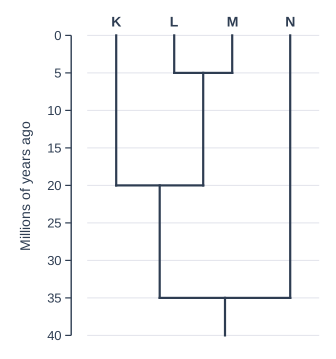
The diagram is an evolutionary tree for four species, K to N.
Scientists say that species L and M are more closely related than species K and L.
Use the diagram to explain why.
Model answer
L and M share a more recent common ancestor than K and L. The lines of L and M split apart 5 million years ago, but the line of K split from the line leading to L and M 20 million years ago.
Explanation
On an evolutionary tree, two species are more closely related when their lines join at a more recent common ancestor - closer to the present day. Reading the times of the two branch points from the axis supports the explanation with data.
Mark scheme
1 mark
L and M share a more recent common ancestor (than K and L)
Allow L and M branched apart / diverged more recently.
1 mark
L and M separated 5 million years ago, but K and L separated 20 million years ago
Both times are needed for this mark. Allow 'L and M split 15 million years after K split from them'.
Question 4
4 marks
The three-domain system divides organisms into Archaea, Bacteria and Eukaryota.
Match each organism, A to D, to its domain.
A: Plasmodium, a single-celled protist that causes malaria B: a single-celled organism that lives in very salty lakes; it has no nucleus and its chemistry is very different from that of true bacteria C: Lactobacillus, a true bacterium used to make yoghurt D: Penicillium, a mould (a type of fungus) that produces penicillin
Write each letter with its domain.
Model answer
A: Eukaryota B: Archaea C: Bacteria D: Eukaryota
Explanation
Eukaryota includes protists, fungi, plants and animals, so both Plasmodium (a protist) and Penicillium (a fungus) are eukaryotes. Archaea are primitive bacteria that usually live in extreme environments such as very salty lakes. Lactobacillus is a true bacterium, so it is in the domain Bacteria.
Mark scheme
1 mark
A - Eukaryota
Allow phonetic spellings of the domain names, e.g. 'Eukaryotes', 'Eucaryota'.
1 mark
B - Archaea
Allow archaebacteria.
1 mark
C - Bacteria
1 mark
D - Eukaryota
If a letter is given more than one domain, 0 marks for that letter.
Ready to try the rest? Every answer you write is marked against the mark scheme, so you can see exactly where the marks are.
Ctrl + Enter to check
Study HelperHints first, answers after you try
Stuck on this one? Ask for a hint and I’ll point you in the right direction, without giving the answer away. Once you’ve checked your answer, I’ll show you how the marks are awarded.