
Level:
Correct: 0
Incorrect: 0
Marks: 0/0
Exam Practice
Course:
Topics:
Avg
score:
–
Topics
done:
0/17

Sexual and asexual reproduction and meiosis

Practise 20 exam-style questions on Sexual and asexual reproduction and meiosis for AQA GCSE Combined Science (Foundation Biology Paper 2). Write your answer as you would in the exam and get it marked in seconds against the mark scheme, point by point, with the Study Helper on hand if you get stuck.

  • 20 questions
  • 1–6 marks each
  • Instant marking
  • No sign-up needed
20 questions, marked as you go

Sample questions with model answers

Here are 4 of the questions in this topic, each with a model answer, an explanation of why it earns the marks and the mark scheme an examiner would use.

Question 1

1 mark

Asexual reproduction produces offspring that are genetically identical to each other and to their parent.

What are these genetically identical offspring called?

Choose your answer.

  • Gametes
  • Embryos
  • Alleles
  • Clones

Model answer

Clones

Explanation

Offspring from asexual reproduction have exactly the same genetic information as their parent and each other: they are clones. They are produced by mitosis only, with no mixing of genetic information. Gametes, embryos and alleles are all terms from this topic, but none of them means genetically identical offspring.

Mark scheme
  1. 1 mark

    Clones

    If more than one option is given, 0 marks. Gametes are wrong: they are sex cells such as sperm and egg cells, not offspring. Embryos are wrong: an embryo is an early stage of development and can come from sexual reproduction. Alleles are wrong: an allele is a form of a gene, not an organism.
Question 2

2 marks

Sexual reproduction in flowering plants involves the joining (fusion) of a male gamete and a female gamete.

Name the male gamete and the female gamete in a flowering plant.

Model answer

The male gamete is pollen and the female gamete is the egg cell.

Explanation

In animals the gametes are sperm and egg cells; in flowering plants they are pollen and egg cells. When they fuse at fertilisation, the genetic information from the two parents is mixed. Naming a structure such as the ovary or ovule, which contains the egg cell, does not gain the mark.

Mark scheme
  1. 1 mark

    (male gamete) pollen

    allow pollen grain / pollen cell / pollen nucleus; do not award for 'sperm' alone (this is the male gamete in animals); do not accept anther / stamen

  2. 1 mark

    (female gamete) egg (cell)

    allow ovum / egg nucleus; do not accept ovary / ovule / seed (structures, not the gamete); if the two gametes are given the wrong way round, 0 marks

Question 3

2 marks

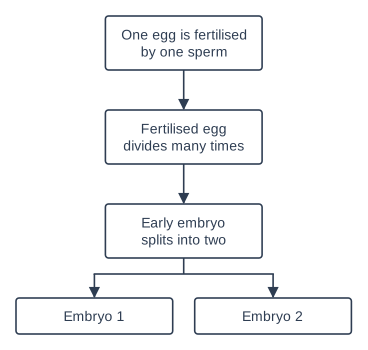
Identical twins develop from one fertilised egg. The flow chart shows how.

Explain why identical twins are genetically identical.

Flow chart of 5 boxes joined by arrows, read from top to bottom. The first box is "One egg is fertilised by one sperm", which leads to "Fertilised egg divides many times", which leads to "Early embryo splits into two". From "Early embryo splits into two", 2 arrows branch out side by side: the left arrow leads to "Embryo 1"; the right arrow leads to "Embryo 2".

Model answer

Both twins come from the same fertilised egg, made from one egg and one sperm, so they start with the same genetic information. The fertilised egg divides by mitosis, which produces genetically identical cells, so when the early embryo splits, both embryos have the same genetic information.

Explanation

The fertilised egg is the only source of the twins' genetic information, and all the divisions after fertilisation are by mitosis, which makes genetically identical cells. Non-identical twins are different: they come from two different eggs fertilised by two different sperm, which are genetically different because they were made by meiosis.

Mark scheme
  1. 1 mark

    they both come from the same fertilised egg / the same egg and sperm (so they start with the same genetic information)

    allow they come from one zygote / the same egg cell and sperm cell; ignore 'they have the same parents' unqualified (non-identical brothers and sisters also do)

  2. 1 mark

    the fertilised egg / cells divide by mitosis, which produces genetically identical cells

    allow the genetic information / DNA is copied exactly each time the cells divide; do not accept meiosis

Question 4

4 marks

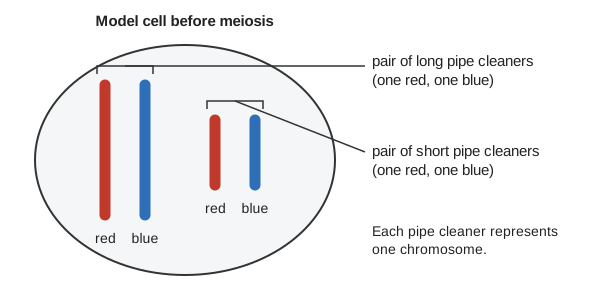
A student uses pipe cleaners to model meiosis. Each pipe cleaner represents one chromosome.

The figure shows the student's model of a cell before it divides. It has a pair of long pipe cleaners and a pair of short pipe cleaners. In each pair, one is red and one is blue. The student has more pipe cleaners of each length and colour.

Describe what the student should do with the pipe cleaners to model the formation of gametes from this cell by meiosis.

A large oval labelled 'Model cell before meiosis'. Inside are four pipe cleaners standing upright: two long ones side by side, one labelled red and one labelled blue, and two short ones side by side, one labelled red and one labelled blue. Labels on the right read 'pair of long pipe cleaners (one red, one blue)' and 'pair of short pipe cleaners (one red, one blue)'. A note reads 'Each pipe cleaner represents one chromosome.'

Model answer

First, the student should make a copy of each pipe cleaner using another pipe cleaner of the same length and colour, to show that copies of the genetic information are made. Then the student should split them into two groups, so each new cell gets one long and one short chromosome with their copies. Then each group is divided again, giving four gametes. Each gamete has just two pipe cleaners, one long and one short, so it has a single set of chromosomes. The gametes can have different combinations of red and blue, showing that they are genetically different.

Explanation

The model must show the three features of meiosis: copies of the genetic information are made, the cell divides twice, and four gametes are formed, each with a single set of chromosomes (one chromosome from each pair). A common error is to make only two gametes, or to put both chromosomes of a pair into one gamete.

Mark scheme
  1. 4 marks

    any four from:
    • make a copy of each pipe cleaner / add a second pipe cleaner of the same length and colour to each one (to show copies of the genetic information are made)
    • split the pipe cleaners into two groups / two new cells (the first division)
    • each new cell has one long and one short chromosome (and their copies) / one chromosome from each pair
    • divide each group again (the second division)
    • to give four gametes
    • each gamete has two pipe cleaners: one long and one short / a single set of chromosomes
    • the gametes can have different combinations of red and blue pipe cleaners (showing gametes are genetically different)

    1 mark for each point, max 4; the points may be given in any reasonable order, but 'divide twice' must follow the copying step for full marks; do not accept each gamete has both long pipe cleaners / a whole pair; do not accept dividing only once to form two gametes; ignore names of stages of meiosis

Ready to try the rest? Every answer you write is marked against the mark scheme, so you can see exactly where the marks are.

Study Helper Hints first, answers after you try

Stuck on this one? Ask for a hint and I’ll point you in the right direction, without giving the answer away. Once you’ve checked your answer, I’ll show you how the marks are awarded.