
Level:
Correct: 0
Incorrect: 0
Marks: 0/0
Exam Practice
Course:
Topics:
Avg
score:
–
Topics
done:
0/17

Communities, abiotic and biotic factors

Practise 22 exam-style questions on Communities, abiotic and biotic factors for AQA GCSE Combined Science (Foundation Biology Paper 2). Write your answer as you would in the exam and get it marked in seconds against the mark scheme, point by point, with the Study Helper on hand if you get stuck.

  • 22 questions
  • 1–6 marks each
  • Instant marking
  • No sign-up needed
20 questions, marked as you go

Sample questions with model answers

Here are 4 of the questions in this topic, each with a model answer, an explanation of why it earns the marks and the mark scheme an examiner would use.

Question 1

1 mark

What is meant by interdependence in a community?

Choose your answer.

  • Species compete with other species for light, water and space
  • The sizes of all the populations stay the same every year
  • Species depend on other species for food, shelter and pollination
  • The organisms depend only on non-living parts of the habitat

Model answer

Species depend on other species for food, shelter and pollination

Explanation

Within a community each species depends on other species for food, shelter, pollination, seed dispersal and so on. This is interdependence. Because of it, removing one species can affect the whole community.

Mark scheme
  1. 1 mark

    Species depend on other species for food, shelter and pollination

    If more than one option is given, 0 marks. Competition is a different idea from interdependence; populations staying fairly constant describes a stable community; organisms depend on other living organisms as well as non-living parts.
Question 2

2 marks

Gardeners remove weeds from around their vegetable plants.

Explain why removing weeds helps the vegetables to grow larger.

Model answer

Weeds compete with the vegetables for light, water, mineral ions and space. Removing the weeds means the vegetables get more of these resources, so they can grow larger.

Explanation

Plants in a habitat often compete with each other for light and space, and for water and mineral ions from the soil. Plants make their own food by photosynthesis, so 'food' is not one of the things plants compete for.

Mark scheme
  1. 1 mark

    (weeds and vegetables) compete (with each other)

    Allow weeds take resources the vegetables need.

  2. 1 mark

    for light / water / mineral ions / space

    Allow nutrients or minerals from the soil. Ignore 'food' (plants make their own food). Allow 'so the vegetables get more light for photosynthesis' for this mark.

Question 3

2 marks

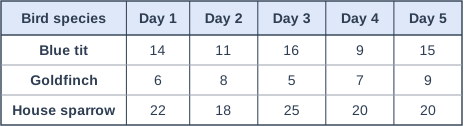
Ali watched a bird feeder for 30 minutes each morning for 5 days. The table shows the number of visits to the feeder by three species of bird.

Calculate the mean number of visits per day by blue tits.

Use the equation:
mean = total number of visits ÷ number of days

Table with columns "Bird species", "Day 1", "Day 2", "Day 3", "Day 4", "Day 5". Bird species: Blue tit; Day 1: 14; Day 2: 11; Day 3: 16; Day 4: 9; Day 5: 15 | Bird species: Goldfinch; Day 1: 6; Day 2: 8; Day 3: 5; Day 4: 7; Day 5: 9 | Bird species: House sparrow; Day 1: 22; Day 2: 18; Day 3: 25; Day 4: 20; Day 5: 20.

Model answer

Total = 14 + 11 + 16 + 9 + 15 = 65
Mean = 65 ÷ 5 = 13 visits per day

Explanation

Add the values first, then divide by the number of values. A common calculator error is to type the sum and the division in one go without brackets, which divides only the last number. Check that the mean lies between the smallest (9) and largest (16) values.

Mark scheme
  1. 1 mark

    (14 + 11 + 16 + 9 + 15) ÷ 5

    Allow 65 ÷ 5.

  2. 1 mark

    13 (visits per day)

    A correct answer with no working scores 2 marks, but full marks are not awarded for a correct final answer from incorrect working. 14 + 11 + 16 + 9 + 15 ÷ 5 = 53 (the calculator has divided only the last value) scores 0.

Question 4

4 marks

Ash dieback is a disease of ash trees caused by a fungus. It was first confirmed in the UK in 2012. Scientists think it may kill at least 80% of the UK's ash trees.

More than 900 other species, including insects, lichens, mosses and birds, are associated with ash trees. Some of these species live only on ash trees.

(Information from the Woodland Trust and the James Hutton Institute.)

Explain how ash dieback could affect a woodland community in which many of the trees are ash trees.

Model answer

Ash dieback is a new pathogen, so many of the ash trees in the wood would die. Species that use ash trees for food or shelter, such as some insects and lichens, would lose their food and shelter, and those that live only on ash could die out in the wood. Birds that feed on these insects would then have less food, so their numbers would fall. The dead trees would let more light reach the woodland floor, so more ground plants and young trees of other species would grow and compete to fill the gaps. Because the species are interdependent, the whole community would change.

Explanation

A new pathogen is a biotic factor that can affect a whole community. A Level 2 answer links the steps: ash trees die, so the species that depend on them decline, so the animals that feed on those species decline; or ash trees die, so more light reaches the ground, so other plants grow. Listing effects with no links stays in Level 1.

Mark scheme
  1. 4 marks

    Levels of response (4 marks).
    Level 2 (3-4 marks): Relevant points (reasons / causes) are identified, given in detail and logically linked to form a clear account.
    Level 1 (1-2 marks): Points are identified and stated simply, but their relevance is not clear and there is no attempt at logical linking.
    No relevant content: 0 marks.

    Indicative content (not a checklist; credit other valid points):
    Effects on species that depend on ash
    - the fungus is a new pathogen (a biotic factor), so many ash trees die
    - species that use ash for food or shelter lose their food or shelter, so their populations fall
    - species that live only on ash trees may die out in the wood
    - animals that eat these species (e.g. birds that eat insects living on ash) have less food, so their numbers fall too
    Effects through abiotic factors and competition
    - when ash trees die, more light reaches the woodland floor (an abiotic factor changes)
    - more ground plants, shrubs and young trees grow in the gaps
    - other tree species (e.g. oak or sycamore) grow to replace the ash, and they support different species
    - dead and fallen ash wood gives food and shelter for some insects and fungi
    Overall
    - because of interdependence, the community is no longer stable: population sizes change
    For Level 2, at least one effect on another species must be clearly linked to the death of the ash trees (e.g. fewer ash trees, so less food for insects that live only on ash, so fewer birds that eat those insects).
    Common errors: saying the fungus is a virus or bacterium; saying the disease will infect the animals.
    There are two marks in each level: start at Level 1 and use best fit. Full marks only if no incorrect statement contradicts a correct one.

Ready to try the rest? Every answer you write is marked against the mark scheme, so you can see exactly where the marks are.

Study Helper Hints first, answers after you try

Stuck on this one? Ask for a hint and I’ll point you in the right direction, without giving the answer away. Once you’ve checked your answer, I’ll show you how the marks are awarded.