Level:
Correct: 0
Incorrect: 0
Marks: 0/0
Exam Practice
Course:
Topics:
Avg
score:
–
Topics
done:
0/17

Homeostasis

Practise 18 exam-style questions on Homeostasis for AQA GCSE Combined Science (Foundation Biology Paper 2). Write your answer as you would in the exam and get it marked in seconds against the mark scheme, point by point, with the Study Helper on hand if you get stuck.

  • 18 questions
  • 1–6 marks each
  • Instant marking
  • No sign-up needed
18 questions, marked as you go

Sample questions with model answers

Here are 4 of the questions in this topic, each with a model answer, an explanation of why it earns the marks and the mark scheme an examiner would use.

Question 1

1 mark

Homeostasis responds to internal changes and to external changes.

Which of these is an internal change?

Choose your answer.

  • A fall in the air temperature at night
  • A loud noise from a passing car
  • Bright sunlight shining on the skin
  • A rise in body temperature during a run

Model answer

A rise in body temperature during a run

Explanation

An internal change happens inside the body, such as body temperature rising when muscles work hard, or blood glucose concentration rising after a meal. External changes happen in the surroundings, such as the air getting colder. Homeostasis responds to both kinds of change.

Mark scheme
  1. 1 mark

    A rise in body temperature during a run

    If more than one option is given, 0 marks. The fall in air temperature, the loud noise and the sunlight are all changes outside the body (external changes). During a run, the muscles respire faster and release more heat inside the body, so body temperature rises: an internal change.

Question 2

1 mark

Homeostasis keeps conditions inside the body at the optimum.

What is meant by the 'optimum' conditions?

Model answer

The optimum conditions are the best conditions for the body's cells and enzymes to work.

Explanation

Homeostasis maintains optimal conditions for enzyme action and all cell functions. Optimum means 'best', not 'highest': for example, the optimum body temperature for human enzymes is about 37 °C, and higher temperatures make enzymes work less well.

Mark scheme
  1. 1 mark

    The best conditions for cells / enzymes to work / function

    Allow 'the ideal conditions (for the body / cells)'. Allow 'the conditions at which enzymes work fastest'. Ignore 'normal' or 'average' unqualified. Do not accept 'the highest' or 'the maximum (temperature)'.

Question 3

2 marks

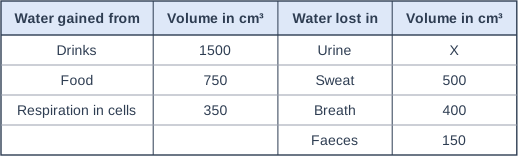
The table shows the volumes of water a woman gained and lost in one day.

Her body's water level stayed the same, so the total volume of water she gained was equal to the total volume of water she lost.

Calculate volume X.

Table with columns "Water gained from", "Volume in cm³", "Water lost in", "Volume in cm³". Water gained from: Drinks; Volume in cm³: 1500; Water lost in: Urine; Volume in cm³: X | Water gained from: Food; Volume in cm³: 750; Water lost in: Sweat; Volume in cm³: 500 | Water gained from: Respiration in cells; Volume in cm³: 350; Water lost in: Breath; Volume in cm³: 400 | Water gained from: (blank); Volume in cm³: (blank); Water lost in: Faeces; Volume in cm³: 150.

Model answer

Total water gained = 1500 + 750 + 350 = 2600 cm³
Other water lost = 500 + 400 + 150 = 1050 cm³
X = 2600 - 1050 = 1550 cm³

Explanation

When the water level stays the same, water in equals water out. Add up all the water gained, then subtract the losses you know. Remember that respiration in cells releases water, which counts as water gained.

Mark scheme
  1. 1 mark

    Total gained = 1500 + 750 + 350 = 2600 (cm³) or X = 2600 - (500 + 400 + 150)

    Allow 2600 - 1050.

  2. 1 mark

    X = 1550 (cm³)

    Allow ecf from their total gained. Do not accept 1050 (the total of the other losses). Correct answer with no working scores full marks. Full marks are not awarded for a correct final answer from incorrect working.

Question 4

4 marks

A central heating system keeps the air in a room at about 20 °C. The flow chart shows how it works.

The temperature sensor detects the air temperature in the room. The control box compares this temperature with 20 °C. When the room is too cold, the control box switches on the boiler, which heats water for the radiators.

The heating system can be used as a model of a control system in the body.

Match each part of the heating system (temperature sensor, control box, boiler) to the part of a control system in the body that does the same job. Choose from: coordination centre, effector, receptor.

Then give one way in which the body's control of its temperature is different from this heating system.

Flow chart of 4 boxes joined by arrows, read from left to right. The first box is "Temperature sensor", which leads to "Control box", which leads to "Boiler", which leads to "Radiators warm the room".

Model answer

The temperature sensor is like a receptor, the control box is like a coordination centre and the boiler is like an effector.
One difference is that the heating system can only warm the room, but the body can respond both when its temperature rises and when it falls.

Explanation

In both systems a change is detected (receptor), the information is processed (coordination centre) and something brings about a response (effector) that restores the set level. Models help explain an idea but are never perfect: the body has many receptors and effectors and can correct changes in both directions, while this heating system can only heat.

Mark scheme
  1. 1 mark

    Temperature sensor = receptor

    If one part of the body's system is given for more than one part of the heating system, neither scores.

  2. 1 mark

    Control box = coordination centre

  3. 1 mark

    Boiler = effector

    Allow 'boiler and radiators = effector'.

  4. 1 mark

    Any one difference, e.g. the body can respond to a rise and to a fall in temperature but the heating system can only warm the room / the body has many receptors and many effectors / the body uses nervous and chemical responses

    Allow 'the heating system cannot cool the room down'. Allow 'a person can change the temperature the heating is set to, but the body keeps its temperature at about 37 °C'. Ignore 'the body is alive' or 'the body is not a machine'. Do not accept 'the heating system is automatic but the body is not'.

Ready to try the rest? Every answer you write is marked against the mark scheme, so you can see exactly where the marks are.

Revision notes

Homeostasis

The big idea

Your cells work best when the conditions inside your body stay steady. Homeostasis is the regulation of the internal conditions of a cell or organism to maintain optimum conditions for function, in response to internal and external changes. It keeps conditions right for enzyme action and all cell functions, whatever the weather is doing or however hard you are exercising.

What is controlled, and why

Homeostasis does not keep conditions perfectly constant. It keeps them within narrow limits around an optimum (best) value. In the human body it controls these three conditions:

ConditionWhy it must be controlled
Blood glucose concentrationCells need glucose for respiration, which releases energy. Too little, and cells (especially brain cells) cannot release enough energy. Too much, and water leaves cells by osmosis
Body temperatureEnzymes work best at about 37 °C. Too cold, and enzyme-controlled reactions are too slow. Too hot, and enzymes are denatured: the active site changes shape
Water levelsIf body fluids become too dilute or too concentrated, cells gain or lose too much water by osmosis and do not function efficiently

The change that sets off a response can be internal, such as exercise making your muscles respire faster and warm your blood, or external, such as a hot day. Homeostasis responds to both. It even happens in single cells: a single-celled organism living in fresh water must keep pumping out the water that enters it by osmosis.

How control systems work

These automatic control systems may involve nervous responses (electrical impulses along neurones, which are fast) or chemical responses (hormones carried in the blood, which are slower). Every control system has the same three parts:

  • Receptors: cells that detect stimuli. A stimulus is a change in the environment, inside or outside the body.
  • Coordination centres, such as the brain, spinal cord and pancreas: they receive and process information from receptors.
  • Effectors: muscles or glands, which bring about responses that restore optimum levels. Muscles respond by contracting; glands respond by secreting a substance such as sweat or a hormone.
Flow chart of 5 boxes joined by arrows, read from left to right. The first box is "Stimulus", which leads to "Receptor", which leads to "Coordination centre", which leads to "Effector", which leads to "Response".
Every control system follows this chain, from detecting a change to putting it right.

Once the optimum level has been restored, the response stops. Because a condition has to change before receptors can detect it, and the effectors take time to act, the level rises and falls slightly around the optimum rather than staying exactly the same.

Identifying the parts of a control system

On a hot day, a dog starts to pant. Temperature receptors detect the rise in its body temperature and send impulses to its brain. The brain sends impulses to the dog's breathing muscles, which contract much faster. Water evaporates from the dog's tongue and airways and cools it down. Identify the parts of this control system.

  • Stimulus: the rise in body temperature (a change, not "the hot day").
  • Receptors: the temperature receptors.
  • Coordination centre: the brain.
  • Effectors: the breathing muscles.
  • Response: fast panting, which cools the dog and restores its optimum temperature.
  • Type of response: nervous, because the information travels as impulses along neurones.

Remember

  • Homeostasis maintains optimum conditions for enzyme action and all cell functions.
  • The three conditions to learn: blood glucose concentration, body temperature and water levels.
  • Receptors detect stimuli; coordination centres (brain, spinal cord, pancreas) receive and process information; effectors (muscles or glands) respond.
  • Control can be nervous or chemical (hormones).

Common mistakes

  • Saying effectors detect changes. Receptors detect; effectors (muscles or glands) respond.
  • Calling a hormone the effector. A hormone such as insulin is the chemical message; the organ that responds to it, such as the liver, is the effector.
  • Saying cold denatures enzymes. Low temperatures only slow enzymes down; high temperatures denature them. Never say enzymes are "killed".
  • Defining homeostasis as "keeping everything the same". Conditions are kept within narrow limits around an optimum, in response to changes.
  • Saying cells need glucose "to make energy". Respiration releases energy.

Exam tip

In a 6-mark answer about homeostasis, build a chain: the definition, why it matters (enzymes and cell function), the three conditions, then receptor, coordination centre and effector. In "explain why this must be controlled" questions, say what goes wrong if the level is too high and if it is too low.

Study Helper Hints first, answers after you try

Stuck on this one? Ask for a hint and I’ll point you in the right direction, without giving the answer away. Once you’ve checked your answer, I’ll show you how the marks are awarded.