The big idea
Organisms have features, called adaptations, that enable them to survive in the conditions in which they normally live. Adaptations are inherited: a species has them because of evolution by natural selection, not because an individual changes itself during its life. In the exam you are usually given information about an organism and its home and asked to explain how its features help it survive.
Three types of adaptation
| Type | What it means | Examples |
|---|
| Structural | A feature of the body's shape or structure | Thick fur, a layer of fat, small ears, camouflaged colouring, spines instead of leaves |
| Behavioural | Something the organism does | Migrating to a warmer place in winter, staying in a burrow by day, a lizard basking in the sun to warm up |
| Functional | A process inside the body | Producing small volumes of very concentrated urine, making venom, enzymes that work at very high temperatures |
Keeping warm and keeping cool
Animals release heat throughout their body (their volume) by respiration, but lose it through their surface. So the surface area to volume ratio matters:
- A large, rounded body with small ears and short legs has a smaller surface area to volume ratio, so it loses heat more slowly. This suits cold places.
- A small body with large, thin ears has a larger surface area to volume ratio, so it loses heat more easily. This suits hot places.
Other adaptations to cold include thick fur, which traps a layer of insulating air, and a thick layer of fat. Many animals are camouflaged: a white coat in snow helps prey hide from predators and helps a predator creep up on its prey. In hot deserts, the main problem is saving water, so animals may avoid sweating, produce very concentrated urine and stay underground in the heat of the day.
Surface area to volume ratio
Model two animals as cubes with sides of 3 cm and 6 cm. Compare their surface area to volume ratios.
3 cm cube: surface area \(= 6 \times 3 \times 3 = 54\text{ cm}^2\); volume \(= 3 \times 3 \times 3 = 27\text{ cm}^3\); ratio \(= 54 : 27 = 2 : 1\)
6 cm cube: surface area \(= 6 \times 6 \times 6 = 216\text{ cm}^2\); volume \(= 6 \times 6 \times 6 = 216\text{ cm}^3\); ratio \(= 216 : 216 = 1 : 1\)
Doubling the side length halves the ratio. The larger animal has less surface for each cm³ of body, so it loses heat more slowly for its size.
Plants in dry places
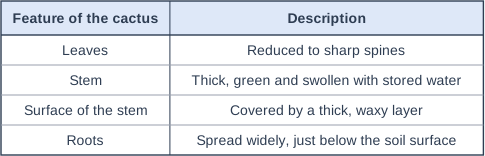
Plants lose water vapour through their stomata by transpiration, so plants in deserts or on windy sand dunes have adaptations that reduce water loss or store water:
- small leaves, or leaves reduced to spines, giving a small surface area for water loss;
- a thick waxy cuticle, which reduces evaporation;
- fewer stomata, or stomata hidden in rolled leaves or among hairs, which trap moist air and reduce the concentration gradient for water vapour;
- swollen stems that store water;
- roots that spread widely near the surface to absorb rain quickly, or grow very deep to reach water underground.
Extremophiles
Some organisms live in environments that are very extreme, such as those with a very high temperature, pressure or salt concentration. These organisms are called extremophiles, and most are microorganisms. Bacteria living in deep sea vents are extremophiles: the water is extremely hot, the pressure is enormous and there is no light. Their enzymes are not denatured at temperatures that would denature most enzymes, because their active sites keep their shape. Bacteria in very salty lakes have cytoplasm about as concentrated as the water around them, so they do not lose water by osmosis.
Explaining how features help an organism
The Arabian oryx is an antelope that lives in hot, dry desert. It has a pale coat, lets its body temperature rise during the day, produces very concentrated urine and feeds at night. Explain how these features help it to survive.
- Pale coat (structural): reflects sunlight, so the oryx absorbs less heat.
- Body temperature rises by day (functional): it does not need to sweat as much to stay cool, so it loses less water; the extra heat is lost in the cool night.
- Concentrated urine (functional): very little water is lost in the urine.
- Feeds at night (behavioural): it avoids the heat of the day, and plants contain more water at night, so it gains water from its food.
Common mistakes
- Saying an animal "adapts" or "develops" a feature because it needs it. Adaptations are inherited and evolve over many generations.
- Writing "a large animal has a smaller surface area". A large animal has a larger surface area but a smaller surface area to volume ratio.
- Saying enzymes are "killed" by heat. They are denatured; an extremophile's enzymes are not denatured at the temperature where it lives.
- Saying salt moves by osmosis. Osmosis is the movement of water.
- Saying a polar predator's white fur is "to hide from predators". For a predator, camouflage helps it get close to its prey.
Exam tip
For "explain how this feature helps" questions, make two steps for each feature: what the feature does, and how that helps the organism survive in its environment ("thick waxy cuticle, so less water evaporates, so the plant survives the dry season"). In comparison questions, mention both organisms in each point and use the numbers you are given.