
Level:
Correct: 0
Incorrect: 0
Marks: 0/0
Exam Practice
Course:
Topics:
Avg
score:
–
Topics
done:
0/17

Deforestation, global warming and maintaining biodiversity

Practise 23 exam-style questions on Deforestation, global warming and maintaining biodiversity for AQA GCSE Combined Science (Foundation Biology Paper 2). Write your answer as you would in the exam and get it marked in seconds against the mark scheme, point by point, with the Study Helper on hand if you get stuck.

  • 23 questions
  • 1–6 marks each
  • Instant marking
  • No sign-up needed
20 questions, marked as you go

Sample questions with model answers

Here are 4 of the questions in this topic, each with a model answer, an explanation of why it earns the marks and the mark scheme an examiner would use.

Question 1

1 mark

Global warming is changing the conditions in many habitats.

Which change is a biological consequence of global warming?

Choose your answer.

  • Some species in the UK move further north
  • The hole in the ozone layer gets larger
  • Plants release more oxygen at night
  • Sea levels fall around the coastline

Model answer

Some species in the UK move further north

Explanation

As the climate warms, species that need cooler conditions move north or to higher ground, and species from further south may move in. This change in the distribution of species is a biological consequence of global warming. Students often confuse global warming with the ozone layer, which is a separate issue.

Mark scheme
  1. 1 mark

    Some species in the UK move further north

    If more than one option is given, 0 marks. The ozone layer is a different problem and is not caused by global warming. Plants do not photosynthesise at night, so they release carbon dioxide, not extra oxygen. Global warming causes sea levels to rise, not fall.
Question 2

2 marks

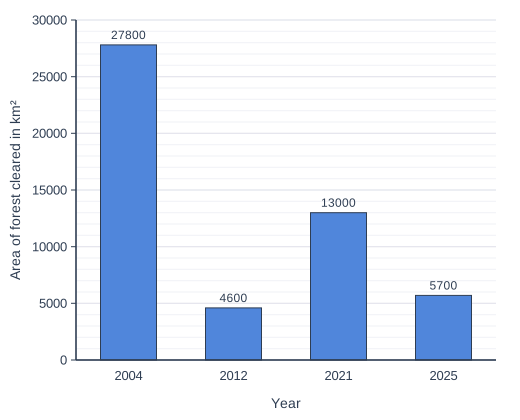
The bar chart shows the area of Amazon rainforest cleared in Brazil in four different years. Each value is for the 12 months up to July of that year. The data are from INPE, Brazil's National Institute for Space Research, rounded to the nearest 100 km².

In 2004 the Brazilian government started a plan to reduce deforestation.

Describe how the area of rainforest cleared changed from 2004 to 2025.

Use data from the bar chart in your answer.

Bar chart of area of forest cleared in km² for each year: 2004 27800, 2012 4600, 2021 13000, 2025 5700.

Model answer

The area cleared fell from 27 800 km² in 2004 to 4 600 km² in 2012. It then rose to 13 000 km² in 2021, before falling again to 5 700 km² in 2025.

Explanation

Describe the pattern in stages and quote values from the chart with their units. The fall after 2004 shows that a government plan can reduce deforestation, but the rise to 2021 shows that progress can be reversed. 'Describe' does not ask for reasons, so explanations score nothing here.

Mark scheme
  1. 1 mark

    decreased from 27 800 km² in 2004 to 4 600 km² in 2012

    allow a decrease of 23 200 km² from 2004 to 2012. allow the values without units.

  2. 1 mark

    then increased to 13 000 km² in 2021 and decreased again to 5 700 km² in 2025

    Both changes after 2012 are needed for this mark. Data must be quoted for 2 marks: an answer that describes the whole pattern correctly (decrease, increase, decrease) without data scores 1 mark. If no other mark is awarded, allow 1 mark for 'decreased overall from 27 800 km² to 5 700 km²'. Ignore explanations: the question asks for a description.

Question 3

2 marks

Scientists want to predict how global warming will affect the number of species living in a tropical rainforest by the year 2100.

Suggest two reasons why their predictions are uncertain.

Model answer

The number of species depends on many factors that interact, such as rainfall, deforestation and disease, not just temperature. Also, not all the species in the rainforest have been discovered, so the data the scientists start with are incomplete.

Explanation

Evidence about global warming and its effects is uncertain or incomplete because the systems involved are very complex, many factors act at once, and it is impossible to run a controlled experiment on a whole ecosystem. Future emissions are also unknown. This uncertainty is about the size of the effects, not about whether global warming is happening.

Mark scheme
  1. 1 mark

    many factors affect the number of species (not just temperature), e.g. rainfall / deforestation / disease, and they interact

    Any two from the points in this list, 1 mark each. allow the system is complex.

  2. 1 mark

    some species may adapt / evolve / move to other areas

  3. 1 mark

    not all the species in the rainforest have been discovered or counted / data are incomplete

    allow there are few measurements from the past / records only cover a short time.

  4. 1 mark

    predictions use (computer) models based on assumptions / it is not possible to do a controlled experiment on a whole rainforest

  5. 1 mark

    we do not know how much carbon dioxide / methane humans will release in the future / how much the temperature will rise

    Max 2. Apply the list rule: if more than two reasons are given, each wrong extra reason cancels a correct one. Ignore 'scientists do not agree about global warming'.

Question 4

4 marks

A company wants to clear 200 km² of tropical forest to grow sugar cane. The sugar cane would be used to make a biofuel to replace some of the petrol used in cars. Petrol is made from crude oil, a fossil fuel.

Sugar cane takes in carbon dioxide for photosynthesis as it grows.

Evaluate the environmental effects of the company's plan.

Give a conclusion.

Model answer

One benefit is that the biofuel would replace some petrol, so less fossil fuel would be burned, and the sugar cane takes in carbon dioxide as it grows. However, clearing 200 km² of forest would destroy the habitats of many species, so biodiversity would fall and some species could become extinct. Burning and decay of the cleared trees would release a lot of carbon dioxide, and only one crop would grow there instead of many types of tree. In conclusion, the plan would harm the environment more than it helps, because the loss of biodiversity and the carbon dioxide released by deforestation outweigh the benefit of replacing petrol.

Explanation

'Evaluate' means give points for and against, then a judgement backed by a reason. The key idea is that biofuels can replace fossil fuels, but clearing tropical forest to grow them releases carbon dioxide and destroys biodiversity. Answers that only list disadvantages cannot get full marks, and points about jobs or profit are not environmental effects.

Mark scheme
  1. 1 mark

    For: the biofuel replaces petrol / less fossil fuel is burned / biofuel is renewable

    allow the sugar cane takes in carbon dioxide as it grows, which partly balances the carbon dioxide released when the biofuel is burned.

  2. 1 mark

    Against: habitats are destroyed, so species lose food or shelter / biodiversity falls / species may become extinct

    allow only one crop (a monoculture) is grown, so few species can live there.

  3. 1 mark

    Against: burning or decay of the cleared trees releases (a lot of) carbon dioxide / fewer trees to take in carbon dioxide (by photosynthesis), which adds to global warming

    allow the forest stores much more carbon than the sugar cane. If this point is not made, allow soil erosion or flooding once the trees are removed for this mark.

  4. 1 mark

    a conclusion supported by a reason, e.g. the plan is harmful because the loss of biodiversity and the carbon dioxide released when the forest is cleared outweigh the benefit of replacing petrol

    Max 3 if only advantages or only disadvantages are given. The conclusion can be for or against the plan, but it must be linked to a reason. Ignore economic points (jobs, profit) as the question asks about environmental effects.

Ready to try the rest? Every answer you write is marked against the mark scheme, so you can see exactly where the marks are.

Study Helper Hints first, answers after you try

Stuck on this one? Ask for a hint and I’ll point you in the right direction, without giving the answer away. Once you’ve checked your answer, I’ll show you how the marks are awarded.