
Level:
Correct: 0
Incorrect: 0
Marks: 0/0
Exam Practice
Course:
Topics:
Avg
score:
–
Topics
done:
0/17

The development of understanding of genetics and evolution

Practise 22 exam-style questions on The development of understanding of genetics and evolution for AQA GCSE Combined Science (Foundation Biology Paper 2). Write your answer as you would in the exam and get it marked in seconds against the mark scheme, point by point, with the Study Helper on hand if you get stuck.

  • 22 questions
  • 1–6 marks each
  • Instant marking
  • No sign-up needed
20 questions, marked as you go

Sample questions with model answers

Here are 4 of the questions in this topic, each with a model answer, an explanation of why it earns the marks and the mark scheme an examiner would use.

Question 1

1 mark

In 2013, scientists found footprints in a layer of hardened mud on a beach in Norfolk. The footprints had been made by early humans more than 800 000 years ago.

Footprints are a type of fossil called a trace fossil.

Give one other example of a trace fossil.

Model answer

Burrows

Explanation

Trace fossils are preserved signs of an organism's activity rather than parts of its body: footprints, burrows and rootlet traces are the main examples. Bones and shells are the remains of the organism itself, so they are not trace fossils.

Mark scheme
  1. 1 mark

    burrow(s) / rootlet traces

    Allow root traces / marks left by roots. Allow trails (left by moving animals), droppings / coprolites, nests, bite marks or tooth marks. Do not accept footprints or tracks (given in the question). Do not accept bones, shells, teeth, leaves or other parts of an organism - these are not traces. If more than one answer is given, a wrong answer cancels a correct one.
Question 2

2 marks

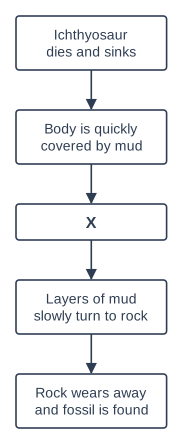
Ichthyosaurs were reptiles that lived in the sea and became extinct millions of years ago. Fossil ichthyosaur skeletons are found in the rocks at Lyme Regis in Dorset.

The flow chart shows how an ichthyosaur skeleton may have become a fossil.

Describe what happened at stage X.

Flow chart of 5 boxes joined by arrows, read from top to bottom. The first box is "Ichthyosaur dies and sinks", which leads to "Body is quickly covered by mud", which leads to box X, which leads to "Layers of mud slowly turn to rock", which leads to "Rock wears away and fossil is found".

Model answer

The bones slowly decayed, and as they decayed they were replaced by minerals from the water in the mud.

Explanation

Many fossils form when parts of an organism are replaced by minerals as they decay, so the fossil has the shape of the bone but is made of rock minerals. Both ideas are needed for 2 marks: the decay and the replacement by minerals. Saying only that the skeleton 'turned into rock' is too vague.

Mark scheme
  1. 1 mark

    the bones / skeleton (slowly) decayed

    Allow the bones broke down slowly. Ignore 'the soft parts / flesh decayed' on its own: it is the bones that decay and are replaced by minerals. Ignore 'the body rotted' unqualified.

  2. 1 mark

    (parts of the skeleton / bones) were replaced by minerals

    Allow minerals (from the water in the mud) took the place of the bone. Ignore 'turned to stone / rock' unless minerals are mentioned. Do not accept 'the bones did not decay because there was no oxygen' (this contradicts mineral replacement for this fossil).

Question 3

2 marks

A new strain of a bacterium that causes disease in humans has appeared. The new strain is resistant to all the antibiotics normally used to treat the disease.

Explain why the new strain can spread quickly between people.

Model answer

People are not immune to the new strain, so many people can catch it. There is no effective treatment because the antibiotics do not kill it, so infected people stay infected for longer and pass it on to more people.

Explanation

There are two reasons a resistant strain spreads: people are not immune to it, and there is no effective treatment. Take care with the words: people can be immune to a pathogen, but bacteria are resistant to an antibiotic.

Mark scheme
  1. 1 mark

    people are not immune to the new strain

    Allow people have no immunity / antibodies against it because it is new.

  2. 1 mark

    there is no effective treatment, so infected people stay infected (for longer) and can pass it on to more people

    Allow antibiotics will not kill it, so it is not stopped. Ignore 'it is a strong strain'. Do not accept 'the bacteria are immune to antibiotics'.

Question 4

4 marks

The golden toad lived only in a small area of mountain forest in Costa Rica. The toads laid their eggs in small pools of rainwater. The golden toad has not been seen since 1989 and is now extinct.

Scientists think two factors may have contributed to its extinction:
- a new pathogen (a fungus that infects the skin of toads)
- changes in the climate that made the forest warmer and drier.

Explain how each factor could have caused the golden toad to become extinct.

Model answer

The fungus was a new pathogen, so the toads had no resistance to it. It spread through the population and killed many toads, until too few were left to breed. The warmer, drier climate meant that the small pools of rainwater dried up, so the eggs and tadpoles in them died and no new toads were produced. Because the toads lived only in one small area, they could not move somewhere more suitable.

Explanation

For each factor, say what it did to the toads and then link it to the population falling to zero. A new pathogen kills many individuals because they have no resistance; a change in an abiotic factor such as rainfall can stop a species breeding. A species that lives in only one small area is especially at risk because it cannot move elsewhere.

Mark scheme
  1. 1 mark

    new pathogen: the toads had no resistance / immunity to the new pathogen, so many toads were infected and killed

    Allow the disease spread through the population and killed many toads. Ignore 'the toads got ill' unqualified.

  2. 1 mark

    new pathogen: the number of toads fell until too few were left to breed / until none were left

    Allow the toads died faster than they could reproduce.

  3. 1 mark

    climate: (less rain / warmer and drier conditions meant) the pools dried up

    Allow there was less water for breeding. Allow the toads were not adapted to warmer, drier conditions.

  4. 1 mark

    climate: so the eggs / tadpoles died / the toads could not breed (successfully), so no new toads were produced

    Allow the toads lived only in one small area, so they could not move to a more suitable habitat. Max 2 marks for each factor. Ignore 'the toads could not survive' unqualified.

Ready to try the rest? Every answer you write is marked against the mark scheme, so you can see exactly where the marks are.

Study Helper Hints first, answers after you try

Stuck on this one? Ask for a hint and I’ll point you in the right direction, without giving the answer away. Once you’ve checked your answer, I’ll show you how the marks are awarded.