
Level:
Correct: 0
Incorrect: 0
Marks: 0/0
Exam Practice
Course:
Topics:
Avg
score:
–
Topics
done:
0/17

DNA, the genome and genetic inheritance

Practise 22 exam-style questions on DNA, the genome and genetic inheritance for AQA GCSE Combined Science (Foundation Biology Paper 2). Write your answer as you would in the exam and get it marked in seconds against the mark scheme, point by point, with the Study Helper on hand if you get stuck.

  • 22 questions
  • 1–6 marks each
  • Instant marking
  • No sign-up needed
20 questions, marked as you go

Sample questions with model answers

Here are 4 of the questions in this topic, each with a model answer, an explanation of why it earns the marks and the mark scheme an examiner would use.

Question 1

1 mark

A mouse has black fur.

Which term describes 'black fur' for this mouse?

Choose your answer.

  • Genotype
  • Allele
  • Phenotype
  • Genome

Model answer

Phenotype

Explanation

The phenotype is the characteristic that is expressed, such as black fur. The genotype is the alleles present, such as BB or Bb, which operate at a molecular level to develop the phenotype. Genotype and phenotype are often confused: the genotype is written as letters, the phenotype is described in words.

Mark scheme
  1. 1 mark

    Phenotype

    If more than one option is given, 0 marks. 'Genotype' is wrong: the genotype is the alleles present, eg BB or Bb. 'Allele' is wrong: an allele is a form of a gene, not the characteristic it produces. 'Genome' is wrong: the genome is all of the mouse's genetic material.
Question 2

2 marks

In guinea pigs, the allele for a rough coat (R) is dominant. The allele for a smooth coat (r) is recessive.

A guinea pig has the genotype Rr.

Give the phenotype of this guinea pig. Explain your answer.

Model answer

The guinea pig has a rough coat. R is the dominant allele, and a dominant allele is always expressed, even if only one copy is present. The recessive allele r is only expressed if two copies are present.

Explanation

Rr is heterozygous: the two alleles are different. Because R is dominant, one copy is enough for it to be expressed, so the phenotype is a rough coat. Saying the dominant allele is 'stronger' does not explain the result; use the idea of being expressed with only one copy.

Mark scheme
  1. 1 mark

    rough coat

    do not accept Rr / R (genotype or allele, not phenotype)

  2. 1 mark

    the (dominant) allele R is always expressed, even if only one copy is present

    allow R is dominant so it is expressed / r is recessive so it is only expressed if two copies are present; allow there is no second r allele / it is not rr; ignore 'R is stronger' / 'R beats r'

Question 3

2 marks

In tomato plants, the allele for purple stems (A) is dominant to the allele for green stems (a).

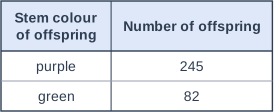
Two tomato plants that both have the genotype Aa were crossed. The table shows the stem colour of their offspring.

Calculate the ratio of offspring with purple stems to offspring with green stems.

Give your answer in the form n : 1, to 1 decimal place.

Table with columns "Stem colour of offspring", "Number of offspring". Stem colour of offspring: purple; Number of offspring: 245 | Stem colour of offspring: green; Number of offspring: 82.

Model answer

245 ÷ 82 = 2.988...
Ratio = 3.0 : 1

Explanation

To write a ratio in the form n : 1, divide the first number by the second. Here 245 ÷ 82 = 2.99, which is 3.0 : 1 to 1 decimal place. This matches the 3 : 1 ratio expected from a cross between two heterozygous parents, where 3 in every 4 offspring have at least one dominant allele.

Mark scheme
  1. 1 mark

    245 ÷ 82 = 2.988

    allow 2.99 / 2.98...; a correct answer with no working scores 2 marks

  2. 1 mark

    3.0 : 1

    allow 3 : 1; allow ecf from their division correctly rounded and written as n : 1; do not accept 1 : 3.0 / 0.3 : 1 (the wrong way round); full marks are not awarded for a correct final answer from incorrect working

Question 4

4 marks

Two black mice were bred together several times. Both mice have the genotype Bb. The allele for black fur (B) is dominant to the allele for brown fur (b).

A Punnett square predicts that 1 in 4 of their offspring will have brown fur.

The mice had 48 offspring in total.

Calculate the number of offspring expected to have brown fur.

The actual number of offspring with brown fur was 15. Suggest two reasons why this is different from the expected number.

Model answer

Expected number with brown fur = 48 ÷ 4 = 12
The 1 in 4 is only a probability, because fertilisation is random: which sperm fertilises which egg is a matter of chance. Also, 48 offspring is a fairly small number, so the actual results are not expected to match the ratio exactly.

Explanation

A Punnett square gives the probability for each offspring, so 1 in 4 of 48 is 12. Real results vary from the prediction because the fusion of gametes is random, and the smaller the number of offspring, the further the results may be from the expected ratio. The prediction is still useful: 15 is close to 12.

Mark scheme
  1. 1 mark

    48 ÷ 4 / 48 × 0.25

    a correct answer with no working scores 2 marks

  2. 1 mark

    12 (offspring)

    full marks are not awarded for a correct final answer from incorrect working; do not accept 36 (the number expected to have black fur)

  3. 2 marks

    any two from:
    • fertilisation is random / which sperm fertilises which egg is a matter of chance
    • the 1 in 4 is only a probability / a prediction, not an exact result
    • the number of offspring is (too) small (for the ratio to be seen exactly)

    1 mark for each reason, max 2; allow each offspring has a 1 in 4 chance of being brown, whatever happened to earlier offspring; ignore 'the Punnett square is wrong'; ignore human error / counting mistakes unqualified; do not accept answers that suggest the parents' genotypes changed; list rule: each wrong extra answer cancels a correct one

Ready to try the rest? Every answer you write is marked against the mark scheme, so you can see exactly where the marks are.

Study Helper Hints first, answers after you try

Stuck on this one? Ask for a hint and I’ll point you in the right direction, without giving the answer away. Once you’ve checked your answer, I’ll show you how the marks are awarded.