
Level:
Correct: 0
Incorrect: 0
Marks: 0/0
Exam Practice
Course:
Topics:
Avg
score:
–
Topics
done:
0/17

Biodiversity, waste management and land use

Practise 21 exam-style questions on Biodiversity, waste management and land use for AQA GCSE Combined Science (Foundation Biology Paper 2). Write your answer as you would in the exam and get it marked in seconds against the mark scheme, point by point, with the Study Helper on hand if you get stuck.

  • 21 questions
  • 1–6 marks each
  • Instant marking
  • No sign-up needed
20 questions, marked as you go

Sample questions with model answers

Here are 4 of the questions in this topic, each with a model answer, an explanation of why it earns the marks and the mark scheme an examiner would use.

Question 1

1 mark

In 1950 the human population of the world was about 2.5 billion. In November 2022 it reached 8 billion (United Nations estimates).

Calculate how many times larger the human population was in 2022 than in 1950.

Model answer

8 ÷ 2.5 = 3.2
The population was 3.2 times larger in 2022 than in 1950.

Explanation

'How many times larger' means divide the larger number by the smaller one: 8 ÷ 2.5 = 3.2. Subtracting (8 - 2.5 = 5.5) gives the increase, not how many times larger. More people, each with a higher standard of living, means more resources are used and more waste is produced.

Mark scheme
  1. 1 mark

    3.2 (times)

    8 ÷ 2.5 = 3.2. A correct answer with no working scores the mark. Do not accept 5.5 (the difference in billions) or 0.31 (2.5 ÷ 8).
Question 2

2 marks

Many human activities are reducing biodiversity. Only recently have measures been taken to try to stop this reduction.

The future of the human species on Earth relies on us maintaining a good level of biodiversity.

Suggest two reasons why humans depend on biodiversity.

Model answer

Many of our medicines come from plants and other organisms, and new medicines may be found in species that have not been studied yet. We also rely on many species for food, for example crops that are pollinated by bees.

Explanation

Each reason must say what humans get from other species, such as medicines, food, materials, oxygen or the recycling of materials by microorganisms. Vague answers such as 'we need them to survive' do not score. Remember that biodiversity means the variety of species, not the number of people.

Mark scheme
  1. 1 mark

    (many) medicines come from plants / other organisms / new medicines may be found in species that have not yet been studied

    Any two from the points in this list, 1 mark each. allow a named example, e.g. aspirin from willow, digitalis from foxgloves.

  2. 1 mark

    food comes from many species / crops are pollinated by insects such as bees

    allow we eat many different species of plants and animals (e.g. fish).

  3. 1 mark

    materials / fuels come from organisms, e.g. wood / cotton / wool

  4. 1 mark

    plants produce oxygen / remove carbon dioxide (by photosynthesis) / microorganisms recycle materials (e.g. return mineral ions to the soil)

    allow other organisms keep water or air clean.

  5. 1 mark

    wild species have genes / characteristics that could be used to breed new crops or animals (e.g. disease resistance)

  6. 1 mark

    a high biodiversity keeps ecosystems stable, so they keep providing what humans need

    Max 2. Apply the list rule: if more than two reasons are given, each wrong extra reason cancels a correct one. Ignore 'to survive' or 'for the environment' unqualified. Ignore tourism or enjoyment.

Question 3

3 marks

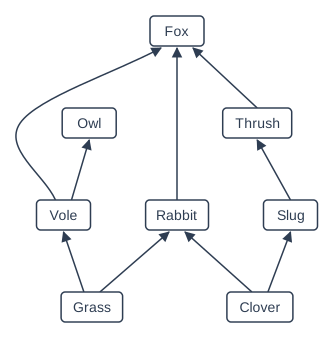
Figure 1 shows a food web for a meadow.

A disease kills most of the rabbits in the meadow.

Explain why the number of foxes in the meadow may not decrease very much.

Use Figure 1 and the idea of biodiversity in your answer.

Food web of 8 organisms in 4 rows, joined by arrows. Bottom row (left to right): Grass and Clover. Second row from the bottom (left to right): Vole, Rabbit and Slug. Third row from the bottom (left to right): Owl and Thrush. Top row: Fox. Arrows point from Grass to Vole and Rabbit; from Clover to Rabbit and Slug; from Vole to Owl and Fox; from Rabbit to Fox; from Slug to Thrush; from Thrush to Fox.

Model answer

Foxes do not depend only on rabbits for food. Figure 1 shows that they also eat voles and thrushes, so they can eat more of these instead. With fewer rabbits, there is more grass and clover for the voles and slugs, so the numbers of voles, slugs and thrushes may increase, giving the foxes more food. Because the meadow has a high biodiversity, the foxes are not dependent on one species, so the ecosystem stays stable.

Explanation

Follow the arrows into the fox: it eats rabbits, voles and thrushes. Having several food sources is what makes a species less dependent on any one other species, and this is why a high biodiversity keeps an ecosystem stable. Answers that only say 'the foxes eat something else' without using the food web, or without linking to biodiversity, cannot get full marks.

Mark scheme
  1. 1 mark

    foxes also eat voles and thrushes / foxes have other sources of food

    allow foxes can eat more voles or thrushes instead. allow 'foxes have other food sources' or 'foxes eat other animals' without naming them.

  2. 1 mark

    with fewer rabbits there is more grass / clover for voles / slugs, so the numbers of voles / slugs (and thrushes) may increase

    allow less competition for grass / clover, so more voles. allow more food for the foxes' other prey.

  3. 1 mark

    high biodiversity / many different species means foxes do not depend on one species (for food), so the ecosystem stays stable

    allow the fox is not dependent on rabbits only. Ignore 'there are lots of animals' unqualified. Max 3.

Question 4

4 marks

A council plans to make a new landfill site on an area of grassland.

Explain two ways the landfill site could reduce biodiversity.

Model answer

First, the grassland habitat would be destroyed and covered with waste, so there would be less land for animals and plants. They would lose their food and shelter, so some species would die or leave the area.

Second, toxic chemicals could leak from the waste into the soil and nearby water. These chemicals could kill plants and animals, so there would be fewer species.

Explanation

For each way, give the cause and then its effect on organisms: 1 mark for the way and 1 mark for how it reduces the number of species. Landfill takes up land and can pollute it with toxic chemicals; it can also attract pests such as rats and gulls. 'It causes pollution' on its own is too vague to score.

Mark scheme
  1. 2 marks

    habitat loss: the grassland / habitat is destroyed or covered / there is less land for (other) animals and plants (1); so there is less food / shelter / fewer places to live, so some species die or leave (1)

    For each way: 1 mark for the way and 1 mark for its effect on organisms, which must be linked to that way. The ways can be given in any order. Max 4 in total: credit the first two different ways given.

  2. 2 marks

    toxic chemicals: toxic / harmful chemicals / poisons leak from the waste into the soil / water (1); which kill plants / animals / organisms, so there are fewer species (1)

    Ignore 'it causes pollution' unqualified.

  3. 2 marks

    pests: the rubbish attracts pests such as rats or gulls (1); which eat the eggs or young of other animals / spread disease, so other species decrease (1)

  4. 2 marks

    any other valid way, e.g. litter blown from the site is swallowed by animals or traps them (1), so they die (1)

    Max 4 in total (two ways).

Ready to try the rest? Every answer you write is marked against the mark scheme, so you can see exactly where the marks are.

Study Helper Hints first, answers after you try

Stuck on this one? Ask for a hint and I’ll point you in the right direction, without giving the answer away. Once you’ve checked your answer, I’ll show you how the marks are awarded.