Practise 22 exam-style questions on Hormones in human reproduction and contraception for AQA GCSE Combined Science (Foundation Biology Paper 2). Write your answer as you would in the exam and get it marked in seconds against the mark scheme, point by point, with the Study Helper on hand if you get stuck.
22 questions
1–6 marks each
Instant marking
No sign-up needed
20 questions, marked as you go
Sample questions with model answers
Here are 4 of the questions in this topic, each with a model answer, an explanation of why it earns the marks and the mark scheme an examiner would use.
Question 1
1 mark
An intrauterine device (IUD) is a small device that a doctor or nurse places inside the uterus. A copper IUD contains no hormones.
Which of these is one way that a copper IUD prevents pregnancy?
Choose your answer.
It inhibits FSH production
It blocks the oviducts
It stops an embryo implanting
It stops sperm being made
Model answer
It stops an embryo implanting
Explanation
Intrauterine devices sit inside the uterus and prevent the implantation of an embryo in the uterus lining; some types release a hormone instead of copper. The copper also makes it hard for sperm to survive and reach an egg, but it does not stop sperm being made. Inhibiting FSH is how the pill works, and blocking the oviducts is female sterilisation, so match each option to the right method.
Mark scheme
1 mark
It stops an embryo implanting
If more than one option is given, 0 marks. 'It inhibits FSH production' is wrong: this is how the hormones in oral contraceptives work, and a copper IUD contains no hormones. 'It blocks the oviducts' is wrong: blocking or cutting the oviducts is female sterilisation, a surgical method. 'It stops sperm being made' is wrong: an IUD is placed in a woman's uterus and has no effect on sperm production in the testes (the copper does affect sperm that enter the uterus, but it does not stop them being made).
Question 2
2 marks
During puberty, reproductive hormones cause changes in the body.
Give two changes caused by reproductive hormones in girls during puberty.
Model answer
Her breasts develop, and her periods start because eggs begin to mature and be released.
Explanation
At puberty, reproductive hormones such as oestrogen cause secondary sex characteristics to develop, for example breasts growing and the hips widening, and eggs begin to mature so that the menstrual cycle starts. A deeper voice and facial hair are changes in boys caused by testosterone, and changes such as spots or a growth spurt happen in both sexes, so they do not answer the question.
Mark scheme
2 marks
any two from: • breasts develop / grow • hips widen / body shape changes (more fat on hips and thighs) • periods start / the menstrual cycle starts / eggs begin to mature (and be released) • pubic hair / underarm hair grows
1 mark for each change, max 2; ignore growth spurt / getting taller (happens in both sexes); ignore spots / acne / mood changes; do not accept voice deepens / breaks or facial hair (changes in boys); list rule: each wrong or contradictory extra answer cancels a correct one
Question 3
2 marks
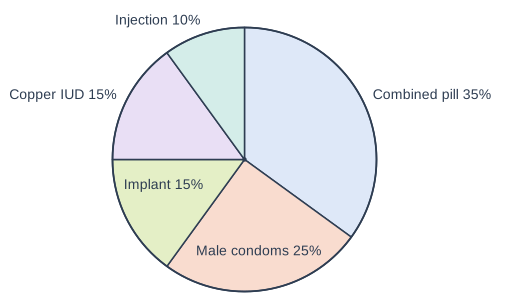
In a survey, 400 women were asked which method of contraception they used. The pie chart shows the results.
Calculate the number of women in the survey who used a hormonal method of contraception.
Model answer
Hormonal methods: combined pill 35% + implant 15% + injection 10% = 60% Number of women = (60 ÷ 100) × 400 = 240 women
Explanation
First decide which methods use hormones: the combined pill, the implant and the injection. Condoms and the copper IUD are non-hormonal. Add their percentages (60%) and then find 60% of 400 women. A common error is to include the copper IUD, which works by preventing an embryo implanting and contains no hormone.
Mark scheme
1 mark
35 + 15 + 10 = 60 (%)
identifies the combined pill, implant and injection as the hormonal methods; allow 0.6 / 60 ÷ 100 as the fraction; a correct answer with no working scores 2 marks
1 mark
240 (women)
allow ecf from their percentage × 4, eg including the copper IUD gives 75% and 300 women for 1 mark; full marks are not awarded for a correct final answer from incorrect working; do not accept 60 / 60% as the final answer (a percentage, not a number of women)
Question 4
3 marks
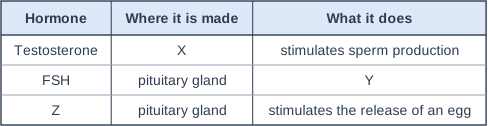
The table shows information about three hormones involved in human reproduction.
Give the missing information X, Y and Z in the table.
Model answer
X = testes Y = it causes an egg to mature in the ovary Z = LH (luteinising hormone)
Explanation
Testosterone is the main male reproductive hormone: it is made by the testes and stimulates sperm production. FSH (follicle stimulating hormone) causes an egg to mature in the ovary, and LH (luteinising hormone) stimulates the release of the egg. Students often swap the roles of FSH and LH: remember the egg must mature (FSH) before it can be released (LH).
Mark scheme
1 mark
X = testes
allow testis / testicles; do not accept scrotum / penis / sperm duct
1 mark
Y = causes (the) maturation of an egg (in the ovary)
allow causes an egg to mature / develop / ripen; do not accept causes the release of an egg (this is LH); do not accept maintains the uterus lining
1 mark
Z = LH / luteinising hormone
allow phonetic spelling, eg luteinizing; do not accept FSH / oestrogen / progesterone
Ready to try the rest? Every answer you write is marked against the mark scheme, so you can see exactly where the marks are.
Ctrl + Enter to check
Study HelperHints first, answers after you try
Stuck on this one? Ask for a hint and I’ll point you in the right direction, without giving the answer away. Once you’ve checked your answer, I’ll show you how the marks are awarded.