Level:
Correct: 0
Incorrect: 0
Marks: 0/0
Exam Practice
Course:
Topics:
Avg
score:
–
Topics
done:
0/17

How materials are cycled

Practise 20 exam-style questions on How materials are cycled for AQA GCSE Combined Science (Foundation Biology Paper 2). Write your answer as you would in the exam and get it marked in seconds against the mark scheme, point by point, with the Study Helper on hand if you get stuck.

  • 20 questions
  • 1–6 marks each
  • Instant marking
  • No sign-up needed
20 questions, marked as you go

Sample questions with model answers

Here are 4 of the questions in this topic, each with a model answer, an explanation of why it earns the marks and the mark scheme an examiner would use.

Question 1

1 mark

All materials in the living world are recycled.

Give one reason why this recycling is important for living organisms.

Model answer

Recycling provides the building blocks for future organisms, because the amount of each material on Earth is limited.

Explanation

The atoms in living things, such as carbon, are used again and again. When organisms die their materials are returned to the environment and then used to build new organisms. Answers about reducing waste or pollution confuse this with human recycling of rubbish.

Mark scheme
  1. 1 mark

    it provides the building blocks / materials for future (new) organisms

    allow so that new organisms can grow. allow the amount of each material (e.g. carbon) is limited, so it would run out if it were not recycled. ignore 'to keep the environment clean' / 'to reduce waste' / 'to stop pollution'.

Question 2

2 marks

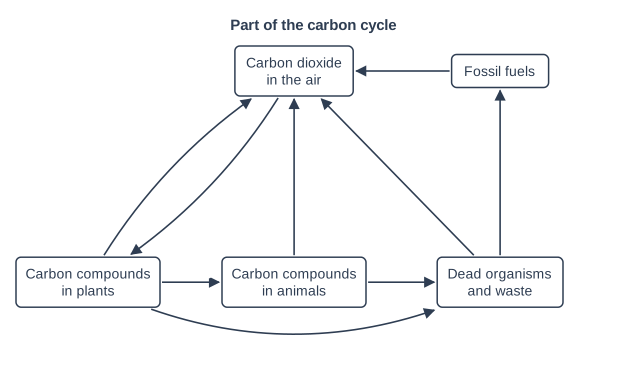
The diagram shows part of the carbon cycle.

Name the processes labelled C and D.

Part of the carbon cycle. Diagram of 5 boxes joined by 9 arrows. The boxes are: "Carbon dioxide in the air" (top row, centre), "Fossil fuels" (top row, right), "Carbon compounds in plants" (bottom row, left), "Carbon compounds in animals" (bottom row, centre), "Dead organisms and waste" (bottom row, right). Arrows go from "Carbon dioxide in the air" to "Carbon compounds in plants", labelled "photosynthesis"; from "Carbon compounds in plants" to "Carbon dioxide in the air", labelled "respiration"; from "Carbon compounds in plants" to "Carbon compounds in animals", labelled "feeding"; from "Carbon compounds in animals" to "Carbon dioxide in the air", labelled "respiration"; from "Carbon compounds in plants" to "Dead organisms and waste", labelled "death"; from "Carbon compounds in animals" to "Dead organisms and waste", labelled "death and waste"; from "Dead organisms and waste" to "Carbon dioxide in the air", labelled C; from "Fossil fuels" to "Carbon dioxide in the air", labelled D; from "Dead organisms and waste" to "Fossil fuels", labelled "millions of years".

Model answer

C: decay (respiration by microorganisms)
D: combustion

Explanation

Microorganisms such as bacteria and fungi decay dead organisms and waste; as they respire they release carbon dioxide into the air (process C). Burning fossil fuels is combustion, which also releases carbon dioxide (process D). A common error is to give 'fossil fuels' for D, which is a store of carbon, not a process.

Mark scheme
  1. 1 mark

    C: decay / respiration by microorganisms

    allow decomposition / rotting / respiration (by decomposers). allow phonetic spelling.

  2. 1 mark

    D: combustion

    allow burning. do not accept respiration / fossil fuels.

Question 3

2 marks

Transpiration returns water from plants to the air. A student measured the water taken up by a potted plant during one week.

- The plant took up 250 cm³ of water from the soil.
- 245 cm³ of this water was lost from the leaves by transpiration.

Calculate the percentage of the water taken up that was lost by transpiration.

Use the equation:
percentage = (volume lost by transpiration ÷ volume taken up) × 100

Model answer

percentage = (245 ÷ 250) × 100
= 0.98 × 100
= 98%

Explanation

Divide the volume lost by the volume taken up and multiply by 100. Almost all the water a plant takes up from the soil is returned to the air by transpiration, which is why plants are an important part of the water cycle. Dividing the numbers the wrong way round gives more than 100%, which cannot be right.

Mark scheme
  1. 1 mark

    (245 ÷ 250) × 100

    A correct answer with no working scores full marks, but full marks are not awarded for a correct final answer from incorrect working.

  2. 1 mark

    98 (%)

    An answer of 2 (%) (the percentage kept by the plant) scores 1 mark if the working (245 ÷ 250) × 100 is shown, otherwise 0. An answer of 102 (250 ÷ 245 × 100) scores 0.

Question 4

4 marks

A student investigated the role of microorganisms in soil. She set up three sealed tubes. Each tube had hydrogencarbonate indicator solution at the bottom and a gauze platform above it. She put different contents on the platform of each tube and left the tubes in the dark for 24 hours.

- Any small animals, such as worms and insects, had been removed from all the soil.
- The heated soil had been heated in an oven and then cooled.
- The dead leaves had been heated to kill any microorganisms on them.

Hydrogencarbonate indicator is red when the concentration of carbon dioxide is normal. It turns yellow when the concentration of carbon dioxide increases.

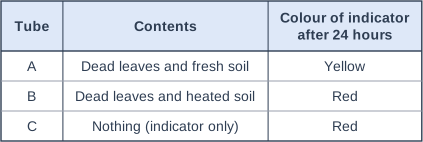
The table shows the results.

Explain the results.

Table with columns "Tube", "Contents", "Colour of indicator after 24 hours". Tube: A; Contents: Dead leaves and fresh soil; Colour of indicator after 24 hours: Yellow | Tube: B; Contents: Dead leaves and heated soil; Colour of indicator after 24 hours: Red | Tube: C; Contents: Nothing (indicator only); Colour of indicator after 24 hours: Red.

Model answer

In tube A the microorganisms in the fresh soil decayed the dead leaves. As they did this they respired, releasing carbon dioxide, which turned the indicator yellow. In tube B the heating had killed the microorganisms, so there was no respiration and no carbon dioxide was released, so the indicator stayed red. Tube C was a control, showing that the indicator does not change colour without microorganisms.

Explanation

The only difference between tubes A and B is whether the soil microorganisms are alive, so the extra carbon dioxide in A must come from microorganisms respiring as they decay the leaves. This is how microorganisms return carbon to the air. Saying 'the soil gave off carbon' is not enough: name the microorganisms, respiration and carbon dioxide.

Mark scheme
  1. 1 mark

    (in tube A) microorganisms in the fresh soil decayed / broke down the dead leaves

    Max 4 marks from the five points. allow bacteria / fungi / decomposers for microorganisms. allow decomposed / digested the leaves. ignore 'ate the leaves'.

  2. 1 mark

    the microorganisms respired

    ignore 'the leaves respired' (their cells were dead).

  3. 1 mark

    respiration released carbon dioxide, which turned the indicator yellow

    allow CO₂. must mention carbon dioxide, not just 'carbon'.

  4. 1 mark

    (in tube B) heating killed the microorganisms, so there was no respiration / no carbon dioxide released, so the indicator stayed red

  5. 1 mark

    tube C is a control: it shows that the indicator does not change colour on its own

    max 4.

Ready to try the rest? Every answer you write is marked against the mark scheme, so you can see exactly where the marks are.

Revision notes

How materials are cycled

The big idea

There is a fixed amount of each material on Earth, so all materials in the living world are recycled to provide the building blocks for future organisms. Many different materials, such as carbon, water, oxygen and mineral ions, cycle through both the biotic (living) and abiotic (non-living) parts of an ecosystem. You need to know the carbon and water cycles, and the vital role of microorganisms. (You do not need to study the nitrogen cycle.)

The carbon cycle

Carbon is in carbon dioxide in the air, in the carbon compounds that make up living things (carbohydrates, fats and proteins), and in fossil fuels. The carbon cycle returns carbon from organisms to the atmosphere as carbon dioxide, so that plants can use it again in photosynthesis.

The carbon cycle. Diagram of 5 boxes joined by 9 arrows. The boxes are: "Carbon dioxide in the air" (top row, centre), "Fossil fuels" (top row, right), "Carbon compounds in plants and algae" (bottom row, left), "Carbon compounds in animals" (bottom row, centre), "Dead organisms and waste" (bottom row, right). Arrows go from "Carbon dioxide in the air" to "Carbon compounds in plants and algae", labelled "photosynthesis"; from "Carbon compounds in plants and algae" to "Carbon dioxide in the air", labelled "respiration"; from "Carbon compounds in plants and algae" to "Carbon compounds in animals", labelled "feeding"; from "Carbon compounds in animals" to "Carbon dioxide in the air", labelled "respiration"; from "Carbon compounds in plants and algae" to "Dead organisms and waste", labelled "death"; from "Carbon compounds in animals" to "Dead organisms and waste", labelled "death and waste"; from "Dead organisms and waste" to "Carbon dioxide in the air", labelled "respiration by decomposers"; from "Dead organisms and waste" to "Fossil fuels", labelled "no decay: millions of years"; from "Fossil fuels" to "Carbon dioxide in the air", labelled "combustion".
Photosynthesis is the only process here that takes carbon dioxide out of the air; respiration and combustion put it back.
  1. Photosynthesis: plants and algae take in carbon dioxide and make glucose, then turn it into other carbon compounds such as starch, cellulose and proteins.
  2. Feeding: animals eat plants (and other animals), so carbon compounds pass along food chains.
  3. Respiration: plants, animals and microorganisms all respire all the time, releasing carbon dioxide into the air.
  4. Death and waste: dead organisms, fallen leaves and faeces are broken down by decomposers, which release the carbon as carbon dioxide when they respire.
  5. Fossil fuels and combustion: some dead organisms do not decay, and over millions of years form coal, oil and gas. Burning (combustion) of these fuels, or of wood, releases carbon dioxide.

The role of microorganisms

Decomposers are microorganisms, mainly bacteria and fungi. They release enzymes onto dead organisms and waste, digest them, and absorb the small soluble molecules. Then:

  • they use these molecules in respiration, returning carbon to the atmosphere as carbon dioxide;
  • mineral ions in the dead material, such as nitrate ions, are returned to the soil, where plant roots absorb them again.

Without decomposers, carbon and mineral ions would stay locked in dead bodies and waste, and plants would run short of both. Animals such as earthworms help by breaking dead leaves into small pieces, giving a larger surface area for the decomposers to work on.

The water cycle

The water cycle provides fresh water for plants and animals on land before it drains into the seas. Water is continuously evaporated and precipitated.

The water cycle. Diagram of 6 boxes joined by 8 arrows. The boxes are: "Water vapour in the air" (top row, left of centre), "Clouds" (top row, right), "Animals" (second row, right of centre), "Sea" (bottom row, left), "Plants" (bottom row, centre), "Rivers, lakes and ground water" (bottom row, right). Arrows go from "Sea" to "Water vapour in the air", labelled "evaporation"; from "Water vapour in the air" to "Clouds", labelled "condensation"; from "Clouds" to "Rivers, lakes and ground water", labelled "precipitation"; from "Rivers, lakes and ground water" to "Sea", labelled "run-off and drainage"; from "Rivers, lakes and ground water" to "Plants", labelled "absorbed by roots"; from "Plants" to "Water vapour in the air", labelled "transpiration"; from "Rivers, lakes and ground water" to "Animals", labelled "drinking"; from "Animals" to "Water vapour in the air", labelled "breathing out, sweating".
Evaporation leaves the salt behind in the sea, so the precipitation that falls on land is fresh water.
  • Evaporation: energy from the Sun heats water in seas and lakes, which turns into water vapour.
  • Transpiration: plants lose water vapour from their leaves; animals add water vapour when they breathe out and sweat.
  • Condensation: water vapour rises, cools and condenses into droplets that form clouds.
  • Precipitation: water falls as rain, snow, sleet or hail, bringing fresh water to the land.
  • Run-off and drainage: water flows over and through the ground into rivers and back to the sea.

Plants need water for photosynthesis and to keep their cells firm, and animals need it for the chemical reactions in their cells, so the cycle is vital for life on land.

Where does the carbon go?

In one year, the plants in 1 m² of grassland took in 800 g of carbon by photosynthesis. Respiration released 360 g (plants), 50 g (animals) and 330 g (decomposers). Calculate the carbon stored in the grassland as a percentage of the carbon taken in.

Carbon released: \(360 + 50 + 330 = 740\) g

Carbon stored: \(800 - 740 = 60\) g

Percentage stored: \(\dfrac{60}{800} \times 100 = 7.5\%\)

Most of the carbon taken in goes straight back to the air, and decomposers release a large share of it.

Common mistakes

  • Saying plants take in carbon dioxide and only animals give it out. Plants respire all the time too, and so do decomposers.
  • Writing "evaporation" for water lost from leaves. That is transpiration.
  • Mixing up condensation (vapour turning into droplets) and precipitation (water falling from clouds).
  • Naming viruses as decomposers. Decomposers are bacteria and fungi.
  • Saying decomposers return "food" to the soil. They return mineral ions to the soil and carbon dioxide to the air.

Exam tip

In a six-mark carbon cycle answer, follow the carbon all the way round: photosynthesis, feeding, respiration, death and decay, respiration by decomposers, combustion. The step most often missed is that decomposers release carbon dioxide by respiration.

Study Helper Hints first, answers after you try

Stuck on this one? Ask for a hint and I’ll point you in the right direction, without giving the answer away. Once you’ve checked your answer, I’ll show you how the marks are awarded.