
Level:
Correct: 0
Incorrect: 0
Marks: 0/0
Exam Practice
Course:
Topics:
Avg
score:
–
Topics
done:
0/17

Human endocrine system and blood glucose control

Practise 22 exam-style questions on Human endocrine system and blood glucose control for AQA GCSE Combined Science (Foundation Biology Paper 2). Write your answer as you would in the exam and get it marked in seconds against the mark scheme, point by point, with the Study Helper on hand if you get stuck.

  • 22 questions
  • 1–6 marks each
  • Instant marking
  • No sign-up needed
20 questions, marked as you go

Sample questions with model answers

Here are 4 of the questions in this topic, each with a model answer, an explanation of why it earns the marks and the mark scheme an examiner would use.

Question 1

1 mark

What is glycogen?

Choose your answer.

  • A hormone made by the pancreas
  • A type of sugar carried in the plasma
  • An enzyme that breaks down glucose
  • A storage carbohydrate made from glucose

Model answer

A storage carbohydrate made from glucose

Explanation

When the blood glucose concentration is too high, insulin causes glucose to move into cells, and in liver and muscle cells the excess glucose is converted to glycogen for storage. The words glucose, glycogen and insulin are easily confused: glucose is the sugar, glycogen is the store and insulin is the hormone.

Mark scheme
  1. 1 mark

    A storage carbohydrate made from glucose

    If more than one option is given, 0 marks. The hormone made by the pancreas that lowers blood glucose is insulin, not glycogen. Glycogen is stored inside liver and muscle cells; the sugar carried in the plasma is glucose. Glycogen is not an enzyme.
Question 2

2 marks

Explain how insulin lowers the blood glucose concentration.

Model answer

Insulin causes glucose to move from the blood into the body's cells. In liver and muscle cells, the excess glucose is converted to glycogen and stored.

Explanation

Both marks are about where the glucose goes: into cells, and then into glycogen stores in the liver and muscles. Insulin does not destroy glucose or turn it into energy. Take care with spelling: glucose, glycogen and insulin are different substances.

Mark scheme
  1. 1 mark

    Insulin causes glucose to move from the blood into (body) cells

    Allow 'cells take up glucose from the blood'. Do not accept 'insulin breaks down glucose' or 'insulin turns glucose into energy'.

  2. 1 mark

    In liver and muscle cells, (excess) glucose is converted to glycogen (for storage)

    Must name the liver or muscle (or both). Allow 'insulin causes glucose to be converted into glycogen in the liver'. Glycogen must be spelled clearly enough that it cannot be confused with glucose or with another hormone.

Question 3

2 marks

Blood glucose concentration is controlled by a hormone. Catching a glass as it falls off a table is controlled by the nervous system.

Suggest why hormonal control is suitable for controlling blood glucose concentration but not for catching a falling glass.

Model answer

The effects of hormones are slower than nervous responses, so a hormone would act far too late to catch a falling glass, which needs a very rapid response. Hormones act for longer, which suits blood glucose control, because the glucose concentration changes over several hours after a meal and needs controlling for all that time.

Explanation

Compared with the nervous system, hormonal effects are slower but act for longer. Match each type of control to the job: rapid, short responses use nerves; slow, long-lasting control uses hormones. Make sure each half of the answer is linked to the right example.

Mark scheme
  1. 1 mark

    Hormonal effects are slower, but catching the glass needs a very fast / rapid response (so the nervous system is needed)

    Allow 'hormones travel in the blood, which is too slow to catch the glass'.

  2. 1 mark

    Hormonal effects last for longer, which suits blood glucose control, as glucose levels change over a long time (e.g. hours after a meal)

    Allow 'blood glucose needs to be controlled all the time / over a long period'. Ignore 'hormones are better for the body' unqualified.

Question 4

3 marks

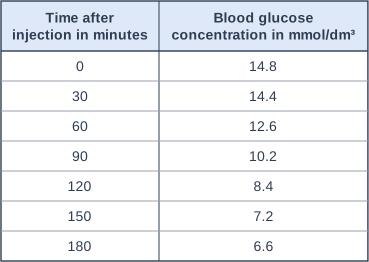
Callum has Type 1 diabetes. He injected insulin at 0 minutes. The table shows his blood glucose concentration after the injection.

Calculate the mean rate of decrease in Callum's blood glucose concentration between 60 minutes and 120 minutes. Give the unit.

Use the equation:
rate of decrease = decrease in blood glucose concentration ÷ time taken

Table with columns "Time after injection in minutes", "Blood glucose concentration in mmol/dm³". Time after injection in minutes: 0; Blood glucose concentration in mmol/dm³: 14.8 | Time after injection in minutes: 30; Blood glucose concentration in mmol/dm³: 14.4 | Time after injection in minutes: 60; Blood glucose concentration in mmol/dm³: 12.6 | Time after injection in minutes: 90; Blood glucose concentration in mmol/dm³: 10.2 | Time after injection in minutes: 120; Blood glucose concentration in mmol/dm³: 8.4 | Time after injection in minutes: 150; Blood glucose concentration in mmol/dm³: 7.2 | Time after injection in minutes: 180; Blood glucose concentration in mmol/dm³: 6.6.

Model answer

Decrease = 12.6 - 8.4 = 4.2 mmol/dm³
Time taken = 120 - 60 = 60 minutes
Rate of decrease = 4.2 ÷ 60 = 0.07 mmol/dm³ per minute

Explanation

Read the two values from the table, subtract to find the decrease, then divide by the time between them (60 minutes). The unit is the concentration unit divided by the time unit. The fall happens because the injected insulin causes glucose to move from the blood into cells.

Mark scheme
  1. 1 mark

    Decrease = 12.6 - 8.4 = 4.2 (mmol/dm³)

  2. 1 mark

    4.2 ÷ 60 = 0.07

    Allow ecf from their decrease. Correct answer with no working scores full marks for the calculation (2 marks). Full marks are not awarded for a correct final answer from incorrect working.

  3. 1 mark

    mmol/dm³ per minute

    Allow mmol/dm³/min. The unit mark is independent of the calculation. Allow 4.2 mmol/dm³ per hour for all 3 marks.

Ready to try the rest? Every answer you write is marked against the mark scheme, so you can see exactly where the marks are.

Study Helper Hints first, answers after you try

Stuck on this one? Ask for a hint and I’ll point you in the right direction, without giving the answer away. Once you’ve checked your answer, I’ll show you how the marks are awarded.