
Level:
Correct: 0
Incorrect: 0
Marks: 0/0
Exam Practice
Course:
Topics:
Avg
score:
–
Topics
done:
0/17

Selective breeding and genetic engineering

Practise 24 exam-style questions on Selective breeding and genetic engineering for AQA GCSE Combined Science (Foundation Biology Paper 2). Write your answer as you would in the exam and get it marked in seconds against the mark scheme, point by point, with the Study Helper on hand if you get stuck.

  • 24 questions
  • 1–6 marks each
  • Instant marking
  • No sign-up needed
20 questions, marked as you go

Sample questions with model answers

Here are 4 of the questions in this topic, each with a model answer, an explanation of why it earns the marks and the mark scheme an examiner would use.

Question 1

1 mark

In selective breeding, a characteristic can be chosen for its usefulness or for its appearance.

Which of these is a characteristic chosen for its appearance?

Choose your answer.

  • Wheat that is resistant to disease
  • Cows that produce more milk
  • Roses with unusually large flowers
  • Pigs that produce more meat

Model answer

Roses with unusually large flowers

Explanation

Examples of selective breeding include disease resistance in food crops, animals that produce more meat or milk, dogs with a gentle nature, and large or unusual flowers. Only the flowers are chosen for their appearance; the others are chosen because they are useful.

Mark scheme
  1. 1 mark

    Roses with unusually large flowers

    If more than one option is given, 0 marks. Large or unusual flowers are chosen for how they look. Disease resistance in crops and animals that produce more meat or milk are chosen for their usefulness.
Question 2

2 marks

Maize was bred from a wild grass called teosinte thousands of years ago.

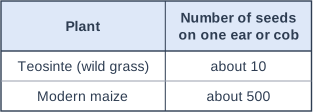
The table shows the number of seeds on one ear of teosinte and on one cob of modern maize.

Calculate how many times more seeds there are on a cob of modern maize than on an ear of teosinte.

Suggest one other characteristic that early farmers would have chosen when they were breeding maize.

Table with columns "Plant", "Number of seeds on one ear or cob". Plant: Teosinte (wild grass); Number of seeds on one ear or cob: about 10 | Plant: Modern maize; Number of seeds on one ear or cob: about 500.

Model answer

500 ÷ 10 = 50, so a cob of modern maize has 50 times more seeds.

Early farmers would also have chosen plants with larger seeds.

Explanation

'How many times more' means divide the larger number by the smaller one: 500 ÷ 10 = 50. Early farmers chose plants with useful characteristics, such as more or bigger seeds, and bred them over thousands of years. Subtracting (490) answers a different question.

Mark scheme
  1. 1 mark

    50 (times)

    500 ÷ 10 = 50. Correct answer with no working scores the mark. do not accept 490 (the difference) or 0.02.

  2. 1 mark

    any sensible useful characteristic, e.g. larger seeds / seeds that stay on the plant / better taste / resistance to disease or pests / faster growth / more cobs on each plant

    ignore 'more seeds' (given in the question). ignore 'bigger plant' unqualified. do not accept characteristics that would not be chosen, e.g. smaller seeds.

Question 3

2 marks

Scientists are researching ways to treat cystic fibrosis using genetic modification. Working copies of a gene are put into the cells lining the lungs of a person with cystic fibrosis.

Suggest why the person could still pass on the cystic fibrosis allele to their children.

Model answer

Only the cells lining the lungs are given the working gene. The person's gametes (sperm or eggs) are not modified, so they still carry the cystic fibrosis allele, which can be passed on to the person's children.

Explanation

Children inherit alleles from their parents' gametes. Genetic modification of body cells, such as lung cells, can relieve the symptoms of an inherited disorder, but it does not change the alleles in the sperm or eggs. A common mistake is to think the treatment changes every cell in the body.

Mark scheme
  1. 1 mark

    only the lung cells / body cells are modified

    allow 'the working gene is only put into the lungs'.

  2. 1 mark

    the gametes / sex cells (sperm or eggs) still contain the cystic fibrosis allele(s)

    allow 'the cells in the testes or ovaries are not changed'. allow 'the alleles passed on are in the gametes, which are not modified'. do not accept 'the treatment does not work'.

Question 4

4 marks

A fungal disease reduces the yield of wheat crops. A few wheat plants in one field are not affected by the disease.

Describe how a plant breeder could use selective breeding to produce a variety of wheat that is resistant to the disease.

Model answer

The breeder chooses wheat plants that are not affected by the disease and breeds them together by cross-pollinating them. From the offspring, the breeder chooses the plants that are resistant to the disease and breeds these together. This is repeated over many generations, until all the offspring are resistant to the disease.

Explanation

The steps are: choose parents with the desired characteristic, breed them, choose the offspring with the characteristic, breed those, and repeat over many generations until all the offspring show it. A common error is to stop after one generation; another is to describe genetic engineering, which is a different process.

Mark scheme
  1. 1 mark

    choose / select wheat plants that are resistant to the disease / not affected by the disease

    allow 'choose the plants that do not get the disease (from the mixed population)'.

  2. 1 mark

    breed these plants together / cross-pollinate them

    allow 'use their pollen to fertilise each other'. ignore 'grow them' unqualified.

  3. 1 mark

    from the offspring, choose the plants that are resistant (and breed them together)

    allow 'test the offspring for resistance and breed the resistant ones'.

  4. 1 mark

    repeat over many generations (until all the offspring are resistant)

    allow 'repeat for several generations'. do not accept 'insert a resistance gene' (genetic engineering). ignore spraying with fungicide.

Ready to try the rest? Every answer you write is marked against the mark scheme, so you can see exactly where the marks are.

Study Helper Hints first, answers after you try

Stuck on this one? Ask for a hint and I’ll point you in the right direction, without giving the answer away. Once you’ve checked your answer, I’ll show you how the marks are awarded.