
Level:
Correct: 0
Incorrect: 0
Marks: 0/0
Exam Practice
Course:
Topics:
AQA GCSE Music Smart practice A mixed round aimed at your weak spots
Unit 1
The language of music
Unit 2
Area of study 1: Western classical tradition 1650-1910
Unit 3
Area of study 2: Popular music
Unit 4
Area of study 3: Traditional music
Unit 5
Area of study 4: Western classical tradition since 1910
Avg
score:
–
Topics
done:
0/44

Tonality and keys

Practise 16 exam-style questions on Tonality and keys for AQA GCSE Music. Write your answer as you would in the exam and get it marked in seconds against the mark scheme, point by point, with the Study Helper on hand if you get stuck.

  • 16 questions
  • 1–3 marks each
  • Instant marking
  • No sign-up needed
16 questions, marked as you go

Sample questions with model answers

Here are 4 of the questions in this topic, each with a model answer, an explanation of why it earns the marks and the mark scheme an examiner would use.

Question 1

1 mark

A piece in E minor modulates to its subdominant key.

Which key does it modulate to?

Choose your answer.

  • A minor
  • A major
  • B minor
  • G major

Model answer

A minor.

Explanation

The subdominant is the fourth note of the scale: in E minor that is A, and the subdominant key of a minor key is also minor, so the answer is A minor (no sharps or flats). B minor would be the dominant key and G major the relative major. Choosing A major is a common slip from thinking only of major keys.

Mark scheme
  1. 1 mark

    A minor

    Accept A min / Am; ignore capital letters. Do not accept A major: the subdominant key of a minor key is minor. B minor is the dominant key and G major is the relative major.
Question 2

2 marks

A piece is in C minor. Later in the piece, F sharps appear, the A flats are replaced by A naturals, and a phrase ends with a chord of D major followed by a chord of G minor.

Name the key the music has modulated to, and state how this new key is related to C minor.

Model answer

G minor, which is the dominant key of C minor.

Explanation

With A naturals the key signature becomes two flats (B flat and E flat), G minor's signature, and F sharp is G minor's raised leading note. D major to G minor is V to i in G minor, a perfect cadence. G is the fifth note of the C minor scale, so G minor is the dominant key; the dominant key of a minor key is normally minor too.

Mark scheme
  1. 1 mark

    G minor

    Accept G min / Gm; ignore capital letters. Do not accept G major (it would need B naturals and E naturals) or D major (D major is only the chord before the cadence).

  2. 1 mark

    (it is the) dominant (key)

    Accept 'dominant', 'dominant minor', 'the key of chord V', 'V', 'the key a 5th above C'. Do not accept subdominant (F minor), relative major (E flat major) or tonic major (C major).

Question 3

2 marks

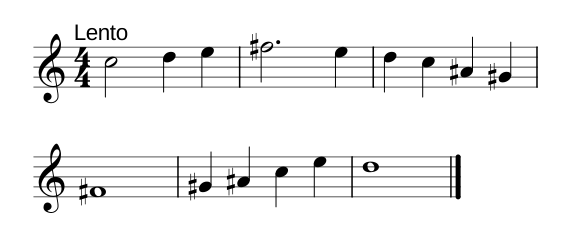
Look at the melody in the figure. It is based on a whole-tone scale.

Explain why music built on a whole-tone scale has no clear key. Give two reasons, based on the intervals of the scale.

A six-bar melody in the treble clef with no key signature, in 4/4 time, marked Lento. Several notes have accidentals.

Model answer

Every step of the whole-tone scale is a tone, so there are no semitones and no leading note to pull the music up to a home note. There are also no perfect 5ths between its notes, so it cannot form major or minor chords, and there is no dominant chord or perfect cadence to confirm a key.

Explanation

The melody uses six different notes, each a tone apart (C, D, E, F sharp, G sharp, A sharp). A key is normally confirmed by the leading note rising a semitone to the tonic and by dominant-to-tonic (V-I) harmony; the whole-tone scale has neither, and because its pattern is the same from every note, no note sounds more like home than another, so the tonality is ambiguous. AQA's AoS 4 guide notes a descending whole-tone scale at the end of the A section of Bartók's 'Slightly Tipsy'. Answers that only describe a mood earn no marks.

Mark scheme
  1. 2 marks

    Any two of: every step of the scale is the same size (a whole tone), so the pattern is the same from every note and no note stands out as the home note (tonic); there are no semitones, so there is no leading note rising a semitone to a tonic; there are no perfect 5ths (or perfect 4ths) between its notes, so it cannot form major or minor chords (only augmented ones), and there is no dominant chord or perfect cadence (V-I) to confirm a key

    1 mark for each different reason, max 2. Accept close spellings of terms; ignore capital letters. 'No semitones' and 'no leading note' are one reason; 'no perfect 5ths', 'no major or minor chords' and 'no perfect cadence' are one reason. Do not accept a description of mood alone (e.g. 'it sounds dreamy'), a restatement that the key is unclear, or 'it is atonal' without a reason from the intervals.

Question 4

3 marks

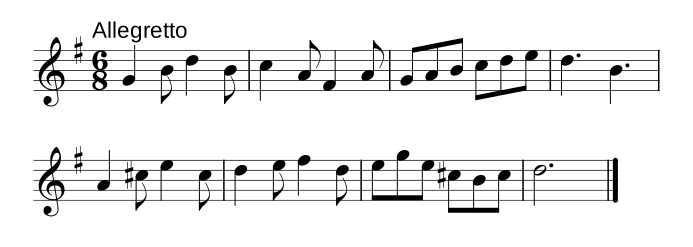
Look at the melody in the figure. It begins in G major and modulates to a new key by the end.

Name the new key, state how it is related to G major, and name the note in the second half of the melody that shows the change of key.

An eight-bar melody in the treble clef with a key signature of one sharp, in 6/8 time, marked Allegretto. Some notes in the second half have accidentals.

Model answer

The melody modulates to D major, the dominant key of G major. The change is shown by the C sharps in bars 5 and 7, the leading note of D major.

Explanation

G major has one sharp (F sharp) and D major has two (F sharp and C sharp). The first half uses C natural, but from bar 5 C sharps appear, and the melody ends on D after notes of the dominant 7th chord of D (E, G and C sharp). D is the fifth note of G major, so D major is the dominant key, a very common modulation in major-key music.

Mark scheme
  1. 1 mark

    D major

    Ignore capital letters. Typed accidentals are accepted throughout (C#, C sharp, C♯). Do not accept D minor (the melody uses F sharp, the major 3rd of D) or A major (the melody has no G sharps).

  2. 1 mark

    (it is the) dominant (key)

    Accept 'dominant', 'the key of chord V', 'V', 'the key a 5th above G'. Do not accept subdominant (C major) or relative minor (E minor).

  3. 1 mark

    C sharp (bars 5 and 7)

    Accept C# / C♯ / C sharps / 'the sharpened C' / 'the sharp on C'. Do not accept F sharp: it is in the key signature of both keys.

Ready to try the rest? Every answer you write is marked against the mark scheme, so you can see exactly where the marks are.

Study Helper Hints first, answers after you try

Stuck on this one? Ask for a hint and I’ll point you in the right direction, without giving the answer away. Once you’ve checked your answer, I’ll show you how the marks are awarded.