
Level:
Correct: 0
Incorrect: 0
Marks: 0/0
Exam Practice
Course:
Topics:
AQA GCSE Music Smart practice A mixed round aimed at your weak spots
Unit 1
The language of music
Unit 2
Area of study 1: Western classical tradition 1650-1910
Unit 3
Area of study 2: Popular music
Unit 4
Area of study 3: Traditional music
Unit 5
Area of study 4: Western classical tradition since 1910
Avg
score:
–
Topics
done:
0/44

Beethoven: the exposition

Practise 12 exam-style questions on Beethoven: the exposition for AQA GCSE Music. Write your answer as you would in the exam and get it marked in seconds against the mark scheme, point by point, with the Study Helper on hand if you get stuck.

  • 12 questions
  • 2–8 marks each
  • Instant marking
  • No sign-up needed
12 questions, marked as you go

Sample questions with model answers

Here are 4 of the questions in this topic, each with a model answer, an explanation of why it earns the marks and the mark scheme an examiner would use.

Question 1

2 marks

Beethoven: Symphony No. 1, movement 1.

The figure shows the 1st violin part at the start of the 1st subject in the Exposition.

Give the note value of the note labelled X, and name the interval from X up to Y.
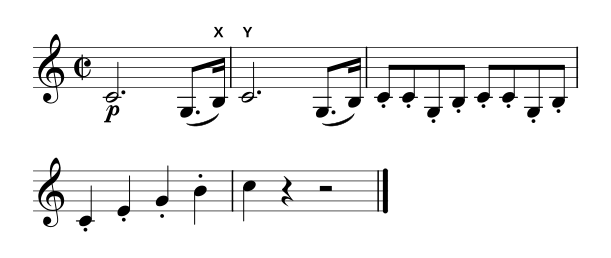
Five bars of music on a treble clef stave, printed as three bars then two bars, no key signature, cut common time (C with a vertical line through it), marked p at the start. Bars 1 and 2 each have a long dotted note followed by a beamed pair (a dotted note and a shorter note) joined by a slur. Bar 3 has eight staccato quavers, bar 4 four staccato crotchets rising, bar 5 one crotchet and then rests. X is printed above the last note of bar 1 and Y above the first note of bar 2.

Model answer

X is a semiquaver. From X (B) up to Y (C) is a minor 2nd, a semitone.

Explanation

X is beamed to the dotted quaver before it and carries two beams (the second a short stub), so it is a semiquaver: the dotted quaver-semiquaver pair fills one crotchet beat. B up to C is a semitone, a minor 2nd; AQA's study guide describes the 1st subject as built on the tonic triad and this rising semitone B to C. Count the semitones: B-C is one, so it cannot be a major 2nd.

Mark scheme
  1. 1 mark

    (X is a) semiquaver / sixteenth note

    Do not accept quaver, demisemiquaver or 'dotted quaver' (that is the note before X).

  2. 1 mark

    (X to Y is a) minor 2nd / minor second / semitone / half step

    X is B and Y is C. Accept 'rising semitone', 'a minor 2nd up', 'min 2nd' or 'm2'. Do not accept 'major 2nd', 'tone', 'whole step' or '2nd' with no quality.

Question 2

2 marks

Beethoven: Symphony No. 1, movement 1.

Describe how the flute answers the oboe at the start of the 2nd subject in the Exposition.

Model answer

The flute echoes the oboe's phrase as a sequence, a perfect fourth higher.

Explanation

The oboe begins with a long G followed by falling quavers; the flute then plays the same shape starting on C, a perfect fourth higher, as AQA's study guide also notes. The exchange happens twice, which creates a gentle dialogue between the two woodwind instruments. Answers must say both what the flute does and how high it is.

Mark scheme
  1. 1 mark

    it repeats / imitates / echoes the oboe's phrase / plays it as a sequence / in dialogue

    Accept 'copies' or 'answers with the same melody'.

  2. 1 mark

    a (perfect) 4th / fourth higher

    Accept 'four notes higher', 'a perfect fourth up' or 'P4'. Do not accept 'an octave higher', 'a fifth higher', 'a third higher' or 'lower'.

Question 3

2 marks

Beethoven: Symphony No. 1, movement 1.

Identify two features of the transition (bridge) theme in the Exposition.

Model answer

The transition theme rises through the notes of the C major triad (C-E-G) and then falls in a scalic semiquaver figure. It is loud (ff) and played by the violins in octaves.

Explanation

AQA's study guide describes the transition theme as rising thirds forming a C major triad, each followed by a short falling scalic motif, with a dotted minim at the start, played first by the violins and then by the flutes and clarinets. Avoid describing the 2nd subject by mistake: the oboe-and-flute dialogue comes later.

Mark scheme
  1. 2 marks

    Any two of: begins with a long note (dotted minim), like the 1st subject; rising notes of the C major triad (C-E-G, rising thirds); followed by a falling scalic semiquaver figure (with passing notes); slurred / legato; loud (ff) with sf accents; played by the violins in octaves, then by the flutes and clarinets; in C major (the tonic) over a tonic pedal; a two-bar rhythm (dotted minim, crotchet, four semiquavers) heard twice

    1 mark for each different correct feature, max 2. Accept 'arpeggio' or 'triadic' for the rising triad and 'scalic' or 'conjunct' for the falling figure. Do not accept 'in G major', 'quiet', 'staccato' or 'played by the oboe and flute' (that is the 2nd subject).

Question 4

8 marks

Beethoven: Symphony No. 1, movement 1.

Explain how Beethoven has used structure, tonality and dynamics to mark out the different sections of the Exposition.

Model answer

Structure: the Exposition follows sonata form, with a 1st subject, a transition (bridge), a 2nd subject and a codetta, and the whole section is repeated. The 1st subject is heard twice, the second time a step higher, and uses irregular six-bar phrases, while the 2nd subject has balanced eight-bar question-and-answer phrases, so the two themes are clearly told apart. The transition has its own theme, and the codetta brings back the 1st subject's rhythm to round the section off.

Tonality: the sections are defined by their keys. The 1st subject firmly establishes C major, the tonic, over a tonic pedal, and its second statement is in D minor. The transition starts in C but leads towards the dominant, so the 2nd subject arrives in G major - the key contrast at the heart of sonata form. When the bass instruments take the 2nd subject it turns to the minor, and the codetta confirms G major with a pedal on G and perfect cadences.

Dynamics: the 1st subject begins p, gains sf accents and builds to ff tutti chords that close it; the transition is loud, ff with sf. The 2nd subject returns to p, a ff passage gives way to a sudden pp for its minor-key version, and a crescendo leads into the forte codetta.

Explanation

This question rewards knowing the sonata-form map of the Exposition and the key of each part: C major for the 1st subject, G major (dominant) for the 2nd subject and codetta. Link each point to a section, as AQA's guides name them (1st subject, transition, 2nd subject, codetta); a list of keys or dynamics with no location stays in the lower levels.

Mark scheme
  1. 8 marks

    Levels of response (8 marks).
    Level 4 (7-8 marks): A comprehensive response which is consistently coherent and logically structured.
    Level 3 (5-6 marks): A wide-ranging response which is mostly coherent and well structured.
    Level 2 (3-4 marks): A relevant response despite some inaccuracy/omission and weaknesses in terms of coherency and structure.
    Level 1 (1-2 marks): A limited response with some significant inaccuracy/omission and a lack of clarity.
    0 marks: No work submitted or worth credit.

    Max 6 if the answer writes about only two of the three named elements (AQA June 2025 report: "for students to access the top band, all elements need to be written about, to make the response comprehensive").
    Indicative content (credit other valid points):
    Structure: sonata-form exposition: 1st subject, transition (bridge), 2nd subject, codetta; the whole Exposition is repeated (repeat marks, first- and second-time bars), but not the Introduction; the 1st subject is stated twice, the second time a step higher; irregular six-bar phrases in the 1st subject v balanced eight-bar question-and-answer (antecedent-consequent) phrases in the 2nd subject; the transition has its own theme; the 2nd subject is restated in the bass instruments with a countermelody; the codetta brings back the 1st subject's rhythm and rounds off the section with cadences.
    Tonality: 1st subject in C major (tonic), confirmed by a tonic pedal, after the Introduction's uncertain key; second statement in D minor; transition begins in C major (tonic pedal) and leads to the dominant; 2nd subject in G major (dominant) - the key contrast typical of sonata form; minor-key (G minor) version when the bass instruments play the 2nd subject; codetta in G major, confirmed by a pedal on G and perfect cadences; the Exposition ends in the dominant key.
    Dynamics: 1st subject begins p, gains sf accents and builds to ff tutti chords that close it; transition ff with sf accents, crescendo to ff tutti chords before the 2nd subject; 2nd subject p; ff followed by a sudden pp for the minor-key bass version; crescendo leading into the codetta (f, sf); ff and sf chords in the codetta; diminuendo in the woodwind at the end.
    Any other valid point under any of these three headings. Ensure there is no repetition of points across different elements. Ensure that responses refer only to the three given elements.
    Guidance (not a cap): a list of terms with no explanation ('scattergun' listing, AQA June 2025 report) stays in the lower levels; no introduction or summary is needed (AQA June 2025 report).

Ready to try the rest? Every answer you write is marked against the mark scheme, so you can see exactly where the marks are.

Study Helper Hints first, answers after you try

Stuck on this one? Ask for a hint and I’ll point you in the right direction, without giving the answer away. Once you’ve checked your answer, I’ll show you how the marks are awarded.