
Level:
Correct: 0
Incorrect: 0
Marks: 0/0
Exam Practice
Course:
Topics:
AQA GCSE Music Smart practice A mixed round aimed at your weak spots
Unit 1
The language of music
Unit 2
Area of study 1: Western classical tradition 1650-1910
Unit 3
Area of study 2: Popular music
Unit 4
Area of study 3: Traditional music
Unit 5
Area of study 4: Western classical tradition since 1910
Avg
score:
–
Topics
done:
0/44

Blues music from 1920 to 1950

Practise 11 exam-style questions on Blues music from 1920 to 1950 for AQA GCSE Music. Write your answer as you would in the exam and get it marked in seconds against the mark scheme, point by point, with the Study Helper on hand if you get stuck.

  • 11 questions
  • 1–3 marks each
  • Instant marking
  • No sign-up needed
11 questions, marked as you go

Sample questions with model answers

Here are 4 of the questions in this topic, each with a model answer, an explanation of why it earns the marks and the mark scheme an examiner would use.

Question 1

1 mark

Robert Johnson, the Mississippi singer-guitarist, recorded all of his 29 songs at sessions in 1936 and 1937.

In which state were these sessions held?

Choose your answer.

  • Mississippi
  • Illinois
  • Texas
  • Tennessee

Model answer

Texas (San Antonio in 1936 and Dallas in 1937).

Explanation

Johnson recorded in a hotel room in San Antonio in November 1936 and in Dallas in June 1937, when record companies took recording equipment to southern cities to find blues talent; he died in Mississippi in August 1938, aged 27. Stories that he sold his soul to the devil at a crossroads are legend, not history (a similar story was told about another Mississippi singer, Tommy Johnson). His recordings, reissued from 1961, strongly influenced later blues and rock guitarists.

Mark scheme
  1. 1 mark

    Texas

    Accept close spellings and answers naming San Antonio or Dallas. Do not accept Mississippi (his home state), Illinois (Chicago) or Tennessee (Memphis). If more than one option is given, award 0.
Question 2

2 marks

Give two differences between the classic blues of singers such as Bessie Smith in the 1920s and the Mississippi Delta blues of singer-guitarists such as Robert Johnson in the 1930s.

Model answer

Classic blues singers were mainly women who sang with piano or a small jazz band in theatres and tent shows, whereas Delta bluesmen accompanied themselves on acoustic guitar, often with a slide, at juke joints and parties. Classic blues songs were regular, often published songs, while Delta performances were freer, with phrases of flexible length.

Explanation

A difference needs both sides, or a clear comparison: 'Delta blues used a slide guitar' alone does not say how classic blues differed. Britannica describes Delta blues as the most intense of the rural styles, with speech-like singing and rhythmic, percussive guitar, often played with a slide. Classic blues singers such as Ma Rainey and Bessie Smith toured theatres and tent shows with pianists or small jazz groups. Shared features (blue notes, AAB words, twelve-bar chords) cannot be differences.

Mark scheme
  1. 2 marks

    Any two different differences: classic blues singers were mainly women professional entertainers, while Delta performers were mainly men who accompanied themselves; classic blues was accompanied by piano or a small jazz band (such as cornet, trombone, clarinet and piano), while Delta blues was usually one acoustic guitar (often with slide or bottleneck), sometimes with harmonica; classic blues was performed in theatres, vaudeville and tent shows, while Delta blues was played at juke joints, house parties, on the streets and in rural communities; classic blues used more regular, often composed and published songs with planned arrangements, while Delta blues was freer and more improvised, with flexible phrase lengths (bars or beats added or left out); classic singers used a powerful, polished theatrical voice, while Delta singing was more speech-like, raw and intense, over rhythmic, percussive guitar

    1 mark for each different difference, max 2. Each difference must make the contrast clear, either by describing both styles or by using a comparative ('Delta blues used a solo guitar instead of a band'). A feature of only one style with no contrast scores 0. Do not credit features shared by both, such as blue notes or the AAB pattern.

Question 3

2 marks

Boogie-woogie, a style of blues piano, became hugely popular in the late 1930s. The pianists Albert Ammons, Meade Lux Lewis and Pete Johnson helped to spread it when they played at the 'From Spirituals to Swing' concert at Carnegie Hall, New York, in December 1938.

Describe two features of boogie-woogie piano playing.

Model answer

The left hand repeats a walking bass pattern in quavers, eight to the bar, following the twelve-bar blues chords. Over it the right hand plays syncopated riffs and repeated chords, making cross-rhythms against the steady bass.

Explanation

Boogie-woogie is one of the most rhythmically driving kinds of blues: a repeating walking bass of eight quavers to the bar in the left hand, with a syncopated, often improvised right hand in counter rhythm. Clarence 'Pinetop' Smith's 'Pinetop's Boogie Woogie' (recorded in 1928) is usually named as the first record with 'boogie woogie' in its title, and it helped to start the craze. An Alberti bass is a Classical broken-chord pattern, not a boogie-woogie bass.

Mark scheme
  1. 2 marks

    Any two different features: a repeating left-hand pattern (ostinato / riff / walking bass that outlines each chord, often in broken chords or octaves); eight quavers to the bar in the left hand ('eight to the bar'); swung (shuffle) or driving, continuous quavers; it follows the twelve-bar blues chord pattern (I, IV, V); right-hand riffs, repeated chords, tremolos or trills; a syncopated right hand, making cross-rhythms against the steady left hand; blue notes and crushed notes (acciaccaturas / grace notes) in the right hand; improvisation in the right hand; a fast, lively tempo and a loud, percussive, energetic style for dancing; often instrumental, with no singer

    1 mark for each different feature, max 2. Any other valid feature may be credited. 'Ostinato bass' and 'walking bass' count as one feature unless the answer also gives the eight-to-the-bar rhythm. Accept close spellings. Do not accept 'Alberti bass', 'slow and gentle' or 'played on organ'.

Question 4

3 marks

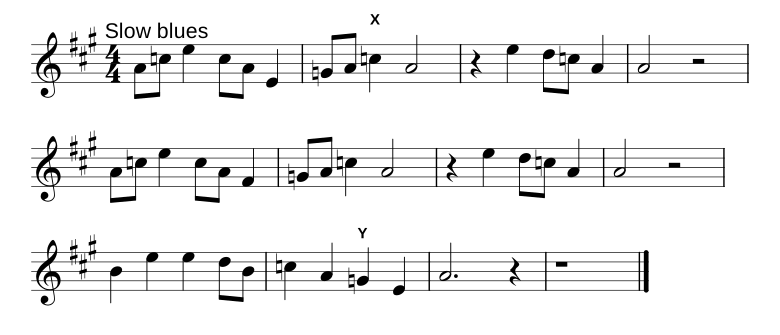
The melody below was written for this course in the style of a blues vocal line in A major. It follows the twelve-bar pattern, in three lines of four bars.

Name the notes labelled X and Y, and explain why notes like these are typical of the blues.

A twelve-bar melody on a treble clef stave with a key signature of three sharps and 4/4 time, marked 'Slow blues', printed on three lines of four bars. Several notes have natural signs. X labels the third note of bar 2 and Y labels the third note of bar 10; both are crotchets with natural signs. Each line ends with a long note followed by rests, and bar 12 is a whole bar's rest.

Model answer

X is C natural and Y is G natural. In A major the 3rd and 7th notes of the scale are C sharp and G sharp, so these are the flattened 3rd and flattened 7th: blue notes, which blues singers and players use (often bending them) for the style's expressive sound.

Explanation

The key signature of three sharps (F sharp, C sharp, G sharp) is A major, and the natural signs lower the 3rd and 7th degrees by a semitone. A common error is to read the notes as C sharp and G sharp from the key signature without seeing the natural signs. The flattened 5th (here E flat or D sharp) is sometimes counted as a third blue note.

Mark scheme
  1. 1 mark

    X: C natural

    Accept C, C natural, C♮ or Cn; typed accidentals are accepted in any form here and in the next point (e.g. G natural, G♮). Do not accept C sharp / C# / C♯ (the natural sign cancels the C sharp of the key signature), B or D.

  2. 1 mark

    Y: G natural

    Accept G, G natural, G♮ or Gn. Do not accept G sharp / G#, F sharp or A.

  3. 1 mark

    They are blue notes: the 3rd and 7th of the A major scale (C sharp and G sharp) lowered by a semitone / the flattened 3rd and flattened 7th

    Accept 'blue notes' with any clear idea that they are flattened or lowered degrees of the major scale (for example 'the minor 3rd and minor 7th sung in a major key', or 'notes bent down from the major-scale notes'). This mark may be awarded even if one note is misnamed. Do not accept 'they are accidentals' or 'they are chromatic notes' on their own, or 'they make it sound sad'.

Ready to try the rest? Every answer you write is marked against the mark scheme, so you can see exactly where the marks are.

Study Helper Hints first, answers after you try

Stuck on this one? Ask for a hint and I’ll point you in the right direction, without giving the answer away. Once you’ve checked your answer, I’ll show you how the marks are awarded.