
Question 1
2 marksBeethoven: Symphony No. 1, movement 1.
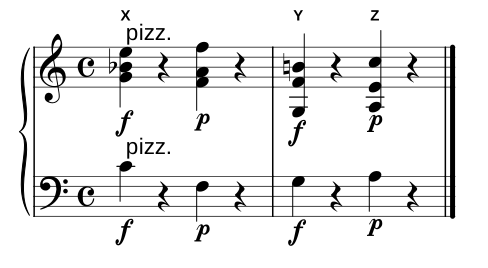
The figure shows the first two bars of the Introduction: the 1st violin part on the upper stave and the cello and double bass part on the lower stave. The strings play these chords pizzicato.
Name the chord labelled X, and name the cadence formed by the chords labelled Y and Z.
Model answer
X is C7, a dominant seventh chord (C-E-G-B flat). From Y to Z is an interrupted cadence: G7 (V7) moves to A minor (vi) instead of to C major.
Explanation
X contains C, E, G and B flat: a major triad with a minor seventh above the root, which is a dominant seventh - the dominant seventh of F major, a startling first chord for a symphony in C. Y is G-B-F over G (G7, V7 in C major) and Z is A-C-E over A (A minor, vi), so V7-vi is an interrupted cadence. A common slip is to call it imperfect: an imperfect cadence ends on chord V, but here the music moves away from V.
Mark scheme
-
1 mark
(chord X) C7 / C dominant seventh / dominant seventh on C / dominant seventh of F major / V7 in F major
Accept Bb / B flat / B♭ in any answer that spells the chord (C-E-G-Bb). Accept 'dominant 7th' alone. Do not accept 'C major' alone (it ignores the B flat that makes the chord a seventh), 'C major 7th' / 'Cmaj7' (that chord has B natural), 'C minor' or 'diminished seventh'.
-
1 mark
(Y to Z) interrupted cadence / V7-vi / V-VI / deceptive cadence
Y is G7 (V7 in C major) and Z is A minor (vi). Do not accept perfect, imperfect or plagal cadence.